Olu Allen
Nigeria’s crisis is no longer just economic or security-based. It is, at its core, a crisis of trust.
And trust, once broken between major blocs, does not respond to slogans, appointments, or short-term political bargains. It responds to structure.
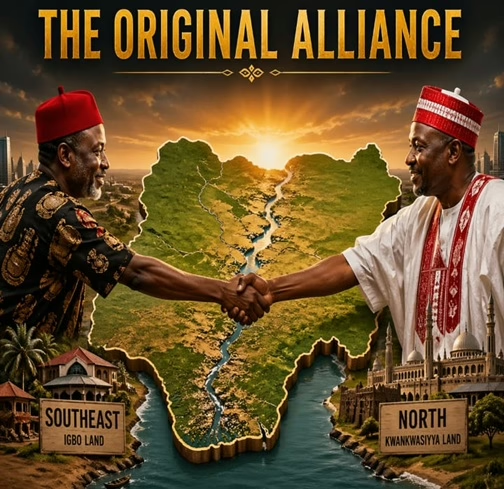
At independence in 1960, Nigeria’s leaders understood this. Nnamdi Azikiwe and Ahmadu Bello were not united by sentiment, but by necessity. The North and the Southeast recognised a shared reality: neither could stabilise Nigeria alone without risking collapse.
What emerged was not a perfect union, but a functional balance. The North brought demographic and territorial weight; the Southeast contributed administrative capacity and commercial energy. The arrangement created a form of mutual dependence that anchored the early federation.
That balance did not survive 1966.
The coups, counter-coups, and ultimately the Nigerian Civil War did more than redraw political lines—they destroyed the trust that made cooperation possible. In its place came centralised military rule, under leaders such as Yakubu Gowon, Olusegun Obasanjo, and Ibrahim Babangida, where command displaced negotiation.
Since 1999, civilian governments have attempted to manage this imbalance through zoning and rotational power. While these mechanisms reduced immediate tensions, they never rebuilt the original foundation of inter-regional trust. Instead, they institutionalised elite bargains that often excluded the Southeast from the highest level of executive power.
The consequences are now difficult to ignore.
In the Northwest, banditry and insecurity have eroded confidence in the state. In the Southeast, separatist agitations reflect long-standing grievances about political marginalisation.
Though different in form, both crises point to the same underlying problem: key regions increasingly feel disconnected from the centre.
This is where the conversation around figures like Peter Obi and Rabiu Kwankwaso becomes more than electoral speculation. It signals a possible return, however imperfect, to a neglected principle in Nigeria’s political design.
A Southeast–North understanding.
The argument here is not about personalities. It is about structure. Nigeria has experimented with various elite coalitions, particularly Southwest–North alignments, which have delivered electoral victories but not durable cohesion.
The missing variable has been a credible partnership that directly addresses the trust deficit between the Southeast and the North.
Ignoring this gap has come at a cost.
Each election cycle now resembles a contest of exclusion rather than inclusion. Each political arrangement leaves at least one major bloc feeling peripheral. Over time, this has normalised a dangerous equilibrium, one where distrust is managed, not resolved.
By 2027, that model may no longer hold.
Nigeria is entering a period where economic strain, demographic pressure, and insecurity are converging. In such a context, a governing arrangement that lacks broad-based legitimacy across its major regions risks deepening fragmentation rather than containing it.
This is why a recalibration is no longer optional—it is strategic.
A Southeast–North alliance, if constructed on genuine partnership rather than tokenism, offers a pathway to redistribute both political inclusion and national responsibility.
For the North, it provides an opportunity to engage a partner without territorial rivalry. For the Southeast, it represents a long-denied stake at the highest level of national leadership.
For the federation as a whole, it could serve as a bridge, one that speaks to constituencies currently drifting in opposite directions.
This does not diminish the importance of the Southwest or other regions. On the contrary, any sustainable arrangement must remain inclusive. But inclusion cannot be built on imbalance.
A stable tripod cannot stand on two dominant legs and one weakened support.
The more difficult truth is this: Nigeria’s current trajectory suggests that continued avoidance of this structural question will not preserve unity, it will strain it further.
The early architects of the federation understood that balance was not a luxury; it was a condition for survival. That insight remains relevant, even if its original form no longer fits perfectly.
What matters is the principle.
If 2027 becomes another exercise in exclusion, Nigeria will not simply repeat its past, it will accelerate its divisions.
But if it confronts its oldest imbalance, between the Southeast and the North, it may yet rediscover a path toward cohesion.
The choice is not between old alliances and new ones. It is between managed distrust and negotiated unity.
Nigeria has tried the former.
The results are already visible.
Allen writes on public affairs and advocate for good governance.