Olu Allen
There are arguments designed to win debates, and then there are truths designed to preserve nations. The former creates noise; the latter creates stability.
Nigeria has reached a juncture where we must stop pretending that power is a vacuum of pure competence. In a multi-ethnic federation, power is the ultimate currency of belonging.
It is the psychological glue that holds a disparate people together. To ignore the geography of power is to invite the geography of discontent.
The hegemonic cycle
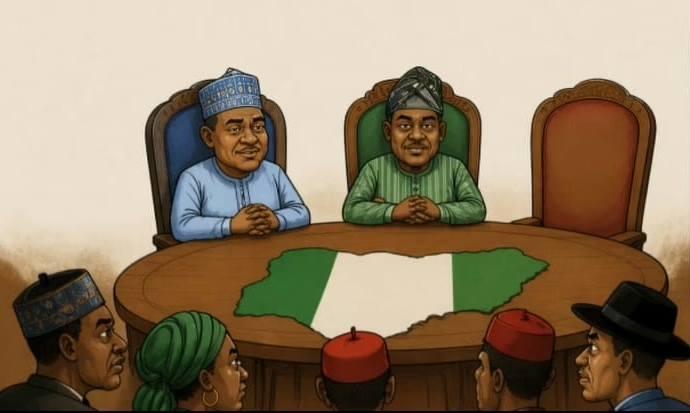
The North has exercised its custodial right to leadership. The South-West has navigated its season of governance. These are not merely “turns”; they are chapters in the unfolding story of Nigerian integration.
In the cold, hard logic of political science, these cycles were necessary for the equilibrium of the Republic.
So, why does the conversation turn brittle when the South East is mentioned?
If we are to be intellectually honest, we must admit that the Nigerian project remains incomplete as long as a significant pillar of its foundation feels like a permanent spectator in the arena of supreme leadership.
The ghosts of 1967 were never truly exorcised by decrees or white papers; they are only silenced when every region sees its face reflected in the highest office of the land.
Inclusion as statecraft, not sentiment
This is not a plea for favoritism. It is an argument for National Security Architecture.
When a region is structurally integrated into the top tier of power, the cost of agitation becomes higher than the benefit of participation.
Inclusion is the most cost-effective counter-insurgency strategy ever devised. It softens suspicion and dissolves the “us versus them” narrative that fuels fringe movements.
Nothing says “One Nigeria” louder than the sight of a South-Easterner taking the oath of office. It transforms the concept of the federation from a colonial inheritance into a shared enterprise.
The peril of historical tone-deafness
This is where we must address the friction of the current moment.
In every political era, there is a difference between what is legal and what is strategic. While any individual may have the constitutional right to seek power indefinitely, there is such a thing as Political Timing.
When established interests insist on extending their dominance at a time when the federation cries out for balance, it creates a “dissonance of power.”
Leadership is not merely the pursuit of an office; it is the wisdom to know when one’s presence stabilizes the system and when it stresses it. Sometimes, the most profound act of leadership is restraint.
The silent consensus
Even the most ardent defenders of the status quo understand this logic in their private moments. They know that a nation that rotates power fairly is a nation that buys itself another fifty years of survival.
You do not weaken a federation by broadening its leadership base; you fortify it against the tremors of secession and apathy.
If “One Nigeria” is to be more than a slogan on a billboard, it must become a pattern of deliberate, structural action. Unity is not something you declare in a broadcast; it is something you demonstrate in a ballot box.
The most powerful way to prove that the Republic is whole is to allow its leadership to rotate through the entirety of its parts.
Think about it. The cost of exclusion is a price the Nigerian economy and security can no longer afford to pay. The future of 2027 is not just about who is “qualified”—it is about who is necessary to keep the house standing.
Allen writes on public affairs and advocates for good governance.