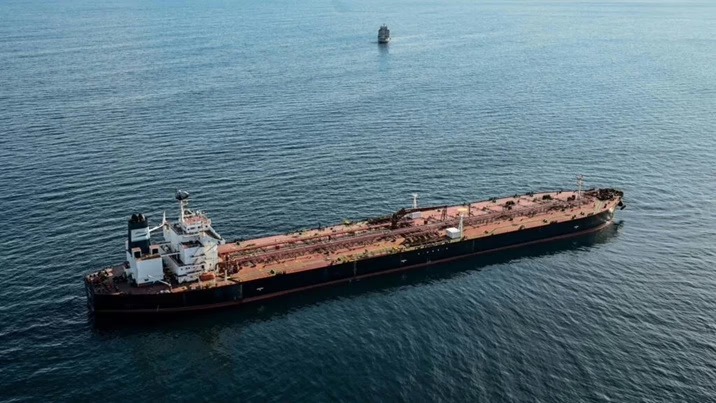
The United States on Thursday temporarily lifted sanctions on Russian oil that is currently at sea, allowing it to be shipped to buyers around the world as the Trump administration scrambles to contain energy prices that have been soaring because of the war in Iran.
The exemptions, which were issued by the Treasury Department, will be in place until April 11.
Treasury Secretary Scott Bessent estimated that freeing Russian oil could add hundreds of millions of barrels of crude to global markets, curbing prices that have been hovering near $100 per barrel as a result of the Iran conflict.
The decision was a significant turning point in America’s effort to punish Russia for its war in Ukraine. Russia has faced punishing sanctions from the United States and the rest of the Group of 7 advanced economies since Moscow invaded Ukraine in 2022.
Those sanctions have included a price cap on Russian oil and a crackdown on Russia’s “shadow fleet” of unmarked vessels that oil exporters have used to evade sanctions.
As President Donald Trump’s war with Iran has unfolded, his administration has looked for ways to mitigate the economic pain.
His administration temporarily freed Russian oil last week that was sitting at sea and was set to be delivered to India.
It is also in the process of offering a $20 billion maritime insurance backstop through the U.S. International Development Finance Corp., an agency that generally lends to and invests in overseas companies and projects.
Bessent asserted on Thursday that Russia would not benefit significantly from the sanctions relief but acknowledged that Moscow would see some financial benefit.
“To increase the global reach of existing supply, Treasury is providing a temporary authorization to permit countries to purchase Russian oil currently stranded at sea,” he wrote in a social media post.
“This narrowly tailored, short-term measure applies only to oil already in transit and will not provide significant financial benefit to the Russian government, which derives the majority of its energy revenue from taxes assessed at the point of extraction.”
In a podcast interview on Thursday, Bessent said that it was “unfortunate” that Russia stood to gain financially from the conflict in Iran but that he hoped it would be beneficial only for a “micro period.”
Top Senate Democrats assailed the Trump administration for easing sanctions on Russia, saying that it was done to mitigate a war of Trump’s own making.
“This war has resulted in huge spikes in gas prices for Americans, who are now paying more at the pump than at any point in either of President Trump’s two terms,” they wrote in a joint statement.
The lifting of oil sanctions represents a sharp reversal from last summer, when the administration doubled tariffs on India as punishment for its purchases of oil from Russia.
“In one fell swoop, we’ve undone a huge amount of pressure on Russia,” said Edward Fishman, a senior fellow and director of the Maurice R. Greenberg Center for Geoeconomic Studies at the Council on Foreign Relations. About 130 million barrels of Russian oil is currently at sea, according to the commodities data tracking service Kpler.
The move by the Trump administration could further divide the United States and Europe, which has been skeptical of Trump’s attack on Iran and has expressed a desire to continue to exert economic pressure on Russia.
Fishman said he did not think that easing the Russia oil sanctions would lower prices, noting that the move last week to let Russian oil be delivered to India did not have an impact.
He noted that the price of Russian oil had been rising since the war in Iran started, and that it was likely that the sanctions relief could be extended indefinitely.
“I do worry that this is effectively the destruction of the oil sanctions on Russia,” said Fishman, the author of “Chokepoints: American Power in the Age of Economic Warfare.”
His prediction was proving to be true: after rising sharply on Thursday, oil prices had little reaction and stayed around $100 a barrel after the announcement.
Along with the lifting of sanctions, the Trump administration plans to waive a century-old maritime law that requires American ships to be used to transport goods between U.S. ports, according to people familiar with the matter.
The 30-day exemption, which is still being developed, is set to apply broadly to vessels moving oil, gasoline, diesel, liquefied natural gas, and fertilizer among U.S. ports, the people said.
That would enable generally cheaper foreign tankers to move those goods, including Gulf Coast oil to refineries on the U.S. East Coast and fuel from the region to more populous areas.
“In the interest of national defense, the White House is considering waiving the Jones Act for a limited period of time to ensure vital energy products and agricultural necessities are flowing freely to U.S. ports,” White House Press Secretary Karoline Leavitt said in a statement.
“This action has not been finalized.” U.S. gasoline futures pared gains after the news. Waiving the Jones Act could save East Coast motorists roughly 10 cents a gallon, according to a 2022 JP Morgan Chase & Co. estimate.
“It absolutely facilitates the free flow of gasoline, which otherwise would have to come from Europe or other destinations to reach the Northeast,” said David Goldwyn, an energy envoy under former President Barack Obama and president of consulting firm Goldwyn Global Strategies.
“There are very few U.S. tankers that are available, so the Northeast continues to import whatever gasoline they can’t get from the pipeline.”
The vast majority of U.S. refineries are on the Gulf Coast, and there’s only one major pipeline connecting them to the Northeast, the U.S.’s most densely populated region.
While waiving the Jones Act could help lower prices somewhat, the impacts are apt to be limited, said Colin Grabow, associate director at the Cato Institute’s Herbert A. Stiefel Center for Trade Policy Studies, which advocates for repealing the law.
“The Jones Act is probably responsible for a few cents per gallon — pennies per gallon, not dimes per gallon,” Grabow said in an interview.
“It could be helpful, but the effects could get swamped by broader movements in the market.” A shipping exemption would do little to address the real source of high prices right now — the backlog of shipping through the Strait of Hormuz, said Josh Linville, vice president for fertilizers at brokerage StoneX Group.
And the move would come too late to make a meaningful dent in fertilizer pricing for U.S. farmers ahead of the spring planting season, he added. While the government has temporarily lifted U.S. shipping requirements to combat fuel shortages after major storms, doing it can be politically fraught.
The Jones Act is championed by some of the nation’s biggest shipbuilders and vessel operators, as well as their allies on Capitol Hill.
On Thursday, a White House official said the Trump administration can assure that the move will not impact American shipbuilding. The U.S. last waived the Jones Act in October 2022 for a tanker heading to Puerto Rico to deliver supplies after Hurricane Fiona.
The Biden administration also temporarily issued an exemption for refiner Valero Energy Corp. following a cyberattack on a major East Coast fuel pipeline in 2021.
(Miami Herald)