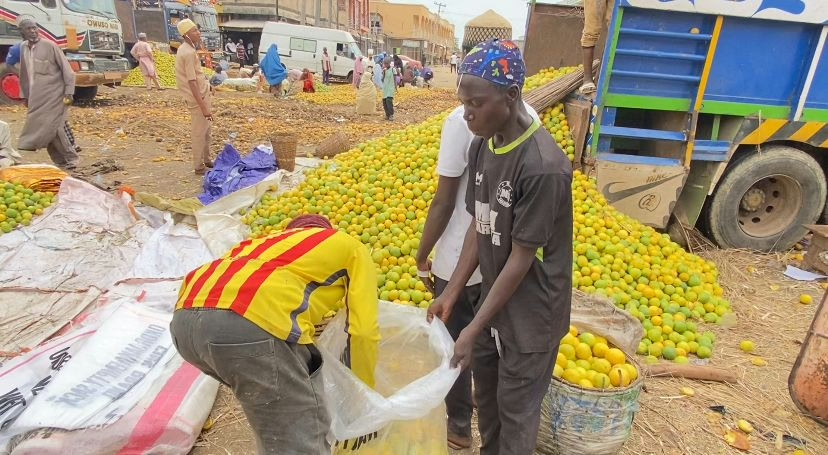
For more than years, residents of Yanlemo have co-existed with the fruit market.
Today, many say that same market has become a source of persistent environmental and health concerns.
What should be a thriving commercial hub, has gradually turned into a dumping ground for rotten fruits and unmanaged waste.
According to residents, the environmental pollution is from the market’s suffocating odor invades their homes daily, disrupts family life, and poses health risks, especially to children.
After years of complaints, meetings, and unresolved tensions, members of the Maikalwa Gayawa Youth Association say they have been left with no option but to seek legal protection of what they describe as their constitutional right to a clean and safe environment.
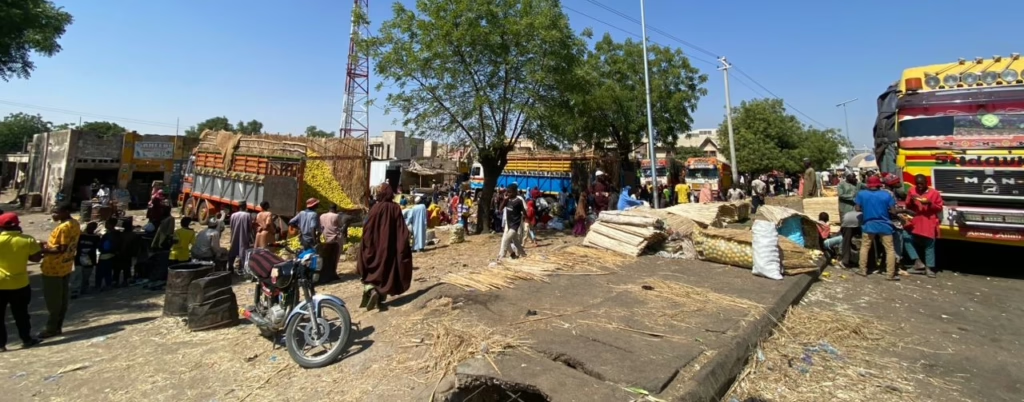
“We Have Endured This For Years” – Resident
Garba Yanlemo, a leader in the community association, said the conflict between the residents and the market management has lingered for years.
“We have lived in this community for more than 30 years. The prolonged conflict between us and the market has become overbearing. We now have to seek our environmental rights,” he said.
According to him, the core issue is the indiscriminate disposal of rotten fruits.
He explained that the market lacks a structured waste management system, leaving traders to dump spoiled produce openly.
“The odor from the rotten fruits is everywhere. Because we are direct neighbors to the market, the bad smell constantly pollutes our environment and causes health challenges,” he said.
A visit to the area shows tightly shut windows in many homes, even in the heat.
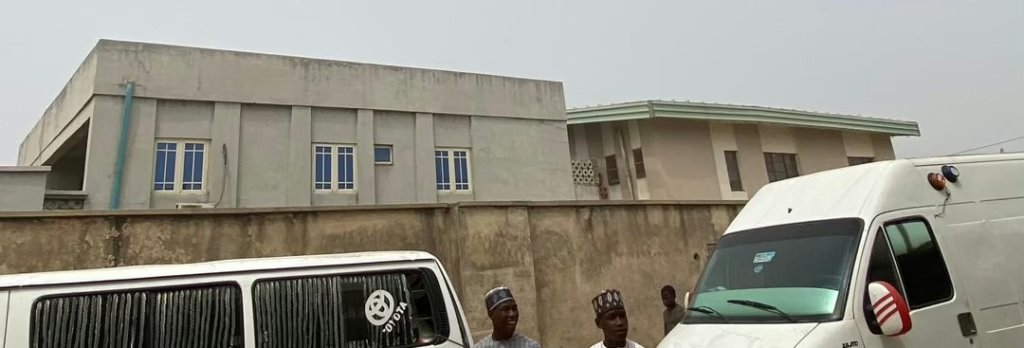
“If you look at the houses here, most windows are always closed because the smell is overwhelming. We can hardly get fresh air,” he added.
Yanlemo said the community initially sought dialogue, holding several roundtable meetings with the market association, but no lasting solution was reached.
He recalled a troubling case involving a neighbor’s infant.
“About a year ago, my neighbor’s two-month-old baby kept having respiratory issues from birth.
“The condition persisted until the parents took the child to Aminu Kano Teaching Hospital.
“After medical investigation, doctors linked the child’s recurring respiratory illness to environmental pollution in the area
“We have escalated the matter to the Human Rights Commission, and the case is currently before a court,” he told Stallion Times.
The Access Road Dispute
Beyond pollution, residents say they are battling another challenge. The obstruction of a major access road shared by both the market and the community.
Musa Ibrahim, a resident, told Stallion Times that heavy-duty trucks delivering fruits to the market often park indiscriminately, blocking the only accessible road into the neighborhood.
“We that have cars cannot pass because the trucks block the road. Sometimes we are stranded for hours,” he said.
The residents reported the matter to the Kano State Urban Planning and Development Authority (KNUPDA), which, according to Ibrahim, granted approval for a temporary barricade pending final authorization for a permanent gate.
“After we mounted the barricade as instructed, some people from the market broke it down,” he alleged.
Alleged Threats And Legal Action
Ibrahim further alleged that tensions escalated after the barricade was removed.
“They told us they can even kill if the road is blocked,” he said.
The case was reported to the State Criminal Investigation Department (CID) and later referred to court.
“While some individuals reportedly apologized, others did not, and legal proceedings are ongoing.
“We do not wish them harm. We only want to live peacefully, free from pollution, and have unhindered access to our homes,” Ibrahim said.

Women, Children Bear The Burden
Residents say women and children suffer the most from the environmental conditions.
Ali Abdullahi explained that during the rainy season, the situation worsens as decomposing fruits mix with stagnant water, intensifying the stench and increasing the presence of flies.
“The smell becomes stronger when it rains. It spreads everywhere,” he said.
He added that before partial intervention on the road, schoolchildren frequently arrived late because trucks blocked their route, forcing them to take longer alternatives.
“I have witnessed the impact of this pollution on women and children. My own children suffer recurring coughs and catarrh,” Abdullahi said.
He revealed that medical expenses have strained many families.
“There was a time we stopped going to the hospital regularly because the bills became too much. We relied on herbal remedies and local treatments just to cope.”
Constitutional Backing: What The Law Says
Residents argue that their demands are not merely emotional appeals but constitutionally grounded.
Section 20 of the Constitution of the Federal Republic of Nigeria (1999, as amended) provides that:
“The State shall protect and improve the environment and safeguard the water, air and land, forest and wildlife of Nigeria.”
Although contained in Chapter II (Fundamental Objectives and Directive Principles of State Policy), which is generally non-justiciable, environmental rights have increasingly been interpreted alongside enforceable fundamental rights.
Section 33 guarantees the right to life, while Section 34 provides for the right to dignity of the human person.
Nigerian courts have, in various cases, linked environmental degradation to violations of these enforceable rights where pollution threatens life and human dignity.
Section 41 also guarantees the right to freedom of movement, which residents say is infringed when access roads are obstructed.
Requests The Residents Made to The Human Rights Commission
“We humbly request the National Human Right Commission to investigate the Human Right Violation
- Direct the relevant Authority (Kano state government Ministry of Environment, kano urban planning and development authority (KNUPDA), Refuse Management and Sanitation Board (REMASAB) and chairman of Kumbotso Local Government which all this parties are aware of the issue in reference that we have already call their attention by writing them official which we have the acknowledgement copy as evidence.
- Recommend appropriate section or prosecution against those responsible for the threats and environmental damage
ill. Ensure protection of the community’s rights
- Facilitate urgent remediation of the polluted environment and rehabilitation of the damage access roads.
Market Leadership React
The Secretary of the market, Adam Mohammed, shed more light on the tension that has existed between traders and residents of Yan Lemo in recent years.
He told this reporter that residents had protested saying heavy trucks bringing fruits into the market were damaging roads within the neighbourhood.
According to him, others complained about the smell from rotten fruits, especially during peak seasons.
“These complaints led to serious disagreement and at some point, the residents took the market management to court,” he revealed.
He explained that the situation could have escalated, but intervention from the market leadership and the local authorities helped to calm tensions.
He dispelled allegations of death threats or any harm to residents.
“The market has always been willing to cooperate with authorities and surrounding communities to address genuine concerns,” Adam asserted.
According to Shehu Abdullahi, the coordinator of the Human Rights Commission, “the case is still in court and we are on the matter. We are hopeful to get justice for the residents.”
For the residents of Yanlemo, beyond commerce and coexistence, they insist that the right to breathe clean air and access their homes safely is not a privilege but a constitutional entitlement.
This report was produced with the support of HumAngle’s 2025 SCOJA Fellowship.