Isiyaku Ahmed
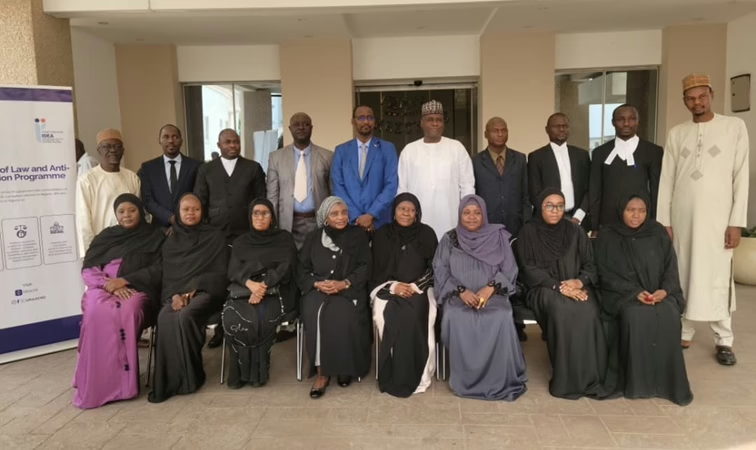
The Kano State High Court in collaboration with the Rule of Law and Anti-corruption Program (RoLAC II), funded by the European Union and implemented by the International Institute for Democracy and Electoral Assistance (IDEA), on Thursday, convened a high-level Peer Learning and Experience-Sharing Roundtable on the adjudication of Sexual and Gender-Based Violence (SGBV) cases at Porto Golf Hotel in Kano.
The event that brought together 6 Kano SGBV designated judges, Kano State High Court Judges, a visiting SGBV-designate judge from Adamawa State, magistrates, and other senior judicial officers’ forms part of RoLAC II’s broader efforts to support justice sector reforms and improve adjudication of SGBV cases across Nigeria.
Delivering his welcome remarks, Kano State Project Coordinator of RoLAC II, Ibrahim Bello, described the gathering as “a significant milestone for the justice system,” noting that it assembled some of the finest judicial minds committed to strengthening justice delivery for SGBV survivors.
He commended the Honourable Chief Judge of Kano State for what he called a historic and visionary step, the appointment of six SGBV-designate judges, the first time in Kano’s history that specialised judicial officers have been assigned to handle such sensitive and complex matters.
The decision, he said, demonstrates deep commitment to protecting vulnerable groups, improving case disposal, and ensuring timely, rights-based justice for survivors.
The RoLAC II Project Coordinator also expressed profound appreciation to the Honourable Chief Judge of Adamawa State for deploying one of her experienced SGBV-designate judges to Kano to lead the roundtable.
The gesture, he described as a powerful symbol of inter-state collaboration and shared responsibility for strengthening justice outcomes nationwide.
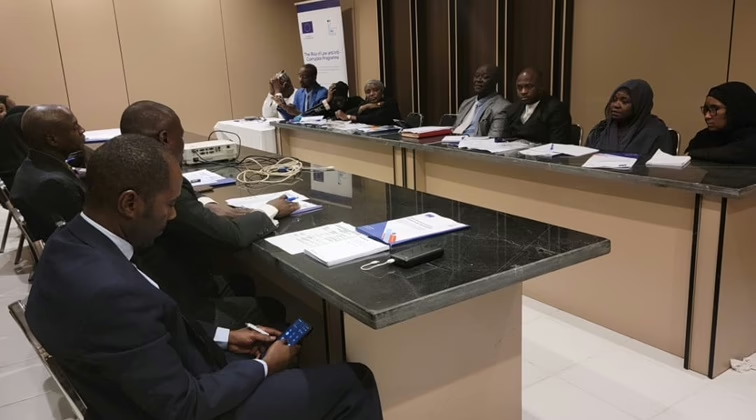
According to him, the roundtable offers a platform for judges to reflect on key procedural, evidentiary, and ethical issues in SGBV adjudication; exchange experiences across jurisdictions; and identify practical strategies to enhance survivor protection, judicial efficiency, and fairness.
The Kano State Acting Chief Registrar, Hussein Hassan-Suleiman, welcomed the distinguished participants to the roundtable discussion and commended the RoLAC II program for its continued investment in judicial capacity building.
He noted that continuous learning remains the minimum standard for professional growth, citing his own recent exposure to the methodology of forensic reading of medical reports as an experience that significantly enhanced his knowledge.
He wished the participants fruitful deliberations.
In his remarks, the Kano State Attorney General and Commissioner for Justice, Barrister Abdulkarim Kabiru Maude, SAN, said Sexual and Gender-Based Violence (SGBV) demands the attention of every citizen, especially the Office of the Attorney General.
“After assuming office, we held discussions with the Director of Public Prosecution, who is now the Solicitor-General, on the need to amend the Penal Code,” he said.
According to him, several issues and innovations were proposed in the draft amendment, and he intends to forward it to the State House of Assembly for consideration and passage, after which it will require the governor’s assent.
He pledged to review the Penal Code, expressing hope that the reforms would soon see the light of day in Kano State.
The session was formally declared open by the Honourable Chief Judge of Kano State, Hon. Justice Dije Abdu Aboki, represented by Justice Hadiza Sulaiman of High Court 9.
While welcoming participants, she noted that SGBV is a very important issue to be discussed, adding that high court judges present and others will put what is learned into practice.
The facilitator of the roundtable, Justice Ishaku Yakubu Haliru, raised concerns that despite having multiple support centres and specialised prosecutorial units, Adamawa State still faces significant challenges in tackling Sexual and Gender-Based Violence.
Speaking on the state’s adjudication and response systems, he explained that SGBV includes sexual violence, harmful traditional practices, physical assault, emotional abuse and psychological deprivation, affecting mainly women and girls but also men and boys.
He identified rape, defilement, sexual exploitation, physical violence and female genital mutilation as the most common offences.
Justice Yakubu listed existing support structures such as the Hope Centres in Yola and Numan, a UNFPA-backed One-Stop Centre in Yola, and SARC facilities in Mubi and Michika, as well as a Special Prosecuting Unit in the Ministry of Justice.
Despite these structures, he said widespread stigma, fear of retaliation, slow court processes, poor police investigations, weak handling of forensic evidence and limited rural access to justice continue to hinder accountability. These barriers, he noted, contribute to the low number of cases that make it to court.
Justice Yakubu criticised poor investigative practices by some police officers and stressed the need for continuous training, especially in handling forensic evidence.
He disclosed that the High Court is collaborating with experts to strengthen judges’ capacity in DNA and forensic matters.
He concluded by calling for improved investigations, continuous capacity building and stronger institutional commitment to ensure justice for survivors and accountability for perpetrators.
Participants were urged to engage collaboratively and contribute insights that will strengthen the judiciary’s role in delivering justice, dignity, and protection for survivors of SGBV.