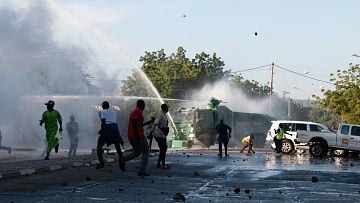
Tensions are rising in Cameroon following the arrest of two prominent opposition leaders ahead of the announcement of official election results.
Anicet Ekane and Djeukam Tchameni, both members of the Union for Change political platform, were detained by armed security forces at their homes, the group said in a statement on Friday.
The arrests come amid mounting unrest over the disputed October 12 presidential election.
Both men had endorsed opposition candidate Issa Tchiroma Bakary, who claims to have defeated longtime President Paul Biya.
Tchiroma’s camp insists its own vote tally shows him as the winner, while Biya’s ruling party has accused the opposition of attempting to destabilize the country.
The African Movement for New Independence and Democracy (MANIDEM), another opposition party, also reported that several of its members were abducted by local security forces, describing the arrests as a campaign of intimidation against citizens demanding transparency.
Cameroon’s electoral commission is expected to release the final results on Monday.
Meanwhile, protests have erupted across several cities. On Saturday, motorcyclists in Bafoussam, the capital of the West Region, blocked major roads demanding a credible count.
Earlier in the week, demonstrations turned violent in other areas, leading to multiple arrests and at least one death.
Authorities confirmed that a 30-year-old teacher, Zairatou Hassana, was killed in Garoua, a northern city, though she was reportedly not participating in the protest.
Her uncle, Amadou Adji, told the Associated Press that she had been out searching for her sister when she was caught in the unrest.
“Her death leaves me with a bitter memory of this regime, like all other Cameroonians,” he said.
In a Facebook post on Friday, Tchiroma warned that any attempt to detain him would be “an assault against the entire Cameroonian people.”
He urged authorities to respect what he described as “the people’s victory” and called for nationwide demonstrations on Sunday.
Local officials have also restricted fuel sales in northern regions, citing fears that contraband petrol was being used to power protests.
However, the measure has further slowed economic activity and deepened public frustration as the nation braces for the final election results.