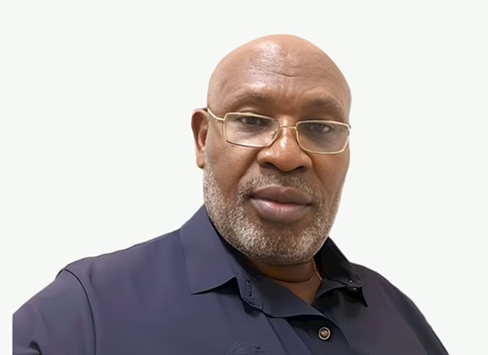
Rekpene Bassey
Democracies rarely collapse in a single, dramatic moment. More often, they erode quietly, their foundations weakened not by coups or revolutions, but by subtler forces: compromised institutions, legal ambiguities, and the steady marginalization of dissent.
Nigeria, Africa’s most populous nation and one of its most consequential democracies, now finds itself confronting that quieter, more insidious threat.
The warning signs are no longer confined to domestic critics.
Tibor Nagy, a veteran American diplomat, recently described developments in Nigeria as a “dangerous assault on opposition politics.” It is a stark assessment, and one that increasingly aligns with the evidence on the ground.
Across party lines, especially in the PDP, Labour Party and ADC, opposition politics is fragmenting under the pressure of perceived covert executive political infiltrations and meddling. Internal divisions have deepened into open conflict.
Questionable judicial interventions have grown more frequent, and more contested. And the institutions meant to safeguard democratic competition are themselves being drawn into the struggle.
At the center of this unfolding drama is the African Democratic Congress (ADC), a party that has, in recent months, come to embody the broader crisis.
Once positioned as a potential coalition platform, the ADC is now splintered into rival factions, each claiming legitimacy.
The disputes are not merely political; they have become legal, with courts issuing rulings that have had the effect, intended or otherwise, of deepening the paralysis.
When the Independent National Electoral Commission (INEC) moved to suspend recognition of the party’s leadership factions following a court decision, it effectively sidelined the ADC from meaningful political participation.
For critics, the issue is not simply the outcome but the interpretation. Human rights lawyer Femi Falana has argued that the relevant court order called for maintaining the status quo, not for stripping the party of recognition. The distinction may appear technical. In practice, it is decisive.
When legal interpretations carry such sweeping political consequences, they raise uncomfortable questions about the role of institutions in a democracy already under strain.
Those questions extend to the judiciary itself. Long regarded as the final arbiter in political disputes, Nigeria’s courts are increasingly perceived, fairly or not, as inconsistent in their application of the law.
Orders are enforced in some cases and ignored in others. Judgments, critics say, are sometimes framed in ways that invite competing interpretations, allowing political actors to claim victory regardless of the ruling’s intent.
The resulting uncertainty has begun to erode public confidence. And as Femi Falana recently observed, there is a growing belief among opposition figures that justice may no longer be attainable through the courts. In any democracy, that perception alone can be destabilizing.
The executive branch, suspected to be fanning the embers of opposition crisis, meanwhile, has done little to ease those concerns.
Unfortunately Political maneuvering has increasingly overshadowed governance, with debates over electoral timelines and coalition strategies dominating the national conversation.
Proposals that could effectively extend the campaign season risk turning governance into a permanent contest for power; one in which policy takes a back seat to politics.
Economic and national security pressures have compounded the problem. Critics have warned that current fiscal policies prioritize borrowing and political expenditure over long-term stability, could be deepening inequality in a country where millions already face multidimensional poverty.
In such an environment, the stakes of political competition become even higher; and the temptation to control its outcomes is even stronger.
However, the opposition’s predicament cannot be explained by external forces alone. Internal rivalries, leadership struggles, and competing ambitions have left parties vulnerable to precisely the kind of interference they now decry. What should be vehicles for democratic contestation have, in some cases, become arenas of self-destruction.
This convergence of pressures: institutional, political, and internal, is producing a troubling effect.
Nigeria is not formally a one-party state. Elections are still held. Parties still exist. But the conditions that make competition meaningful are steadily being weakened.
The danger is not the sudden end of democracy, but its gradual hollowing out.
History offers sobering lessons. Democracies that lose credible opposition do not immediately collapse; they persist, often for years, as diminished versions of themselves; systems in which outcomes are predictable, accountability is limited, and public trust steadily declines.
Nigeria is not there yet. Its civil society remains active. Its media, though under pressure, continues to scrutinize power. And its political landscape, for all its fractures, still contains the raw elements of competition. But those strengths cannot be taken for granted.
For democracy to endure, its institutions must do more than exist; they must command confidence. The electoral body must be seen as impartial.
The courts must be consistent and clear. Political actors must accept not only the benefits of competition, but its constraints.
Above all, there must remain a genuine possibility of alternation; the idea that power can change hands not through crisis, but through credible, contested elections.
That possibility is the lifeblood of any democracy. Without it, the system may continue to function. But it will no longer, in any meaningful sense, be democratic.
The question facing Nigeria today is, therefore, not whether democracy still exists. It is whether it is being preserved, or quietly, systematically, allowed to die.
Indeed the question remains: who wants democracy in Nigeria dead? The political class, judiciary, or INEC – the controversial electoral umpire, which has, at various times made mendacious decisions?
Bassey is the President of the African Council on Narcotics and a Security Specialist.