Olu Allen
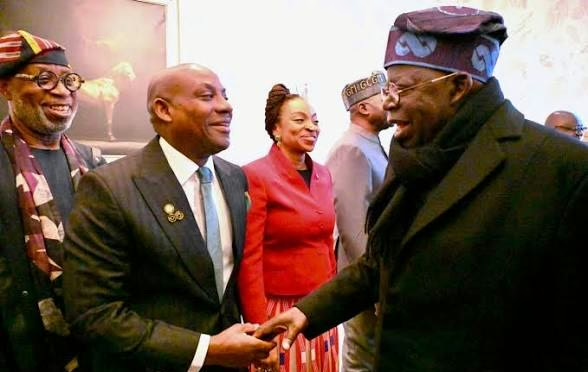
There is a pattern we must stop pretending not to see. Every time the President travels, Nigeria performs a ritual, not of statecraft, but of subservience. They line up. Governors. Ministers. Political loyalists. At the airport. Waiting to exchange a fleeting handshake on the tarmac.
Then, with a mathematical predictability, some of the same faces reappear on foreign soil—thousands of miles away, waiting to welcome the man they just saw off.
Not once. Not occasionally. Repeatedly. Consistently. Systemically.
This is not a travelogue. This is a market. Welcome to the Tarmac Economy.
In this economy, the currency is not the naira, but proximity. The goods on offer are loyalty and the appearance of relevance.
And the transaction, a handshake, a wave, a spot in the official photograph, is traded for political insurance. It is a theatre of performance, a multi-million naira roadshow funded by public coffers.
Every governor’s jet that idles on the tarmac in Abuja burns fuel that could have powered a primary healthcare centre.
Every security detail pulled from a troubled state to hover at a foreign embassy is manpower stolen from the citizens who need them.
Now, let’s bring in context, because context is the graveyard of excuses. Just days ago, Nigeria was hit with tragedy. In Maiduguri, multiple bomb blasts tore through the mundane: markets, hospitals, public spaces.
At least 23 people were killed. Over 100 others were injured. This was not an abstract “security challenge.” This was blood on the asphalt. This was national pain.
Now pause.
Hold the image of a grieving mother in Borno. Then picture the “Tarmac Committee.” While the dust was still settling in Maiduguri, the lines were forming at the airport. Powerful men, custodians of state resources, assembled in a choreographed display of “loyalty.”
And here is the disconnect: This is not protocol. This is a systemic bypass. Governance is not tested when the sun is out; it is tested when the clouds break.
One might argue this is simply our culture, a sign of unity and respect for the office of the President. But let us dismantle that excuse.
Unity is built on shared strategy in a war room, not shared selfies on a runway. If this is ‘culture,’ it is a culture of institutional insecurity, where leaders feel the need to physically fortify their position because their constitutional footing is weak.
Compare this to an earlier generation of Nigerian leaders, during the turmoil of the Civil War or the structured governance of the First Republic.
Governors then were anchored to their regions; their power was derived from the institutions they ran, not the frequency of their visits to the Head of State. They understood that true respect for the president meant securing their own front so the president wouldn’t have to.
The foreign examples are equally instructive. When Donald Trump or Keir Starmer travels, the machinery of their states remains at their desks. A U.S. Secretary of State’s power is rooted in a Senate-confirmed department, not a proximity to Marine One.
A British Minister is judged by departmental metrics, not their presence at the Heathrow VIP lounge. They do not abandon crises to wave at a plane because their political survival depends on institutional performance, not personal patronage.
But in our case, something deeper and more dangerous is at play. Power has shifted from the Institutional to the Personal.
When power is personal, you cannot afford to be out of sight. In this “Eye-Service Economy,” visibility is confused for loyalty, and physical presence is the only valid collateral. The “Inner Circle” is defined by who stands closest to the jet engines.
So the leaders move. Not to where they are needed, the Situation Room in a besieged state, but to where they are seen, the Red Carpet.
This is the ultimate Opportunity Cost. Every hour a Governor spends on a tarmac in Abuja or a sidewalk in London is an hour stolen from the security architecture of his home state.
As the Chief Security Officer, his absence during a crisis has a direct, quantifiable cost: delayed decisions, poor coordination, a leadership vacuum that emboldens attackers and demoralizes troops. It is a literal abandonment of the duty post.
Let’s be clear: The UK visit, hosted by King Charles III, is legitimate diplomacy. But diplomacy has a structure. This pattern has only symptoms. A functional delegation is small, role-based, and outcome-driven.
This cross-continental welcoming committee is a Theatre of Proximity, where the purpose of the trip is secondary to the performance of being on it.
The question is no longer rhetorical. It is an audit of our national soul. In moments of agony, where is the leadership? Are they physically and mentally present at the site of the wound, or are they competing for a three-second handshake in the VIP lounge?
This is not a grievance. It is a diagnosis. Patterns, when repeated long enough, become Culture. And a culture that prioritizes the “Tarmac” over the “Trenches” is a culture in decline.
The Prescription:
Good governance must be anchored, not itinerant. We need to move from moral appeals to structural mechanisms.
Let the Principle of Subsidiarity reign: A matter should be handled by the smallest, most local competent authority. A state crisis is the governor’s to manage. By leaving, they force the federal government to stretch its resources even thinner.
Let Performance be the Metric: A governor’s performance, and by extension, their political future, should be tied to verifiable metrics of internal security, not attendance at state functions. If a governor is absent during a crisis in his state, he must face public questioning and legislative scrutiny.
Let there be Sunlight: Perhaps it’s time for civil society to publish a “Tarmac Index,” tracking which leaders spend the most time in the air and at airports, and correlating it with the development indicators on the ground. Public shame is a powerful disinfectant.
Above all, let leadership develop the discipline to respond to national pain with an Alignment of Presence. A serious nation is not judged by how many “big men” gather around power.
It is judged by how quickly power gathers around the broken, the grieving, and the vulnerable. Until our leaders understand that their office is stationary, even when they move, the Tarmac Economy will continue to bankrupt our nation’s soul.
Allen writes from Kano. He writes on public affairs and promotes good governance.