Olu Allen
There is always noise when a government knows its scorecard cannot speak for itself.
Listen carefully to the political atmosphere and you will notice a certain frenzy, a desperate chorus, a coordinated echo.
The louder the chant of “City Boy,” deployed first in Kano and now echoing across rallies, the more it reveals something deeper: not confidence, but anxiety.
This is not random chaos. It is a calculated information strategy.
The goal is not always to persuade; it is often to exhaust.
To flood the public space with so much controversy, distraction, and sloganeering that the average citizen gives up trying to separate truth from theatre. An exhausted electorate is easier to manage than an alert one.
Noise is the campaign of a government unsure of applause.
When a ruling party truly trusts its performance, it does not need to shout. Results speak calmly and convincingly.
Today, however, the political space feels crowded with sound and short on substance.
Much of this frenzy is tied to an obsession with what political insiders call “structure.”
Under the banner of the All Progressives Congress, structure has become more than organization, it has become a quest for total political alignment. Every governor must belong.
Every regional stronghold must tilt one way. Every influential voice must be courted, absorbed, or neutralized.
This urgency suggests not the confidence of a party certain of popular affection, but the caution of one unsure of the people’s verdict.
A government that trusts voters does not fear an open field.
It welcomes competition as validation.
A government that trusts its record does not fear debate.
It knows its achievements can withstand scrutiny.
But a government that fears the verdict must control the conditions of the test.
It must shape the narrative, manage the referees, and influence the environment long before the first ballot is cast.
This is not uniquely Nigerian. Around the world, from parts of Eastern Europe to Asia and Latin America, incumbents facing economic pressure or declining popularity often rely on narrative dominance, institutional alignment, and coalition absorption to maintain electoral advantage.
Nigeria is simply experiencing its own version of a global democratic stress test.
When performance is loud, propaganda whispers.
When performance is weak, propaganda shouts.
History reminds us that Nigeria has witnessed at least one election still widely regarded as a benchmark: the June 12, 1993 presidential election.
Decades later, many Nigerians remember it as the freest and fairest expression of the national will.
Why does it endure in memory? Because, for once, the people were allowed to speak clearly.
The field was relatively open. The verdict, though later annulled, was unmistakable.
If leadership today is confident of public support, why not replicate that level of transparency? Why not create conditions so credible that even critics must concede fairness?
Because nothing unsettles a politician more than facing voters with unfinished promises.
Consider past pledges: millions of jobs, millions lifted out of poverty, a secured nation.
Today, economic pressures, rising living costs, currency strain, and persistent insecurity in many regions, have intensified public scrutiny of governance outcomes.
Whether one supports or opposes the current administration, the lived experience of citizens has become the true campaign ground.
When delivery is widely felt, re-election campaigns feel like celebrations.
When delivery is disputed, campaigns become exercises in narrative management.
Distraction replaces discussion.
Symbolism replaces substance.
Public relations tries to outrun public memory.
Think back to moments when citizens stood alone, such as the #EndSARS protests of October 2020.
Young Nigerians gathered not for party or tribe but for dignity, justice, and accountability.
In those defining moments, many political actors now seeking renewed mandates appeared distant or cautious.
Voters must quietly ask themselves: Who stood with the people when it mattered? Who spoke clearly? And who waited for the dust to settle?
Institutions meant to guarantee fairness also face growing public scrutiny.
The Economic and Financial Crimes Commission continues to play a visible role in anti-corruption enforcement, yet public perception increasingly questions whether its intensity is applied evenly across political lines.
Whether such perceptions are fair or exaggerated, inconsistency, real or perceived, erodes trust, and democracy depends heavily on trust.
Similarly, agencies such as the Department of State Services sometimes find themselves at the center of political controversies.
To many citizens, these institutions appear more visible during politically sensitive moments than in addressing everyday insecurity.
This perception, whether accurate or not — feeds a broader anxiety about the neutrality of state institutions during electoral cycles.
Where trust is strong, rumours struggle.
Where trust is weak, whispers multiply.
Across the country, political conversations are filled with speculation: alliances negotiated behind closed doors, defections encouraged, loyalties demanded.
Whether exaggerated or grounded in reality, the fact that such narratives flourish reveals something deeper, a deficit of confidence in the political process itself.
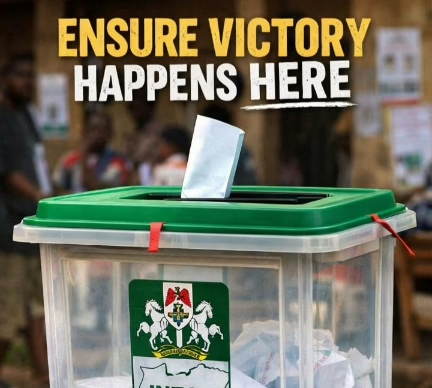
And yet, history shows that the ultimate power in a democracy does not lie with noise, intimidation, or control. It lies quietly with the voter.
Ballots are more powerful than slogans.
The real question is not what any politician says about themselves.
The real question is what their record says, and what your conscience says.
Does any leader deserve another term?
That answer should not come from party chants or trending hashtags. It should come from lived experience. From whether daily life has improved or deteriorated.
From simple, honest questions:
Am I safer than I was four years ago?
Can I afford basic needs more easily?
Does my business have room to grow?
Do I trust that my vote will count?
Silence the noise.
Ignore the orchestrated excitement.
Step away from the talking points.
Ask yourself: why should any incumbent be rewarded with another chance?
If there are clear reasons, vote accordingly.
If there are doubts, vote accordingly.
Democracy does not demand uniformity; it demands sincerity. It does not require that citizens agree, only that they think, reflect, and choose freely.
Democracy does not die when people shout.
It dies when citizens grow tired of listening.
Elections are not ultimately won on social media or at rallies.
They are won quietly, one voter at a time, inside a polling booth.
So when the noise becomes overwhelming, remember this:
The most powerful political statement is not a slogan.
It is a vote.
Go to the polls.
Vote your conscience.
Let performance, not propaganda, decide the future.
Allen writes from Kano. He writes on public affairs and promote good governance.