Olu Allen
To those still sharing that 2019 video of Peter Obi and Atiku Abubakar in conversation with Kadiriya Ahmed, pause for a moment and consider: that clip belongs to a political season that has ended.
It is not a blueprint for our current terrain; it is a measure of how much has shifted, and how quickly.
Because Nigerian politics is unforgiving in its mathematics. Numbers tell a story in real time.
Atiku’s Waning Pull, Numerically and Organisationally
If Atiku Abubakar had truly grasped the lessons of recent cycles, the years between 2019 and 2023, and indeed 2025, would have been spent rebuilding, forging durable alliances, and planting roots where his PDP once enjoyed automatic loyalty.
Instead, his influence has shrunk drastically.
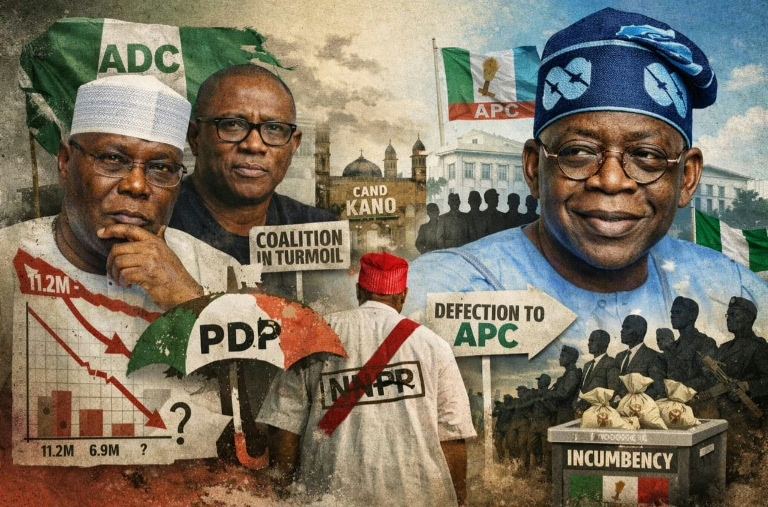
From 11.2 million votes in 2019 to under 7 million in 2023, that decline was already stark.
This was not a small slide, it was a brake failure on a long, downhill descent of support.
Electoral arithmetic is a prophecy: When support collapses by millions, it does not resurrect itself without a new strategy.
Adding to this calculus, Atiku’s exit from the PDP in 2025, opting instead to anchor his future on the African Democratic Congress (ADC) coalition with Peter Obi, has not brought revitalisation; it has brought uncertainty.
Despite the initial fanfare of opposition realignment, the ADC has struggled to attract real institutional heft. Governors, kingmakers and grassroots organisers have largely kept their distance, a telling sign of where power still truly lies in Nigeria’s patronage-driven political system.
Peter Obi: Movement With Limits
Peter Obi’s rise between 2019 and 2023 was not accidental.
It was powered by energy, frustration with the old duopoly, and a generation that wanted something different.
He turned six million votes into a national statement, impressive in any context.
But by 2026, that movement remains just that: a movement, not yet a structure.
The African Democratic Congress coalition, while a headline, has yet to translate into the governors, senators, local government networks and grassroots machinery that win elections at scale.
Many of Obi’s core supporters now grumble openly that the coalition is a strategy without an organisation, capable of inspiring online fervour but not yet capable of shifting local power brokers in pivotal states.
That distinction matters because Nigerian presidential elections are not won on Twitter or by viral videos: they are won in constituencies, wards and state party chapters, the very places where ADC’s presence is thin.
APC’s Steady Structural Advantage
While the opposition debates its identity, the All Progressives Congress (APC) continues to consolidate structural power.
The ruling party now boasts roughly 30 governors, an overwhelming share of the federation, and it has been the default destination for defection after defection.
The biggest political realignment of early 2026 occurred not within the opposition coalition but in Kano State.
Governor Abba Kabir Yusuf, until recently the only NNPP governor, formally quit his party, leaving behind the leader who made him: Rabiu Musa Kwankwaso. Yusuf’s resignation and defection to the APC, alongside a large cohort of lawmakers and local government leaders, was a seismic shift in northern politics.
Kano was once the flagship of the NNPP and the Kwankwasiyya movement.
Today, it is a clear APC stronghold. Governors matter; their networks matter; their ability to deliver votes matters.
And in 2026, the APC is accruing those assets far faster than any opposition bloc.
Kwankwaso, a formidable political personality with deep grassroots support, finds himself politically adrift, his machine hollowed out, his political heir now an opponent.
The Strategic Bottlenecks for the Opposition
There are three stark realities the opposition must confront:
Coalitions without structure are fragile.
The ADC alliance has personality but lacks the deeply rooted local presence that parties like the APC and even the PDP once had.
Numbers still matter at the grassroots. Governors and state executives, not ex-presidents and former governors, deliver votes on the ground.
Nigeria’s electorate is both aspirational and pragmatic.
Voters may cheer online, but when it comes to elections, they look to parties that seem capable of winning and governing.
Tinubu’s Advantage: Continuity + Capacity
President Bola Tinubu, for all the criticism his government attracts, controls an unparalleled political apparatus in the country.
The APC’s structure, its governors, its leverage in state and federal institutions, and a willingness to embrace defectors mean that it goes into 2027 not merely as the incumbent, but as the architect of political momentum.
Opposition narratives may dominate editorial pages. But elections are not won by narratives alone.
The Arithmetic Isn’t Kind
Atiku holds the coalition ticket. Obi provides the energy. But Tinubu holds the structures that translate votes into victory.
Between loss of party strongholds, defections of governors, and the absence of a consolidated grassroots network, the current arithmetic tilts in favour of the APC.
Numbers don’t lie. Parties do.
And at this moment in Nigeria’s political history, structure still beats sentiment.
Allen writes from Kano. He writes on public affairs and advocates good governance.