Musa Ubandawaki, Sokoto
Sokoto State Government has launched a far-reaching strategy to combat the out-of-school children crisis, expand Early Childhood Care and Education (ECCE), and reform the Almajiri system, positioning the state as a potential blueprint for nationwide replication.
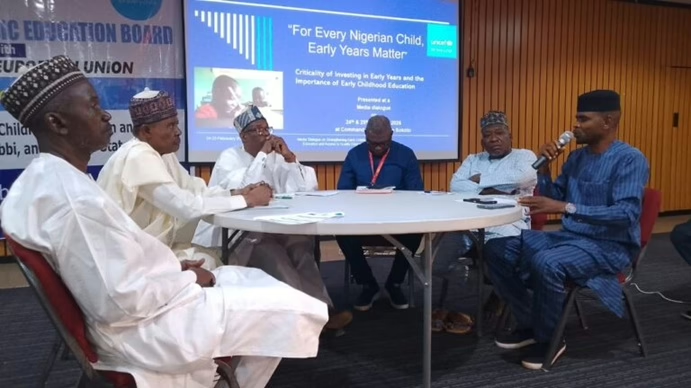
The sweeping reforms were unveiled at a high level media dialogue on out of school children and education reform convened by the Sokoto State Universal Basic Education Board (SUBEB) in partnership with UNICEF and supported by the European Union.
Speaking at the event, SUBEB Executive Chairman, Alhaji Umar Nagwari Tambuwal, declared that the future of Sokoto and indeed Nigeria depends on urgent, sustained and strategic investment in children’s education.
He described early childhood education as “the great equaliser,” stressing that the first eight years of life form the most critical foundation for cognitive, emotional and social development.
“High-quality ECCE is not a luxury.
“It is the foundation upon which long-term health, learning achievement, and economic productivity are built, especially for children from disadvantaged backgrounds,” Tambuwal said
According to him, between 2024 and 2025, SUBEB with UNICEF’s backing strengthened 160 ECCE centres through improved learning materials and caregiver training.
An additional 80 centres are scheduled for support, while plans are underway to triple intervention coverage by 2026.
Despite measurable progress, Tambuwal acknowledged the magnitude of the crisis, revealing that 66.4 per cent of school-aged children in Sokoto remain out of school a figure translating into hundreds of thousands of vulnerable children, including girls, orphans and Almajiri pupils.
Under the leadership of Governor Ahmad Aliyu, the state has initiated a comprehensive mapping exercise across all 23 local government areas.
So far, 25 per cent of out-of-school children have been identified and documented in streets, rural settlements and Tsangaya centres for targeted reintegration.
The administration has also declared basic education free and compulsory, abolished school levies, and prioritised teacher recruitment to strengthen classroom delivery.
In May 2025, the state launched the Digital Village Initiative to equip Almajiri children and out of school girls with digital literacy and practical 21st-century skills.
Tambuwal further highlighted the intervention of the Adolescent Girls Initiative for Learning and Empowerment (AGILE) Project, which is providing infrastructure grants to 240 secondary schools to ensure safe, inclusive and conducive learning environments.
A central pillar of the reform agenda is the restructuring of the Almajiri system.
Working closely with the Sultanate Council, the state has profiled and registered over 249,000 vulnerable children.
The government is transitioning from street begging to integrated education models in Shuni, Gagi, Tambuwal and Wamakko blending Qur’anic instruction with literacy, numeracy and vocational training, alongside free accommodation and feeding.
To decongest schools and raise standards, the state has begun constructing three mega model schools across its senatorial zones: Aliyu Magatakarda Model Primary School in Wamakko (Sokoto Central), Muhammad Sambo Model Primary School in Goronyo (Sokoto East), and Government Day Junior Secondary School in Tambuwal (Sokoto South).
Each facility spans approximately 35,700 square metres and will feature 60 classrooms, laboratories and recreational facilities.
In a decisive move to guarantee quality teaching, Tambuwal disclosed that 3,000 teachers recently underwent a rigorous screening exercise conducted by a specialised recruitment committee.
Successful candidates will be deployed to the mega schools, the SMART School, the Second Chance Centre for girls in Sokoto South, and vocational centres in Sifawa, Wurno and Wamakko.
Technology driven monitoring systems have also been introduced, including Kobo Collect and GPS tools, to strengthen data accuracy and real time reporting.
Traditional rulers are now integrated into community-based monitoring frameworks to replace unsustainable cash-driven mobilisation campaigns.
With the Out of School Children dashboard recording 326,119 children between 2024 and 2025, Tambuwal said Sokoto is building a data-backed education reform model capable of delivering measurable impact.
He called on federal stakeholders and the Universal Basic Education Commission to provide technical and financial backing to replicate the Sokoto template across Nigeria.
In his goodwill message, Dr. Michael Juma of UNICEF’s Sokoto Field Office said the media dialogue was designed to deepen public awareness, sustain policy engagement and strengthen community participation in early childhood education.
The Permanent Secretary of the State Ministry of Information also commended SUBEB and UNICEF for championing advocacy efforts, describing early childhood education as “the bedrock of national development” and pledging expanded media support across Sokoto, Kebbi and Zamfara states.
Panelists at the roundtable emphasised that sustained investment in the early years is essential to breaking intergenerational poverty, reducing insecurity and strengthening national cohesion.
They called for stronger legislation to regulate the Almajiri system, revival of home-grown school feeding programmes, and deeper collaboration among government, development partners and the media.
In conclusion, the dialogue, Tambuwal urged journalists to act as a bridge between policy and the public, ensuring sustained momentum toward 2026.
“Educating every child is not merely a developmental target,” he declared. “It is a moral obligation and the ultimate safeguard for our collective future.”