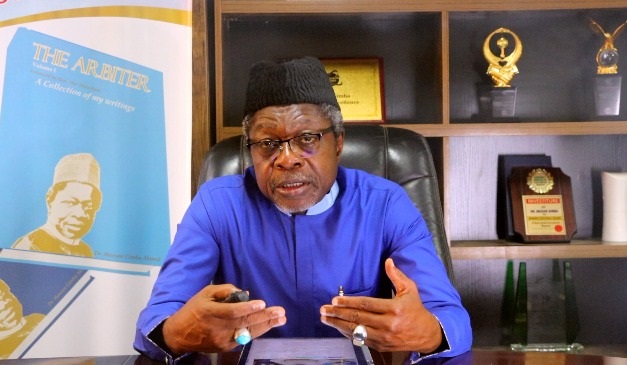
Hassan Gimba
Last time, we parted with the following words: ‘So, with all this before us, where do we turn? How do we reverse the “curses”, catch our breath, and return to who we ought to be – security-wise – not merely to avoid Trump’s threat, but to make Nigeria once again a haven for all, irrespective of race, region, or religion. It is in light of this that we will see the effect(s) of the Ribadu shuttle.’
At the height of the Trump threat, when he was bristling with fury based on an erroneous narrative that Christians are being massacred in Nigeria, Ribadu was given marching orders by President Bola Ahmed Tinubu to go to Trump’s lair and douse the flame by laying on the table the truth about Nigeria.
The narrative that Christians are being deliberately targeted for elimination in Nigeria was started by some unpatriotic elements in Nigeria for their pecuniary benefit.
This is an issue that all those who love truth know to be false. There is no international agreement on it, as the Economic Community of West African States (ECOWAS), the African Union (AU), and the European Union (EU) have refuted it. The Pope and Archbishop Matthew Hassan Kukah, both back home, have refuted it.
But it is a narrative amplified not only by Trump himself but also by comedian Bill Maher, Senator Ted Cruz, Congressman Riley Moore, and others who are pursuing a narrow and sinister agenda.
Both Muslims and Christians are victims of insurgents and bandits. And despite the disappointment of many Nigerians that America, seen as a global leader, should have shown concern for all humans (both Muslims and Christians) being killed, as opposed to its stance of defending only Christians, Nigeria, through its National Security Adviser, Nuhu Ribadu, went to the USA with facts, not sentiments.
Ribadu met with Congressman Moore, who acknowledged that he and other US lawmakers had held “productive and positive” conversations with the NSA. He wrote on X: “There were concrete steps and actions discussed at length” with Mr Ribadu and other Nigerian officials.
Members of the US Congress from both major parties subsequently rejected military intervention, acknowledging the seriousness of terrorism and the human suffering it has caused in different parts of our country.
Recognising the complexity of the conflict and the potential consequences of any foreign action, they suggested a joint approach in which the US would provide intelligence support and work closely with Nigerian security forces in identifying, isolating, arresting, or eliminating Boko Haram terrorists who have caused havoc in different regions of our country, especially in the North East.
However, beyond his success, and without detracting from the fact that he has performed credibly in his USA brief, there are issues the NSA must address to safeguard our nation’s security and sovereignty and to build confidence in us as a people.
Daniel Bwala, a special adviser to the Nigerian President, recently stated that Nigerian security agencies cannot track or monitor terrorists using Elon Musk’s Starlink satellite internet service.
He said that while local internet users can be tracked, the use of Starlink and networks from neighbouring countries makes it impossible to trace those involved in criminal activities, such as displaying weapons and ransom demands on social media platforms like TikTok and Facebook.
“If you are using Starlink, we cannot trace it because Starlink is not registered in Nigeria. It’s in space,” he explained.
However, in late 2024, the Nigerian Communications Commission (NCC) was set to sanction Starlink for unilaterally increasing its subscription prices in Nigeria without prior approval, a move the commission said violated Nigerian telecommunications laws (Sections 108 and 111 of the NCA).
That move, which halted Starlink at the time, demonstrated that even foreign providers, including Starlink, are subject to local telecommunications regulations. But beyond that, it means that Starlink is registered with the NCC, which is why the commission can sanction it.
Although Starlink is in space and its owner is South African, it is not operating in the country because the government has blocked SpaceX’s operations under its Broad-Based Black Economic Empowerment (B-BBEE) laws, which require 30 per cent local ownership for telecoms licences, a requirement SpaceX has resisted.
Yet it dares not operate there, despite being “in space”. Here, foreign business concerns come, harvest what they can, and take it back home at our expense.
Despite being in space, countries that are conscious of their security and sovereignty, and therefore suspicious of how Starlink services might be used, do not permit the deployment of Starlink services on their territory.
Officially, it is unavailable in China, Russia, Iran, and North Korea. Russia has built its own system, and China is developing a similar domestic network, with all three countries viewing Starlink as a threat to state control over information. Users in Iran face the risk of imprisonment.
Suppose you consider this unsurprising, given the four countries listed above, note that Belarus, Syria, Afghanistan, and Cuba also prohibit it. Closer to home, Cameroon, Côte d’Ivoire, Burkina Faso, the Democratic Republic of the Congo, and Senegal have banned it or had its services cut off by regulators for operating without a licence or failing to comply with local regulations.
Nigeria should not allow the spurious excuse of being “in space” to justify security risks and permit outlaws to do as they please.
This is something the NSA must take into cognisance. Nigeria must be able to geo-locate criminals wherever they may be.
While it is a monumental shame that a Brigadier General could not be geo-located, it is not only shameful but scandalous when kidnappers can communicate with families of abductees to negotiate and receive ransom without being traced. This must stop.
Then the cases of several abductees should be revisited by the NSA, as this will give Nigerians confidence in their nation.
There are thousands in the dens of evil elements. And let us examine the case of Leah Sharibu. Is she gone? Has Nigeria given up on her? We should move beyond being a country of selective amnesia.
We tend to have short memories or attention spans. The NSA has a duty to reverse that attitude, particularly regarding security. These should be only a few items on his work schedule, in addition to numerous others, many of them confidential.
Another issue many Nigerians are keenly interested in is the weighty allegation by the former General Officer Commanding (GOC) 1 Division of the Nigerian Army, Major General Danjuma Ali-Keffi (rtd), who claimed that the air crash that killed the former Chief of Army Staff, Lt Gen Ibrahim Attahiru, was not an accident but an assassination by sponsors of terrorism.
He lamented that the matter was swept under the carpet, with the full report of the crash investigation not made public. This is a serious allegation, coming from a high-ranking figure.
Surely, Nigeria should not choose to slumber on this one; we must get to the bottom of the matter, but that is only if we are serious about fighting terrorism and its sponsors.
Concluded.
Gimba is the Publisher and Editor-in-Chief of Neptune Prime.