Musa Ubandawaki, Sokoto
For thousands of families across Nigeria’s North West, violent extremism is not an abstract debate but a daily reality, leaving behind abandoned farms, empty classrooms, and fractured livelihoods.
Amid the violence, a quieter but determined effort is emerging, led by the PCVE-focused PAVE Network, aiming to restore trust, dignity, and peace.
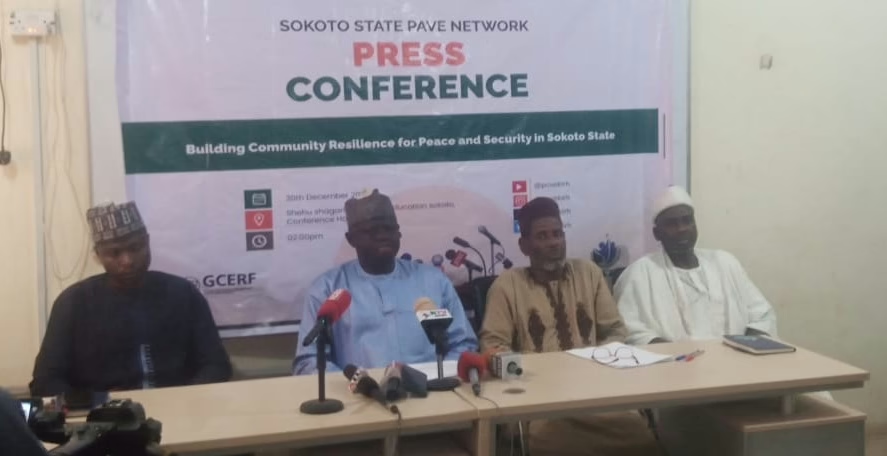
At a press conference on Tuesday at Shehu Shagari College of Education, the network outlined its expanding work on preventing and countering violent extremism (PCVE).
Speaking for the organization, Coordinator Dr. Ahmed Sarajo Mohammed emphasized that their strategy goes beyond force, addressing the root causes of insecurity through prevention, resilience, and social cohesion.
From Sokoto to Kebbi and Zamfara, he noted, insecurity thrives on poverty, weak governance, porous borders, and a thriving kidnapping economy, conditions that armed groups exploit.
These local challenges, he explained, mirror global conflict trends, underscoring the need for inclusive, non-kinetic solutions alongside conventional security operations.
The North West has seen a renewed urgency for PCVE.
In recent weeks, the PAVE Network and partners have intensified initiatives to strengthen local capacities to identify, prevent, and defuse extremist threats before they escalate.
Central to their approach is capacity building. Multi-stakeholder workshops bring together government agencies, security institutions, traditional leaders, women and youth groups, and civil society actors to develop prevention strategies rooted in local realities.
Technical Working Groups are being trained to create State and Local Action Plans that reflect lived experiences, fostering local ownership and sustainability.
Dialogue has also proven critical. Town halls and consultation forums allow community members to engage officials on drivers of radicalization, including youth unemployment, broken social contracts, and weak early-warning systems, replacing suspicion with cooperation.
Cross-state peer learning among PAVE chapters is strengthening the regional PCVE framework, allowing states to share lessons, adapt best practices, and avoid duplication.
This collaborative model aligns with international PCVE standards promoted by multilateral and development partners.
Advocacy has elevated PCVE onto political agendas, with some states activating Technical Working Groups to institutionalize prevention.
At the grassroots level, 15-day community resilience campaigns provide peace education, tolerance messaging, and conflict awareness, equipping residents to challenge extremist narratives and rebuild social bonds strained by years of violence.
Early results are promising. Multi-sector collaboration is improving, State Action Plans are taking shape, and alignment with Nigeria’s National Action Plan on PCVE is enhancing national coherence.
Communities are more aware of early-warning mechanisms, and trust between citizens and authorities is gradually returning.
Opportunities are emerging as well. Inclusion of PCVE priorities in state budgets, growing private sector interest, and increased youth participation suggest a future where prevention is embedded in governance and development planning, not merely treated as an emergency response.
Challenges remain, however. Armed groups still operate in parts of the region, youth unemployment fuels vulnerability, intelligence coordination at local levels is uneven, and funding gaps threaten to slow progress.
Stakeholders agree on a key lesson echoed nationally and internationally: military action alone cannot defeat violent extremism.
Lasting peace requires shared responsibility, citizens staying vigilant, traditional and religious leaders promoting harmony, women and youth driving inclusion, institutions budgeting for prevention, and security agencies upholding human rights.
As the North West stands at a crossroads, PCVE actors insist that peace and resilience are not the sole responsibility of government but of every citizen.
By placing people at the center of security, they believe fear can be replaced with stability, offering Nigeria, and the world, a model of hope rooted in community strength.