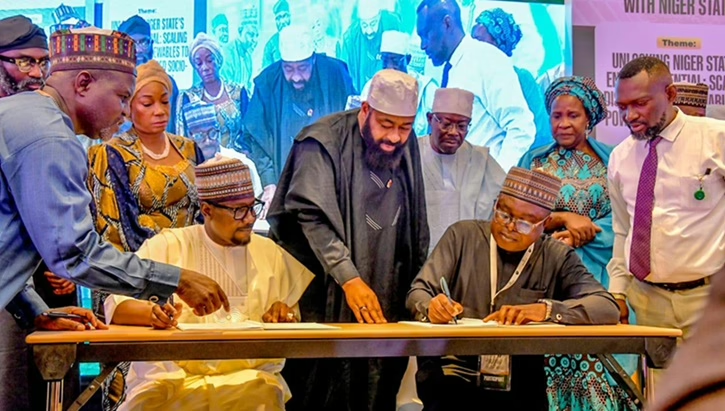
Niger State Government has signed a Memorandum of Understanding (MoU) with the Rural Electrification Agency (REA) to scale up the development and operations of sustainable, decentralised solar power solutions across rural communities in Niger State.
According to a statement signed on Friday by the Governor’s spokesperson, Bologi Ibrahim, the agreement is a long-term electrification strategic collaboration that was signed during a roundtable engagement with the Niger State government in Abuja.
Farmer Governor Mohammed Umaru Bago described the agreement as a pathway to sustainable renewable energy development, adding that the state is endowed with strong solar radiation, averaging between 5.5 and 7.0 kWh per square metre per day, significant biomass resources derived from the agricultural base, viable wind corridors, and nationally strategic hydroelectric assets.
The farmer governor said the state government has embraced renewable energy as a source of power supply, and it is gradually exiting government institutions from the national grid, and stressed the need to make the project successful and sustainable.
He reaffirmed the readiness of his administration to continue to invest in the production of renewable energy for a guaranteed power supply.
Managing Director, Rural Electrification Agency, Abba Abubakar Aliyu, said the only viable means of electrifying communities is by deploying and distributing independent renewable sources while noting that President Bola Ahmed Tinubu has approved the biggest renewable energy project in the world that will electrify 17.5 million Nigerians using 1,350 mini grids, of which 250 will be interconnected.
He disclosed that in Niger State, about 1.5 million people have been identified from 69,300 households spread across 3,564 communities that will be connected with off-grid by injecting 20 megawatts of electricity.
The Managing Director further revealed that funding has already been provided and will be used to bring in the private sector that will be in charge of building the transmission and distributing infrastructure to all benefiting communities at the state level.
Executive Director, Rural Electrification Fund, Doris Uboh, disclosed that the agency has several projects ongoing across the country, Niger State inclusive, especially the e-HEART which centres on energy, health, education, agriculture, rural communities, and transportation, and the project is expected to benefit 100 communities in each state of the federation.
Secretary to the Niger State Government, Abubakar Usman, said the state is uniquely positioned within Nigeria’s energy ecosystem and that it considers energy not just an infrastructure but as a foundation for productivity, competitiveness, and inclusive growth, which can be achieved through dependable, affordable, and decentralised power solutions.