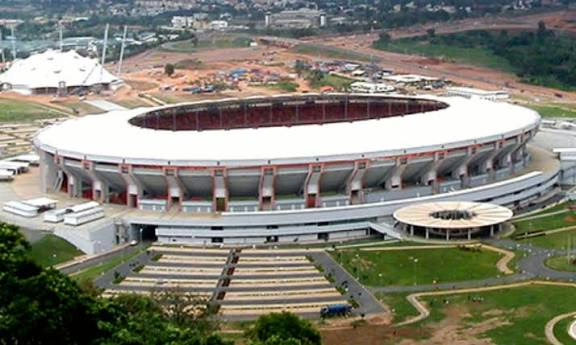
The proposed upgrade of the Moshood Abiola National Stadium in Abuja is expected to consume N24,642,000,000 from the N203,602,968,852 budget allocated to the National Sports Commission in the 2026 Appropriation Bill, according to budget documents currently before the National Assembly.
The allocation has once again drawn national attention to the long-delayed rehabilitation of Nigeria’s flagship sports facility, which has remained largely underutilised for years despite repeated promises by successive administrations to restore it to international standards.
The Moshood Abiola National Stadium, commissioned in 2003, was once envisioned as a world-class sporting complex capable of hosting major continental and global events. However, years of neglect, structural deterioration, and failed concession arrangements have left large sections of the stadium unusable, including the main bowl, athletics tracks, and auxiliary facilities.
Under the 2026 budget proposal, the N24.6 billion earmarked for the stadium upgrade represents one of the single largest capital expenditures within the National Sports Commission’s allocation. The overall N203.6 billion budget is expected to cover infrastructure rehabilitation, grassroots sports development, athlete welfare, international competitions, and administrative costs.
What the Stadium Upgrade Is Expected to Cover
While detailed breakdowns of the stadium upgrade project are yet to be fully published, officials familiar with previous renovation plans say the funds are expected to address critical structural repairs, seating refurbishment, pitch reconstruction, electrical and water systems, security installations, and modern facility upgrades required to meet international sporting standards.
There are also expectations that the renovation will include improvements to media facilities, dressing rooms, medical units, and spectator amenities, all of which are essential for hosting high-profile football matches, athletics competitions, and national events.
The stadium has hosted limited activities in recent years, mainly non-sporting events, due to safety concerns and inadequate maintenance. Sports stakeholders have repeatedly warned that without comprehensive rehabilitation, Nigeria risks losing its ability to host major international competitions.
News of the N24.6 billion allocation has triggered widespread reactions on social media, with Nigerians expressing both hope and skepticism. While some users welcomed the funding as a necessary step toward reviving sports infrastructure, others questioned whether the project would finally be completed or end up as another abandoned or poorly executed government initiative.
Several commentators pointed out that similar budgetary provisions had been made in previous years with little visible progress, raising concerns about transparency, value for money, and project monitoring.
Others argued that the focus should not only be on renovating one stadium but also on developing grassroots sports facilities across states to nurture young talent and reduce overdependence on a single national complex.
Officials within the sports sector have defended the allocation, noting that Nigeria cannot aspire to sporting excellence without adequate infrastructure. They argue that rehabilitating the Moshood Abiola National Stadium is central to repositioning the country as a viable host for international sporting events and reducing the cost of hosting national competitions in private venues.
The National Sports Commission is expected to work with relevant ministries and contractors once the 2026 budget is passed into law, with assurances that procurement processes will follow due process and project timelines will be clearly defined.
As lawmakers continue deliberations on the 2026 Appropriation Bill, attention will remain on how effectively the proposed N24.6 billion stadium upgrade is implemented, and whether it will finally restore the Moshood Abiola National Stadium to its intended status as Nigeria’s premier sports arena.
)Agency report)