Isiyaku Ahmed
The Executive Director of the Safer Media Initiative (SMI), Peter Iorter, has urged media stakeholders to urgently engage with the fast-evolving impact of Artificial Intelligence (AI) on journalism, describing the moment as “critical for the future of the profession.”
Speaking at a virtual meeting with media executives and journalists on Thursday, Iorter said rapid technological innovation is transforming global media in unprecedented ways.
While journalism’s core values remain intact, he noted that audience behaviour, content formats, distribution channels, and revenue models are shifting at high speed, a change driven largely by advances in AI.
“The theory of disruptive innovation is no longer theory; it is reality.
“Even mainstream media organizations are now compelled to rethink long-standing patterns and redefine their practices,” he said.
He warned that AI now sits at the centre of this transformation, offering both tremendous opportunities and serious ethical challenges.
“AI brings efficiency, deeper audience engagement and new revenue prospects. But it also raises questions about the integrity of news and the safety of journalists,” he said.
Iorter said the AIM (AI and Media) Project was created to help the industry navigate these complexities by grounding research in lived newsroom experiences.
He solicited participants’ insights to help validate the project’s assumptions, stressing that the Safer Media Initiative relies heavily on stakeholder-driven research.
“We do not sit in isolation.
“We listen to the people who live these realities every day,” he said.
AI and Gender: New Threats for Women in Newsrooms
In her presentation, Adaora Onyechere, Executive Director of Gender Strategy Advancement International (GSAI), warned that despite AI’s benefits, it is quietly widening gender inequality in newsrooms.
She noted that AI now influences nearly every aspect of journalism, from fact-checking to writing, translation and audience analytics, but is not neutral in its impact.
Onyechere cited a Reuters Institute study showing that AI-driven story-ranking systems often prioritise content featuring male political figures while downplaying stories about women.
She also pointed to rising cases of deepfake harassment targeting female journalists and politicians in countries such as India and Kenya.
She further warned that automation could push women out of roles they predominantly occupy, including transcription, editing support and administrative duties, citing newsroom restructuring trends in the UK and South Africa.
To address these risks, Onyechere called for gender-responsive AI integration, including gender audits of newsroom AI tools, more inclusive datasets, diverse leadership and stronger editorial guidelines for detecting synthetic content.
“We stand at a turning point.
“AI will not slow down, but we must shape it, not allow it to shape us,” she said.
Balancing Innovation and Ethics in AI-Driven Newsrooms
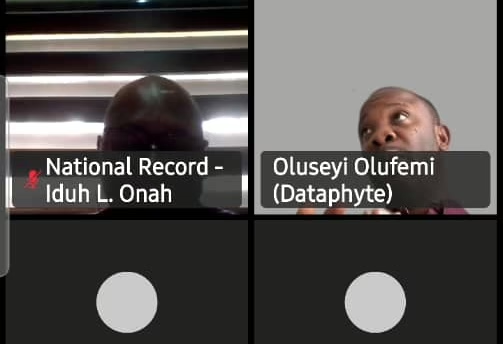
Oluseyi Olufemi, Country Director of Dataphye, spoke on AI capabilities, ethical implications and best practices for responsible integration into news production.
He said AI introduces both efficiency and vulnerability, affecting people across varying levels of literacy, from professionals to children, and must therefore be deployed with strong ethical oversight.
“The ethics of AI are as important as the economics of efficiency,” he remarked.
Olufemi emphasized the need for governance structures, accountability frameworks and proper training for journalists.
He noted that trust remains fundamental to news consumption and audiences must be assured that “a human being, not just a robot, is ultimately accountable.”
Drawing from Dataphye’s experience with its Nubia tool, Olufemi explained how AI now aids research, data mining, transcription, trend detection, and storytelling, including in multiple African languages.
However, he cautioned that excessive reliance on automation could weaken editorial judgment.
Newsrooms Face Policy Void Amid Rapid AI Adoption
Publisher of National Records, Lawrence Onah, warned that while AI has improved efficiency in Nigerian newsrooms, it has also exposed serious policy gaps.
“AI saves time, no doubt. But it demands accountability,” he said.
Onah noted that many reporters now forward AI-processed stories without fact-checking, leading to errors such as outdated or inaccurate information.
He warned that without clear policies, journalists face ethical dilemmas alone, especially around accuracy, transparency, disclosure of AI use and editorial oversight.
Onah also highlighted safety risks, including AI tools storing data on external servers that could expose sources, and deepfake content being weaponised against journalists.
He added that foreign-trained AI systems often misinterpret Nigerian contexts, threaten originality and erode audience trust.
“The danger is not AI itself, but the absence of policies guiding its use,” he stressed, calling for frameworks inspired by UNESCO and the BBC to ensure transparency, human oversight, data protection and regular training.
Next Steps: Training and a Framework for AI Governance
Participants shared their experiences using AI in their newsrooms before the meeting was rounded off by Iorter, who emphasized that the discussions would feed directly into upcoming project activities.
He announced that the AIM Project will hold training sessions in Abuja, Lagos, and Benin City, alongside two virtual trainings for journalists who cannot attend in person.
Iorter said the team will also develop a practical AI-use framework for newsrooms, particularly smaller organizations lacking internal guidelines.
“Only a few newsrooms currently have such policies.
“We will develop a framework that can guide them and ensure these concerns are addressed,” he said.
He reaffirmed the project’s commitment to promoting safe, ethical, and responsible AI adoption in Nigerian journalism.
In her closing remark, Anita Haruna, the Programs Strategic Support Officer at SMI, on behalf of the Executive Director and the entire team at SMI extend heartfelt appreciation to participants for their time and contributions.
She said as the virtual meeting conversation on AI integration in Nigerian newsrooms concluded, it is clear that journalists are navigating both exciting opportunities and significant challenges.
“Together, we have explored how AI tools are being applied, the ethical considerations they raise, the rights at stake, and the urgent need for policies to ensure their responsible use and the safety of journalists.
“The insights shared today will inform the ongoing activities of the AIM project, strengthening newsroom practices and advancing ethical AI integration.
“We are deeply grateful to our lead discussants for their perspectives and to each of you for your active engagement,” she added.
Haruna acknowledged with sincere gratitude the support of SMI donor partners, UNESCO and the IPDC.