Stephen Enoch
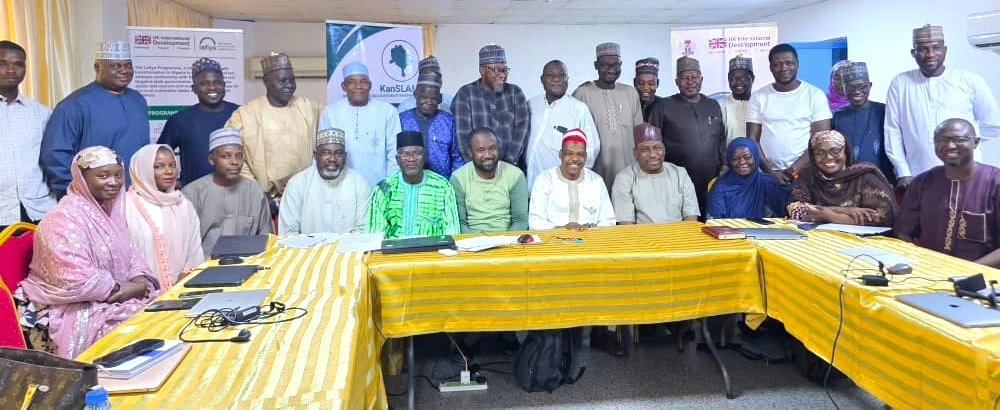
The Kano State Accountability Led Mechanism (KanSLAM), in partnership with the UK-FCDO Lafiya Program, has renewed calls for improved planning, timely releases, and effective utilization of Child Birth Spacing (CBS) funds.
This was carried out in a three-day Citizens-Led CBS Financing Advocacy Message Development workshop in Kaduna.
The activity which took place at The Pyramid Hotel held Saturday to Monday.
Speaking at the workshop, the Kano State Commissioner for Health said budgetary allocation alone does not translate to impact without proper planning and coordination.
“You can have billions of naira captured in the health budget, but if planning is weak and releases are delayed, nothing meaningful will happen,” he said.
He added that many activities fail not because of lack of funds but because ministries and agencies do not align their plans with realistic timelines and measurable outcomes.
The Commissioner stressed the importance of accountability and evidence-based reporting, especially as donor funding continues to decline.
“If we want government to continue funding family planning and other health interventions, we must be able to show results,” he said.
He expressed concern over persistently high neonatal mortality in Kano, noting that while progress has been recorded in some indicators, neonatal deaths remain troubling.
“We are working towards establishing a 100-bed neonatal centre with support facilitated by the National Health Authority of Egypt, because our major hospitals currently lack adequate neonatal capacity,” he disclosed.
He described KanSLAM as “the eyes of government in the communities,” adding that citizen oversight strengthens service delivery.
In her remarks, KanSLAM CSO Co-chair, Pharm. Maimuna Yakubu, described the platform’s growth as a major milestone in civic engagement within Kano’s health sector.
“KanSLAM has grown into a credible voice that government and the legislature now recognize,” she said.
She recalled the platform’s recent participation in a public hearing at the Kano State House of Assembly, where its advocacy efforts were formally acknowledged.
She said KanSLAM remains committed to pushing for improved CBS financing.
“Our focus is not just on allocations but on releases and utilization.
“By the end of 2026, we want to see clear improvements in funding commitments CBS in Kano State, and more importantly, evidence that the funds are reaching the people who need them,” she added.
Speaking on behalf of the UK-FCDO Lafiya Programme, State Team Lead Abdulkadir Kabara reaffirmed the programme’s support for CBS.
“Citizen-led accountability is at the heart of our work, and that is why we are supporting this process,” he said.
According to him, Lafiya wants to see advocacy messages that are strong enough to influence policy decisions and budget outcomes.
While acknowledging some progress, Kabara stressed that success should be measured by actual funding released.
“The real issue is not just what is written in the budget but what is eventually released and utilized,” he said.
He urged KanSLAM members to adopt innovative advocacy approaches and closely track CBS financing, including performance under the Basic Healthcare Provision Fund.
Salisu Umar one of the consultants engaged by Lafiya emphasized the role of communication in driving effective advocacy.
According to him, effective communication is the best way to ensure a good advocacy that can bring about desired result and ultimately required change.
He explained that advocacy messages must be simple, precise, and audience-specific.
“When messages are not communicated in a language people understand, advocacy fails,” he added.
He expressed hope that the workshop would produce a comprehensive and practical advocacy message pack.
Also speaking, Dr. Ashiru Mohammed, a consultant, said the workshop focused on linking CBS financing to sustainable development outcomes.
“Rapid population growth without corresponding investment will continue to strain our limited resources,” he said.
He explained that participants were equipped with evidence-based tools, advocacy packs, and tracking mechanisms.
“Modern advocacy must be driven by data and measurable outcomes if we want real impact,” he stressed.
In his remarks, the Kano State Coordinator of the National Population Commission (NPC), Balarabe Kabir, described child birth spacing as central to effective population management.
“Birth spacing is critical to planning, service delivery, and sustainable development,” he stated.
He warned that without proper population management, competition for limited resources would intensify.
“We must use population data to guide policies that improve the quality of life for families,” he added.