Isiyaku Ahmed
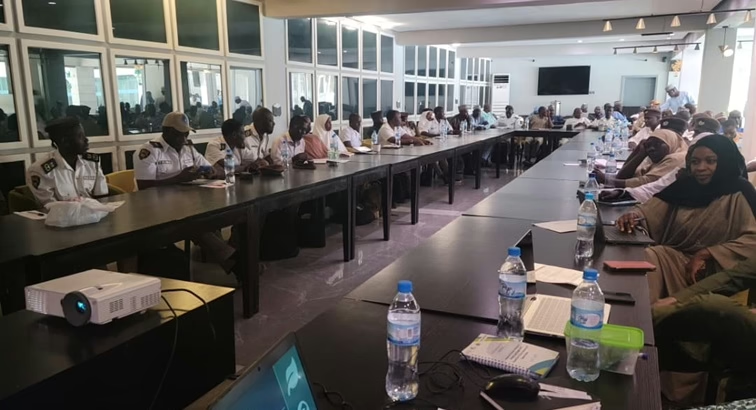
The Kano State Ministry for Local Government on Wednesday commenced a 2-day capacity-building training on climate change for 120 participants, including DPRSs and Climate Change Desk Officers across 44 local government areas, with a call for proactive engagement in tackling environmental challenges at the grassroots.
The capacity-building workshop aimed to improve participants’ awareness and understanding of climate change and related actions, clarifying the roles of key stakeholders in tackling the challenge, and equipping attendees with knowledge of existing coordination mechanisms for integrated climate action in Kano State.
The session was held with technical assistance from the Partnership for Agile Governance and Climate Engagement (PACE), a UK International Development-funded program in Kano, the Ministry of Environment & Climate Change (MoECC), the Ministry of Planning & Budget (MoPB), and the Kano Investment Promotion Agency (KanInvest).
Stallion Times reports that the Kano State Climate Change Policy Implementation Action Plan represents a groundbreaking initiative that translates comprehensive climate policies into actionable, measurable interventions.
In his opening remarks, the Commissioner for Local Government, Hon. Tajudeen Othman Zaura, represented by the Director of Administration and General Services (DAGS), described the participants as critical links between government policies and local communities.
He noted that the training was designed to equip the officers with the knowledge and tools needed to address the growing impact of climate change at the local level.
“You are here because you are the bridge between policy and the people. The real work of climate change happens in our neighborhoods, farms, and local infrastructure,” he said.
The director stressed that climate change is no longer a distant or abstract concept, but a reality already affecting communities through shifting seasons, erratic rainfall patterns, and increasing pressure on natural resources.
“As local government representatives, you are the first responders to these challenges. Your role is vital in mitigating the effects and building resilience within your communities,” he added.
Watch the video below
He urged participants to actively engage in the training sessions by sharing experiences and challenges from their respective areas, noting that such collaboration would help in developing practical and sustainable solutions.
The ministry expressed optimism that the training would serve as a foundation for strengthening climate action at the grassroots and fostering a more resilient and sustainable future for communities across Kano State.
Speaking during a capacity-building session for local government climate change desk officers, a Partnership for Agile and Climate Engagement (PACE) facilitator, Habiba Isyaku Njidda, said the PACE program, a governance initiative with a 30 per cent focus on climate governance, builds on over 25 years of governance interventions across the country.
She outlined progress in strengthening climate governance in Kano State, describing it as one of the program’s key focal areas in Nigeria.
She noted that since the program’s inception in 2024 and full implementation in 2025, Kano State has recorded significant improvements in institutional frameworks for climate governance.
According to her, these efforts include the development of climate change policies, integration of climate action into budgeting processes, and the incorporation of climate considerations into local government development plans.
Njidda also highlighted the appointment of climate change desk officers across the 44 local government areas, stressing that their role is crucial given that the impacts of climate change are most felt at the grassroots.
“Because most of the impact of climate change is felt at the grassroots, your role is critical in addressing these challenges within your communities,” she said.
She explained that the two-day training aims to strengthen the capacity of participants and equip them with the necessary skills to tackle climate-related issues effectively.
The facilitator added that participants would engage with technical officials from various Ministries, Departments, and Agencies (MDAs), including the Ministry of Environment and Climate Change, to gain insights into ongoing state-level interventions.
She further disclosed that representatives from the Kano Investment Promotion Agency would provide guidance on leveraging public-private partnerships and investment opportunities to support climate action at the grassroots.
In addition, the Ministry of Planning and Budget is expected to brief participants on climate-related planning and budgeting processes at both state and local government levels, including mechanisms for tracking implementation and impact.
Njidda commended participants who volunteered as rapporteurs, noting that their reports would play a vital role in informing the Ministry for Local Government on the outcomes of the engagement and shaping future interventions.
She reiterated PACE’s commitment to strengthening local capacity and expanding the benefits of its interventions to communities across Kano State and beyond.
Hussaini Gambo, Deputy Director of Water, Environmental Sanitation and Hygiene at the Kano State Ministry for Local Government and Chieftaincy Affairs, said the workshop was designed to strengthen the capacity of climate change desk officers and enhance their effectiveness in addressing environmental challenges at the grassroots.
He noted that the training would equip participants with practical knowledge and tools to better mitigate the impacts of climate change within their respective local government areas, particularly in critical sectors such as water management, sanitation, and hygiene.
Gambo emphasized that building the competence of desk officers is key to translating government policies into tangible actions that improve community resilience.
“For me, the workshop has significantly enhanced my understanding of climate change issues, especially within the context of Kano State,” he said, adding that the knowledge gained would improve his approach to planning and implementing environmental interventions at the local level.
Umma Salisu Musa, WASH Focal Person at the Kano State Ministry for Local Government and Chieftaincy Affairs, said the workshop improved her understanding of climate change and its impact on water, sanitation, and hygiene, adding that it will help her implement more effective interventions at the local level.
According to her, the knowledge gained will enhance her ability to design and implement more effective, climate-responsive WASH interventions across local government areas.