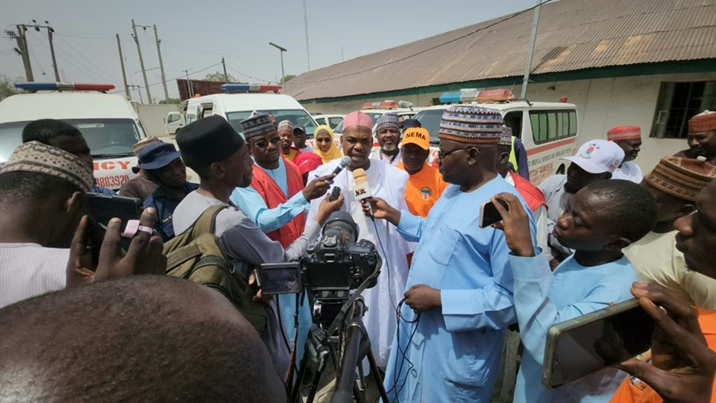
On Tuesday, Kano State rolled out the State Emergency Medical Services and Ambulance System (KN-SEMSAS) as part of efforts to strengthen emergency response and improve access to timely healthcare across the state.
Speaking at the ceremony, the Commissioner for Health, Dr. Abubakar Labaran Yusuf, commended the governor for procuring 20 ambulances for the program, describing the initiative as a strategic step to align the state with ongoing national emergency health interventions. He noted that a formal inauguration of the scheme would be held at a later date.
Dr. Yusuf said the ambulances would play a critical role in transporting pregnant women to hospitals during labour, thereby reducing maternal and infant mortality.
He added that any patient conveyed to a hospital through the scheme would have their transportation costs covered by the government.
He also called on members of the Guild of Medical Directors to support the initiative by procuring additional ambulances to complement government efforts.
According to the commissioner, the vehicles are expected to respond to distress calls within the shortest possible time, ensuring prompt medical attention for residents in need.
Dr. Yusuf further stated that KN-SEMSAS would provide free, coordinated pre-hospital and emergency care services statewide.
He described the establishment of the system as a major milestone in strengthening emergency medical response, reducing preventable deaths, and improving access to life-saving care for the people of Kano State.
Goodwill messages were presented by representatives of various stakeholders, including the Lafiya Project, the Kano State Accountability Mechanism (KanSLAM), and the Kano State Fire Service, among others.
The event was attended by the Director-General of the Drugs and Medical Consumables Agency, Pharmacist Ghali Sule; the Executive Secretary of the Kano State Contributory Healthcare Management Agency (KASCHMA), Dr. Rahila Aliyu Mukhtar; and the Director-General of the Kano State Centre for Disease Control (KNCDC), Prof. Mahmoud Adamu Abbas.
Credit: Nasiru Yusuf Ibrahim