Isiyaku Ahmed
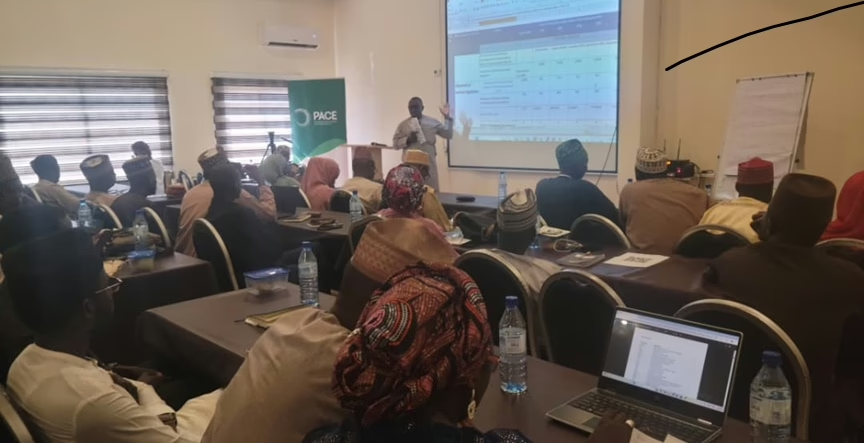
On Wednesday, the Kano State Ministry of Environment and Climate Change, with support from the Partnership for Agile Governance and Climate Engagement (PACE), began a three-day Climate Change Policy Monitoring and Evaluation Results Framework Workshop aimed at strengthening the implementation and accountability of climate action in the state.
The workshop was designed to enhance participants’ understanding of the linkages between the Kano State Climate Change Policy and the National Climate Policy Framework, while also providing a platform to review and update sector-specific monitoring and evaluation (M&E) performance indicators within the state’s climate results framework.
In his welcome remarks, the Kano State Team Lead of PACE-FCDO, Mallam Auwal Hamza, commended the Kano State Government for its consistency in the inclusive climate policy process, from policy design, the action plan, implementation framework, and the current M&E results phase, and the proposed Kano State Climate Change Bill.
He described the continuity as a clear demonstration of the state’s commitment to effective climate governance and sustainable development.
Mallam Hamza also praised the establishment of a dedicated Climate Change Secretariat, noting that the institutional structure would enhance coordination across sectors, strengthen accountability, and ensure that climate policies translate into measurable and tangible outcomes.
He reaffirmed PACE’s commitment to supporting Kano State as it strengthens its systems, aligns with national frameworks, and delivers meaningful climate outcomes for its people.
The Commissioner for Environment and Climate Change, Dr. Hashim, represented by the Director of Climate Change, Umar Saleh Anka, said the workshop was convened at a critical stage in Kano State’s climate response journey.
He explained that a major objective of the engagement was to deepen participants’ understanding of the alignment between the state’s climate change policy and the national climate framework, which he said was essential for policy coherence, efficiency, and access to national and international climate support mechanisms.
According to Dr. Hashim, the workshop also focused on reviewing and updating sector-specific climate change M&E performance indicators, describing robust monitoring and evaluation systems as vital tools for tracking progress, measuring impact, and supporting evidence-based decision-making.
He noted that refining the indicators would help identify gaps, assess what is working, and improve accountability across sectors.
Dr. Hashim further stressed that the participation of heads of ministries, departments, and agencies (MDAs) should reflect the collective commitment of the Kano State Government to strengthening climate governance and ensuring that climate policies are not only designed but also effectively implemented, monitored, and evaluated.
He urged participants to actively engage in the discussions, share experiences from their respective agencies, and contribute technical inputs towards developing a practical and responsive results framework aligned with the state’s development priorities.
Speaking to Stallion Times on the technical aspect of the workshop, the consultant, Mr. Sunny Kulutuye of The Policy Practice, explained that the exercise followed the approval of the Kano State Climate Change Policy and marked a shift towards effective implementation.
He said the results framework being developed would contain clear indicators for tracking and assessing the performance of the policy.
Mr. Kulutuye noted that once validated, the framework would serve as a critical tool for government, the private sector, and civil society organizations to measure progress, monitor commitments, and ensure that intended results are achieved under the state’s climate change policy.
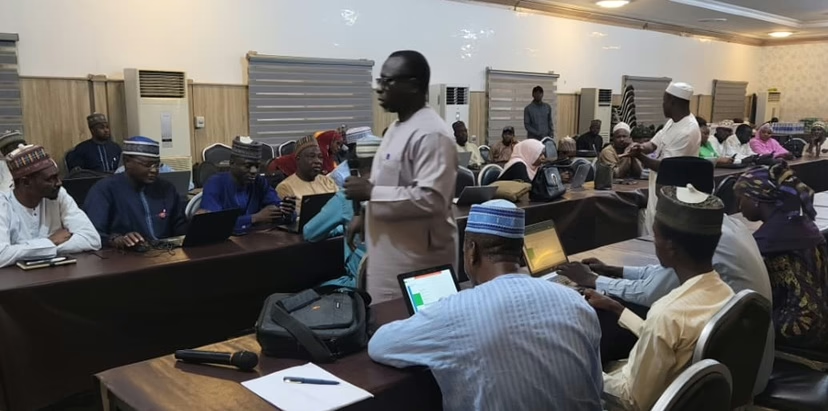
MDA leaders at the workshop broke into groups and worked on developing sector-specific results frameworks for their ministries, aligning them with the national climate change policy.
On his part, the Managing Director of Northwest Development Commission (NWDC), Prof. Shehu Abdullahi Ma’aji, commended the Director of Climate Change, Anka, PACE-FCDO, and the consultants, for convening what he described as a timely and important event.
Prof. Ma’aji stressed that a clean and safe environment is fundamental to all aspects of human activity and development.
According to him, every form of work and productivity takes place within the environment, making environmental safety a critical requirement for effective governance and sustainable development.
He noted that his commitment to the climate change workshop was the reason he made special efforts to attend, despite being unable to participate in the opening ceremony.
Prof. Ma’aji explained that his absence on the first day was due to an official engagement at the National Assembly, where he appeared to give an account of the commission’s activities.
“Immediately after that engagement, I instructed the Chief of Staff to ensure I took the first available flight so I could be here this morning,” he said, adding that he planned to remain engaged with the workshop for its duration, including the following day, if proceedings continued productively.
The NWDC Boss further revealed his strong interest in participating directly in the technical sessions, particularly the validation working groups.
He said he has been actively involved in validation exercises for several organizations, noting that only recently he participated in the validation of the National Anti-Terrorism Policy using a non-kinetic approach.
Prof. Maaji expressed confidence that the outcomes of the workshop would contribute meaningfully to strengthening environmental governance and policy implementation.
The PACE is a Foreign, Commonwealth and Development Office (FCDO) funded program that supports accountable and inclusive institutions to respond to Nigeria’s governance and climate change challenges.