
Isiyaku Ahmed
A two-day climate change workshop has called for urgent reforms in coordination, planning, and financing mechanisms to strengthen climate action across Local Government Councils (LGCs) in Kano State.
The capacity-building workshop, which had 120 participants, including DPRSs and Climate Change Desk Officers across 44 local government areas, was aimed at improving participants’ awareness and understanding of climate change and related actions, clarifying the roles of key stakeholders in tackling the challenge, and equipping attendees with knowledge of existing coordination mechanisms for integrated climate action in Kano State.
Stallion Times reports that the session was held with technical assistance from the Partnership for Agile Governance and Climate Engagement (PACE), a UK International Development-funded program in Kano, the Ministry of Environment & Climate Change (MoECC), the Ministry of Planning & Budget (MoPB), and the Kano Investment Promotion Agency (KanInvest).
A communiqué, issued by the drafting committee at the end of the session on Thursday, 26 March 2026, and made available to Stallion Times on Sunday, highlighted critical gaps in governance, funding, and institutional capacity, while outlining actionable steps to enhance climate resilience at the grassroots level.
On the first day, participants were introduced to the fundamentals of climate change, including its causes, impacts, and the need for immediate and coordinated action.
Discussions focused on mitigation, adaptation, and resilience strategies, particularly at the local government level.
A review of the current climate coordination landscape revealed overlaps in institutional roles, weak communication channels, and unclear mandates among Ministries, Departments, and Agencies (MDAs) and local councils.
Participants also stressed the importance of integrating climate priorities into Local Government Development Plans. This includes aligning initiatives with state and national policies while promoting climate-smart and community-driven approaches.
Sessions further examined implementation frameworks, emphasizing the need for clearly defined roles, effective monitoring systems, and stronger institutional collaboration.
However, concerns were raised over limited budgetary allocations for climate-related activities and the inadequate integration of climate considerations into local government budgets.
The second day centered on financing, reporting, and governance.
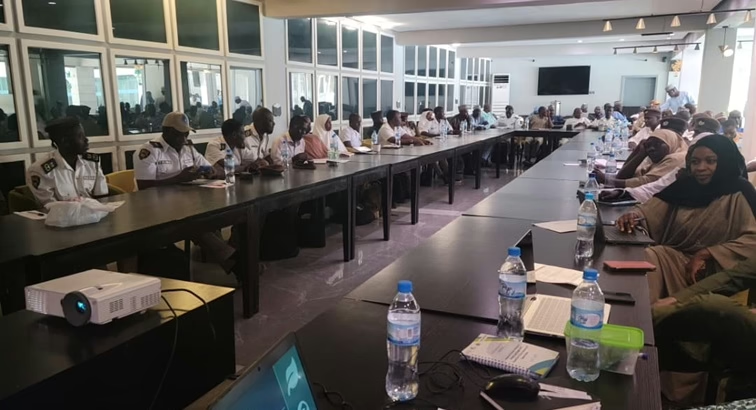
The Participants were introduced to climate budget tagging as a tool to track expenditures, improve transparency, and enhance accountability.
The rationale for climate tagging, including better resource allocation and increased access to climate finance, was discussed extensively.
Stakeholders also underscored the need for improved alignment between state and local government budgets to ensure cohesive implementation.
In addition, the capacity building workshop highlighted the importance of accountability and performance reporting, calling for transparent systems that support evidence-based decision-making.
An interim reporting framework and a structured local government reporting template were proposed.
Discussions on governance emphasized the role of Public-Private Partnerships (PPPs) in driving green growth.
Participants advocated for clear policy frameworks, multi-sectoral investment planning, and the identification of climate-resilient projects.
The communiqué identified several challenges, including weak coordination mechanisms, limited integration of climate priorities, inadequate data systems, and low technical capacity.
To address these issues, participants recommended strengthening coordination frameworks, embedding climate considerations into development plans and budgets, and institutionalizing climate budget tagging.
Other recommendations included adopting standardized reporting templates, building technical capacity, enhancing accountability systems, and promoting PPPs.
The communiqué also called for better alignment with existing policies, provision of computers and office facilities for Climate Change Desk Officers, and the re-adaptation and re-issuance of schedules of duties for key local government officials.
It concluded that improved coordination, effective planning, and strengthened governance structures are essential to advancing climate action across Kano State’s local governments.
The communique that sustained collaboration and institutional reforms would be critical in achieving long-term climate resilience and sustainable development.