Olu Allen
There is a growing perception among many Nigerians who still follow elections closely: the ballot box is no longer the sole determinant of who governs. Increasingly, the courts play a decisive role.
The script has become familiar. Votes are cast, results are announced, and then attention shifts to the courtroom.
What follows is often a prolonged legal contest where procedural arguments, technical interpretations, and judicial discretion take center stage.
By the time final rulings are delivered, many citizens feel far removed from the outcome.
This concern is not isolated. Legal scholars and public commentators, including Sam Amadi and Chidi Odinkalu, have in recent times raised questions about judicial independence and the broader health of Nigeria’s legal system.
Their observations reflect a wider national conversation, one that deserves careful attention.
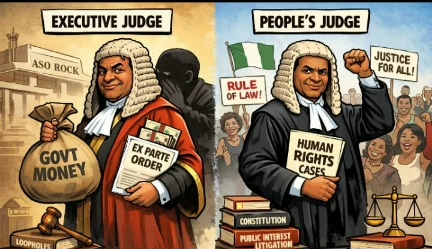
Two competing approaches within the system
What we are witnessing is not necessarily a formal divide, but a tension between two broad tendencies within Nigeria’s legal and judicial space.
The first tendency: Institutional alignment with power
One perspective, often highlighted by critics, points to a pattern where legal processes appear to align with prevailing political power.
This is not about a formal group or coordinated conspiracy, but about what some observers describe as a systemic tendency shaped by incentives, career advancement, institutional pressures, and the realities of political influence.
In this view, legal procedures can sometimes be deployed in ways that significantly affect political outcomes.
Emergency applications, jurisdictional strategies, and interim orders, though legitimate legal tools, have, in certain high-profile cases, generated public debate about their timing and impact.
The events surrounding the tenure of Ayo Salami in 2011 remain a reference point in discussions about judicial independence.
Interpretations of those events differ, but they continue to shape how many Nigerians understand the risks faced by judicial officers in politically sensitive matters.
Critics argue that election litigation, in particular, sometimes reflects disparities in access to legal resources and influence.
This perception, whether fully accurate or not, has contributed to a growing sense of distrust in the system.
The result is a difficult question: when legal outcomes consistently override electoral expectations, how do citizens sustain confidence in democratic institutions?
The second tendency: Law as a tool for accountability
On the other side is a long-standing tradition of public interest lawyering, driven by human rights advocates, civil society organisations, and reform-minded legal practitioners.
Prominent voices such as Femi Falana have, over the years, used the courts to challenge unlawful detentions, demand transparency, and push for accountability within government institutions.
This approach relies on litigation, advocacy, and public engagement. It has produced important victories, particularly in advancing civil liberties and reinforcing the rule of law.
However, practitioners in this space often face structural challenges, delays in the judicial process, high litigation costs, and procedural complexities that can limit the speed and scale of impact.
The result is an imbalance: while reform efforts persist, they often struggle against systemic constraints that are slow to change.
Beyond the divide: .Making the law work for the people
If meaningful reform is to happen, it may not come solely from within government institutions.
It may require more consistent civic engagement using the legal tools already available.
Here are practical pathways that can strengthen accountability while remaining firmly within the bounds of the law:
- Engage judicial transparency processes
Recent steps by the National Judicial Council (NJC) to allow public input in judicial appointments provide an opportunity for constructive civic participation.
Citizens, professional bodies, and civil society groups can submit documented observations, positive or critical, about nominees. Over time, this can contribute to a more transparent and merit-based process. - Use established complaint mechanisms
The NJC maintains procedures for addressing complaints against judicial officers. Where concerns arise, individuals and organisations can submit well-documented petitions citing specific provisions of judicial conduct and relevant laws.
Consistency and documentation, not volume alone, are key to making such efforts effective. - Promote public legal awareness
A major gap in accountability is information. Many citizens are unaware of how judicial decisions are made or who is responsible for them.
Breaking down complex rulings into clear, accessible language, across English and local languages, can help bridge this gap and encourage informed public discourse.
- Strengthen community-level engagement
Organised civic groups, market associations, professional bodies, youth organisations, can play a role in observing and understanding legal processes within their jurisdictions.
Constructive engagement, including court observation and lawful advocacy, helps build a culture where institutions are not distant, but accountable to the people they serve. - Highlight delays and procedural challenges
Delays in the justice system are a widely acknowledged issue. Drawing attention to prolonged cases through lawful advocacy and public discussion can contribute to pressure for administrative improvements.
The way forward is consistent engagement
The conversation about judicial independence in Nigeria is ongoing, complex, and necessary.
It is not about discrediting institutions, but about strengthening them. It is not about assigning blanket blame, but about examining systems, incentives, and outcomes.
The judiciary remains a critical pillar of democracy. Its credibility depends not only on its rulings, but also on public confidence in its processes.
As Nigeria approaches future election cycles, the role of the courts will remain central.
Whether that role strengthens or weakens democratic trust depends on continuous engagement, from legal professionals, civil society, and citizens alike.
Note: This article reflects a synthesis of public commentary, legal debates, and widely expressed civic concerns about judicial processes and institutional accountability in Nigeria.
It does not assert misconduct by any individual but seeks to contribute to ongoing discussions on governance and reform.
Allen writes on public affairs and promotes good governance.