Isiyaku Ahmed
The Chairperson of the International Federation of Women Lawyers (FIDA), Kano State branch, Salma Dan Pappah, on Monday called on the Kano State Government to urgently facilitate the passage of the reviewed and harmonized Penal Code Law and establish a government-funded shelter for survivors of gender-based violence (GBV) in the state.
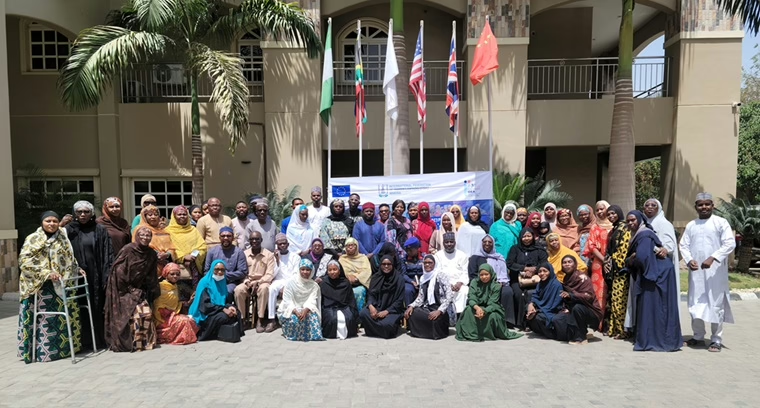
Dan Pappah made the call while delivering her keynote address at a one-day town hall meeting at BON Hotel, organized by FIDA Kano Branch, with support from the Rule of Law and Anti-corruption Program (EU/RoLAC II), with the theme ‘Strengthening GBV Protection Mechanism and Access to Justice,’ to commemorate International Women’s Day 2026 celebration in Kano.
The FIDA Kano Boss also highlighted the need for stronger legal frameworks, improved protection mechanisms, and greater representation of women in leadership positions.
She expressed appreciation to partners and stakeholders for their continued support toward advancing justice and protecting the rights of women and vulnerable groups.
According to her, the gathering was not only part of a global effort to celebrate women but also an opportunity to recognize the strength, leadership, resilience, and supportive roles women play in families and communities.
“Women remain central to the development of society. From a young age, many girls grow up caring for their siblings and supporting those around them.
“As mothers, sisters, and daughters, women continue to promote prosperity and progress not only for themselves but for the wider society,” she said.
Dan Pappah also reflected on the organization’s longstanding advocacy, noting that FIDA has spent over 32 years championing the rights of women and vulnerable persons and will soon celebrate its 33rd anniversary of service and advocacy.
She commended partners and institutions, including the National Human Rights Commission (NHRC), for their collaboration in promoting justice and safeguarding the rights of vulnerable groups.
However, the FIDA chairperson expressed concern over rising insecurity, violence, and crime, which she said disproportionately affect women and other vulnerable members of society.
“Women are often categorized as vulnerable, not because they are weak, but because they are meant to be protected.
“The question we must ask today is whether our institutions, communities, and families are doing enough to ensure the safety and dignity of women,” she said.
Dan Pappah emphasized that despite growing challenges, women continue to demonstrate remarkable resilience, overcoming hardship while still contributing positively to society.
She therefore urged the Kano State Government to facilitate the speedy passage of the reviewed Penal Code Law, originally enacted in 1963.
According to her, the law has undergone more than a decade of review and harmonization in Kano State in collaboration with partners to address emerging issues such as gender-based violence and sexual offences in line with the provisions of the 1999 Constitution.
The FIDA chairperson also called for the full implementation of key legal frameworks in the state, including the Child Protection Law (2020), Child Care Law (2020), and the Administration of Criminal Justice Law (2019).
She noted that effective enforcement of these laws is essential for securing justice and ensuring the successful prosecution of offenders.
While acknowledging the Kano State Government’s efforts to promote women’s inclusion in governance through appointments into key positions such as the Chief Judge and Accountant General, Dan Pappah said more progress is needed to meet affirmative action targets.
She urged the government to meet and exceed the recommended 30 percent representation of women in leadership by working toward at least 40 percent inclusion.
According to her, this should include increasing the number of women in the State House of Assembly, appointing five to seven female commissioners or executive secretaries, and expanding women’s leadership opportunities across government institutions.
Dan Pappah further stressed the urgent need for the establishment of a state-funded shelter for survivors of gender-based violence.
She explained that such a facility is necessary to support effective rescue, rehabilitation, reformation, and reintegration of survivors.
“Without proper shelter facilities, it becomes extremely difficult to rehabilitate survivors or reintegrate them into society,” she said.
The proposed shelter, she added, should include adequate accommodation, a vocational skills acquisition centre, a Child Protection Information Management System unit, and access to specialized medical professionals.
Dan Pappah noted that many survivors of abuse suffer long-term physical and psychological trauma due to the lack of professional support services.
Providing such facilities, she said, would ensure survivors receive the care, protection, and empowerment they need to rebuild their lives.
She reaffirmed FIDA’s commitment to working with the government, civil society organizations, and other stakeholders to promote justice, dignity, and protection for women and vulnerable groups.
According to her, through collective action, a safer and more just society can be built for all citizens.
Delivering his goodwill message, Kano State Project Coordinator of RoLAC II Program, Ibrahim Bello, urged society to invest more in women, noting that empowering them benefits families and the wider community.
He said the theme “Give to Gain” highlights the need for society to provide opportunities that enable women to thrive.
He stressed that educating and economically empowering women contributes to social development and called for greater representation of women in leadership and legislative institutions to improve governance and justice.
The state RoLAC II Coordinator expressed optimism that increased participation of women in decision-making would strengthen leadership and promote the dignity and welfare of women in society.
In their separate remarks, key stakeholders including Abba Bello of the Sexual Assault Referral Centre (SARC), Kano; Abdullahi Shehu of the National Human Rights Commission (NHRC); Superintendent of Corps (SC) Habiba Haruna of the Nigeria Security and Civil Defence Corps (NSCDC); a past Chairperson of FIDA; Hajiya Rabi Shehu of the Ministry of Justice (MoJ); Reverend Adeyemi Adeolu Samuel; and the former Chairman of the Association of Magistrates, Kano Branch, Aminu Usman, commended FIDA for organizing what they described as an impactful town hall meeting.
They noted that the initiative represents a critical step toward strengthening community awareness and promoting collective action against gender-based violence (GBV), while also improving access to justice for vulnerable groups.
They further emphasized the indispensable role women play in the growth and stability of society, describing them as the backbone of families, communities, and national development.
Conclusively, they called for increased support, protection, and empowerment of women, stressing that sustainable development cannot be achieved without recognizing, protecting, and harnessing the contributions of women in all spheres of society.