Olu Allen
When does “politics as usual” become the quiet death of a democracy? Something is hardening in Nigeria’s political space, and it looks less like politics and more like a slow, calculated seizure of the machinery of state itself.
Look at the systematic pattern.
First, cripple the opposition. The Labour Party in 2023 represented disruptive hope. Then came the engineered chaos: factions, court cases, recognition games.
INEC grew hesitant, selective. And when Peter Obi stepped back, the crisis magically cooled. The lesson was clear: disruption that challenges the centre will be managed into oblivion.
Then, subdue independent power centres. The Kano emirate tussle was never just cultural. It was a constitutional showdown.
The most chilling sight was state institutions, especially the police, appearing to protect illegality. The moment Governor Abba decamped, the grapevine shifted.
A coincidence? Or a demonstration of how resistance becomes too costly?
Finally, make governance personal and peace transactional. Rivers has always been turbulent. But now, its crisis carries a deeper message: stability is conditional, protection is political.
Be “inside,” and the state is gentle. Be “outside,” and its machinery weighs you down.
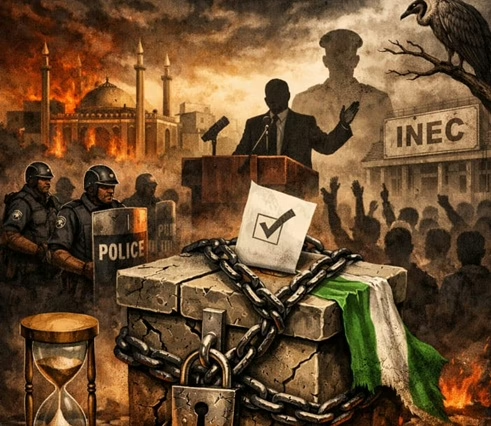
This is the modern blueprint for authoritarianism. It doesn’t arrive with tanks, but with capture.
Democracy dies when the police protect power, not the people.
It dies when INEC recognizes convenience, not votes.
It dies when defection is not ideological, but existential, the price of political survival.
It dies when elections still happen, but their outcomes feel pre-ordained.
We must therefore ask the question we are avoiding: If this is the machinery at work in Kano, in the LP, in Rivers, can it be trusted in 2027? Can a system that rewards defection, punishes resistance, and weaponizes partisanship conduct a credible election?
When El-Rufai warns of a “Paul Biya” future, is it bitterness, or an insider’s view of the engine room, where levers are being permanently welded into place?
Nigeria is drifting into a dangerous phase: a democracy with shrinking space, a neutered opposition, and institutions loyal first to a party, not the republic.
We are not yet a dictatorship. But we are ceasing to be a functioning democracy. The 2027 election will not be its test, it will be its symptom.
So the heavy, urgent question is no longer about who will win.
It is this: Is our democracy still safe?
Allen writes from Kano on public affairs and the promotion of good governance.