The Gender Mobile Initiative (GMI) has unveiled Campus Pal 2.0, an upgraded version of its mobile application designed as a safe reporting tool for sexual harassment and violence in Nigerian tertiary institutions.
Alongside the launch, the organisation premiered a short film titled “The Moment We Stand”, which explores how culture, power, and context shape students’ experiences of sexual harassment.
The campus Pal App was launched and presented by Abubakar Abdullahi, GMI’s communications officer alongside Timothy Avell, the Chief Technology Officer (CampusPal).
According to Abubakar Abdullahi, the CampusPal V2 is upgraded using insights from students, administrators, and safeguarding focal points across multiple institutions, and it represents a refined architecture that responds better to the lived experiences and institutional realities while protecting the identity of survivors who would rather be anonymous.
Speaking at the event in Abuja on Monday, Omowumi Ogunrotimi, the Executive Lead of GMI, emphasised that the initiative was part of activities commemorating the global 16 Days of Activism Against Gender-Based Violence.
“We are here today to premiere a movie titled ‘The Moment We Stand,’ which explores the intersection between culture, power, and context, and how this shapes the experiences of students when it has to do with experiences of sexual harassment. And we are also having a public presentation of the Campus Pal app, which is a reporting tool for sexual violence at our campuses.”
Highlighting the scale of the problem, Ogunrotimi revealed that sexual harassment remains widespread in Nigerian higher institutions.
“It might interest you to know that sexual harassment is epidemic and endemic in learning environments, with 70 percent of female undergraduate students experiencing sexual harassment. This scale of the problem has been largely attributed to a lack of reporting and accountability mechanisms and a lack of policy,” she said.
The Campus Pal 2.0 app is designed to close this gap by providing students with a safe platform to report cases and demand institutional accountability.
While stressing the broader impact of sexual violence on education and national development, Ogunrotimi revealed that GMI is already working with over 350 higher institutions across Nigeria, many of which have integrated the tool into their safety frameworks.
“These institutions have mainstreamed this tool into their framework as a core safety infrastructure, because we believe learning environments are supposed to be spaces where you nurture and shape young minds, and so when people’s education is tainted with experiences of sexual violence, it will definitely impact their learning and educational outcome.”
“Women are mostly affected, and when they have to drop out of school because of experiences of sexual harassment or violence, it extinguishes their economic potential as a major contributor to economic development of the nation,” she emphasised
Speaking at the event, Bisi Adeleye-Fayemi, co-founder of the Amandla Institute for Policy and Leadership Advancement and the former first lady of Ekiti State, also condemned the persistence of sexual harassment on Nigerian campuses and called for the adoption of the campus pal app by students.
“We cannot continue to have a situation whereby young girls are going to school and their education is being truncated by their lecturers; it is totally unacceptable in this day and time. Even though sexual harassment has been around for a long time and the culture of silence has kept it that way, times have changed.”
“I am really happy that the work of Gender Mobile Initiative is ensuring that the voices of our daughters and children are being heard and that justice is being served as required. And I implore all students in tertiary institutions to make use of this app,” she noted.
As a show of government commitment, Sunday Adedayo, the Senior Special Assistant on Student Engagement to President Bola Tinubu, assured that efforts are underway to strengthen the legal framework against sexual harassment.
“We have been working together to ensure that the sexual harassment bill is assented by the president so that it becomes a working document that every Nigerian can see as a law against anyone who commits sexual harassment or any violence against women in this country.”
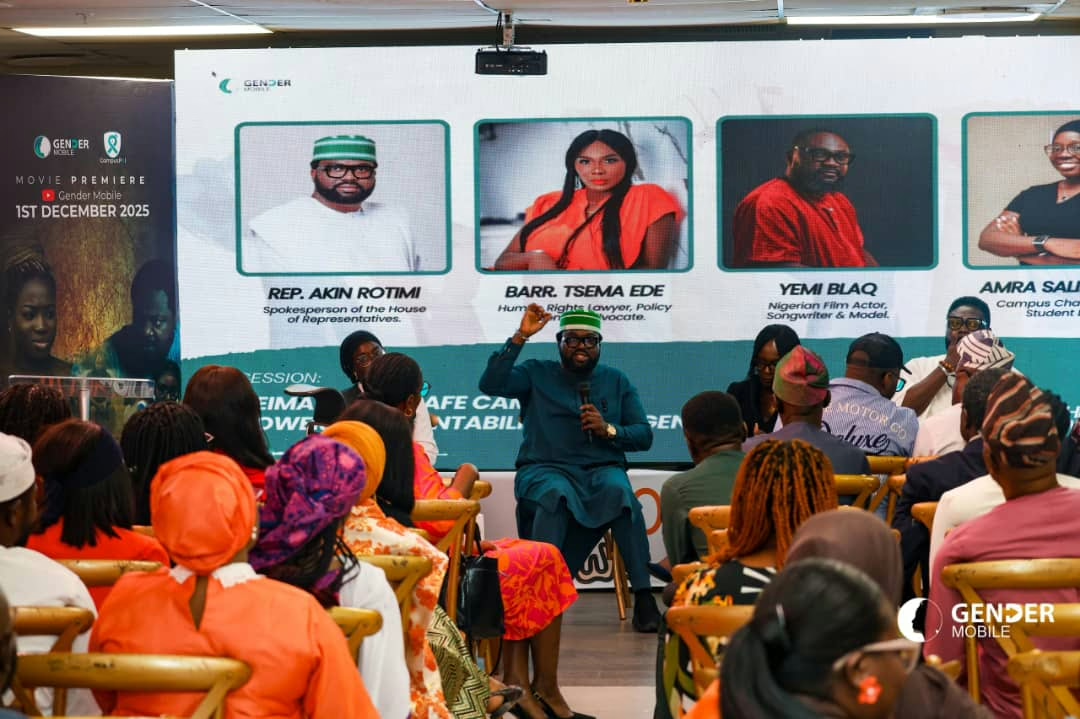
The event also featured a compelling panel discussion on “Reimagining Safe Campuses: Power, Accountability & Agency,” with contributions from Hon. Akin Rotimi, Spokesperson of the House of Representatives and Co-sponsor of the Anti-Sexual Harassment Bill; Barr. Tsema Ede, representing an ecosystem partner leading national GBV prevention efforts; Yemi Blaq, Actor in The Moment We Stand
and long-standing advocate for the eradication of GBV; and Amra Salihu Onize, Campus Champion and student leader driving anti-sexual harassment advocacy
within tertiary institutions.