Comrade Najeeb Nasir Ibrahim
Urbanization is not merely the construction of roads and bridges; it is the deliberate transformation of a society’s physical environment to support economic growth, social mobility, and human dignity.
Cities that thrive in the modern world are those guided by leadership that understands the importance of infrastructure, planning, and long-term vision.
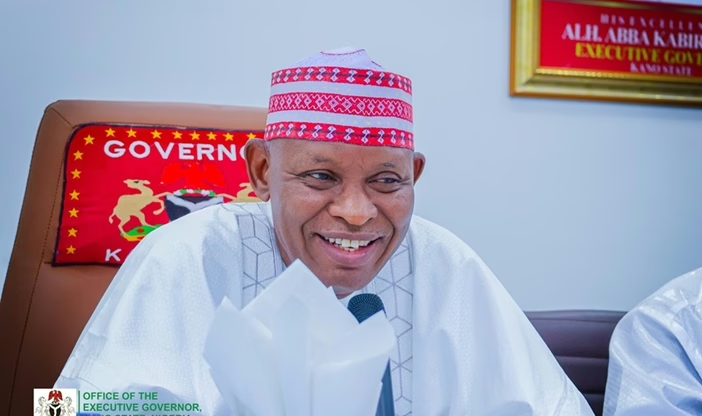
In Kano State today, the ongoing urban renewal efforts under His Excellency, Governor Abba Kabir Yusuf, have positioned him as a leader whose work justifies the title “Jagoran Sabuwar Kano” — the Leader of the New Kano.
Kano has historically been one of West Africa’s most important commercial cities, a hub of trade, culture, and industry. With a population exceeding ten million residents and a rapidly expanding metropolitan area, the demand for modern infrastructure and efficient urban planning has never been greater.
Recognizing this reality, the administration of Governor Abba Kabir Yusuf has embarked on a bold agenda to modernize the ancient city while preserving its economic vitality.
A key pillar of this transformation lies in the government’s ambitious infrastructure projects across the Kano metropolis.
Among the most prominent initiatives is the construction of major interchange bridges such as the Dan Agundi three-layer interchange and the Tal’udu cloverleaf flyover, projects valued at about N27 billion.
These strategic developments were initiated to reduce traffic congestion, improve mobility, beautify the city, and strengthen Kano’s urban infrastructure.
Traffic congestion has long been a challenge in Kano, especially within the bustling commercial districts where daily trade activities attract thousands of commuters.
By investing in modern flyovers, underpasses, and improved road networks, the Yusuf administration is not only addressing immediate transportation challenges but also laying the foundation for a future mega-city capable of supporting expanding economic activity.
Beyond large bridges, the administration has also launched an extensive urban road rehabilitation and renewal program.
This initiative includes the reconstruction and dualization of key roads such as Lodge Road, Wuju-Wuju Road, and Bayero Soli Road within the Kano metropolis.
These projects aim to enhance accessibility, stimulate commerce, and improve connectivity between important commercial and residential areas.
Urban transformation under Governor Yusuf is not limited to the city center alone. The government has also prioritized the expansion of infrastructure across semi-urban and rural areas.
One example is the 85-kilometre road network and bridge project worth N21 billion, designed to connect communities such as Madobi, Yako, Kafin Mai Yaki, and Kiru.
This initiative seeks to bridge the gap between rural and urban communities, promote economic activity, and reduce rural-urban migration.
Such projects demonstrate a broader understanding of urbanization as an integrated system where rural development supports urban stability.
When rural roads improve, agricultural goods reach city markets faster, transportation costs decline, and the urban economy benefits. In this sense, the Yusuf administration’s development strategy reflects a holistic vision of sustainable growth.
Another critical dimension of the governor’s urban agenda is the rehabilitation of dilapidated metropolitan roads.
The government recently flagged off the reconstruction of 17 major urban roads, reinforcing the commitment to transform Kano into one of the best-developed cities in Nigeria in terms of infrastructure.
Infrastructure development on this scale sends a powerful message about governance priorities.
By allocating a significant portion of the state budget to capital projects, the administration has demonstrated that development is not just a campaign promise but a practical policy direction.
Roads, bridges, lighting systems, and urban renewal projects create jobs, encourage private investment, and strengthen public confidence in leadership.
Equally important is the symbolic significance of these projects. Kano is an ancient city with centuries of history, yet it must evolve to compete with modern urban centers.
Governor Yusuf’s policies reflect a delicate balance between tradition and modernization, preserving Kano’s heritage while preparing it for the future.
For many residents, the changes unfolding across the state represent more than infrastructure; they symbolize hope.
Markets are becoming more accessible, transportation is gradually improving, and communities previously isolated are now connected through new road networks.
These developments contribute to economic productivity and improve the daily lives of ordinary citizens.
In political leadership, titles are often given as recognition of vision and performance. The phrase “Jagoran Sabuwar Kano” is therefore more than a ceremonial expression; it reflects the perception that the current administration is guiding the state toward a new era of modernization, urban growth, and economic opportunity.
Governor Abba Kabir Yusuf’s approach to urbanization demonstrates that leadership is most effective when guided by a clear purpose the improvement of people’s lives.
Through large-scale infrastructure projects, urban renewal programs, and strategic investments in connectivity, the administration is redefining Kano’s development trajectory.
As Kano continues its journey toward becoming a modern mega-city, history may well remember this period as a turning point a time when purposeful leadership laid the groundwork for a New Kano, built on infrastructure, opportunity, and progress.
In the final analysis, urban transformation is a defining test of leadership. It requires courage to invest in long-term infrastructure, discipline to pursue development beyond political cycles, and vision to imagine what a city can become decades into the future.
Through his ongoing urban renewal initiatives, Governor Abba Kabir Yusuf has demonstrated that Kano is not destined to remain only an ancient commercial center but can rise as a modern metropolis capable of competing with the great cities of Africa.
If the current pace of development continues, the story of this era will not simply be about road construction or flyovers; it will be remembered as the moment Kano began its decisive transition into a new urban age.
In that unfolding history, the name Jagoran Sabuwar Kano will stand as a symbol of leadership committed to building a stronger, more connected, and more prosperous Kano for generations yet to come.