Lukman Abdulmalik
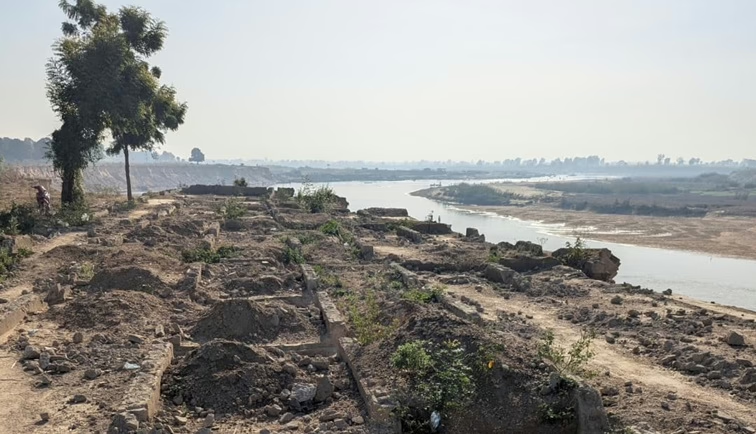
From a beacon of hope for young Nigerians who had dreams of a future in aquaculture, the School of Fisheries now lies in ruins with its classrooms buried under heaps of sand and the foundations exposed to the sun.
What was supposed to nurture knowledge has been transformed into a wasteland carved out by illegal sand miners.
Dredging machines, replacing students along the riverbanks, have left behind gaping craters and shattered dreams where once a place of learning and sustainable livelihoods thrived.
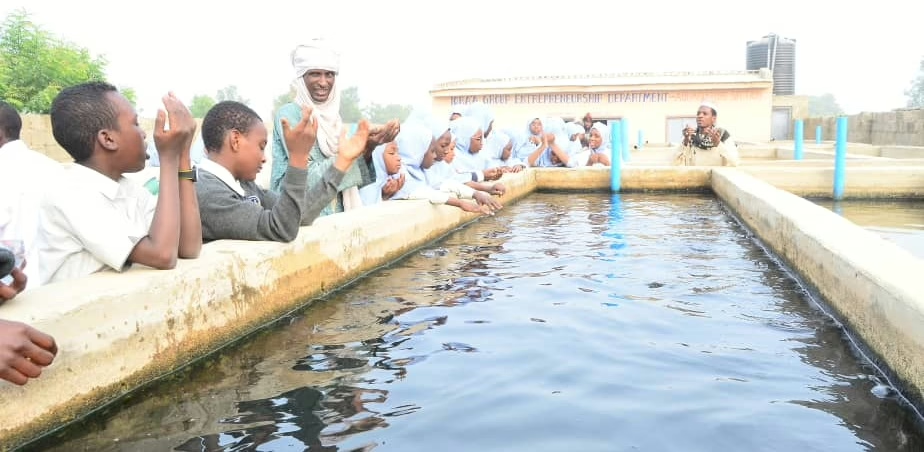
On the dusty plains of Tassa in Dawakin Kudu Local Government Area of Kano State stands the shell of what was once a beacon of hope: the Entrepreneurship Fishery Center, established in 2019, was a school meant to train young people in modern aquaculture and open up new vistas for rural livelihoods.
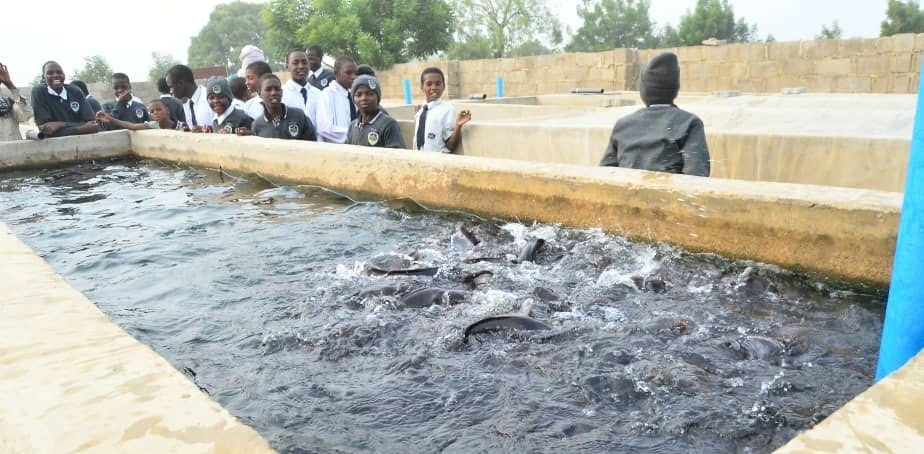
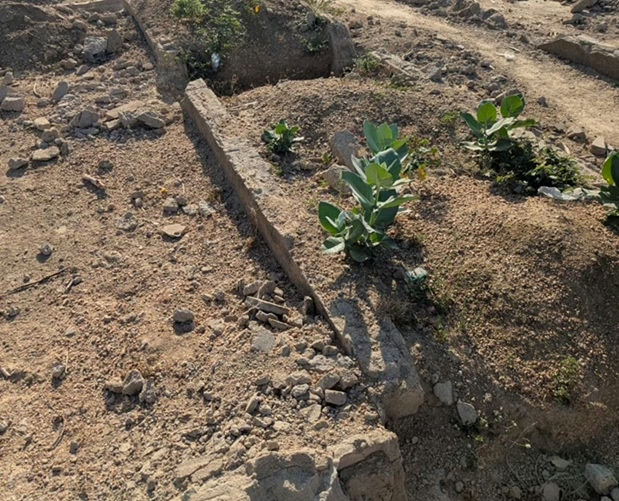
Today, the structures are cracked, the ponds caved in, and the access road turned into a jagged trail carved by the relentless movement of trucks hauling sand from illegal mining sites.
For Ibrahim Bala, the founder of the center, the devastation is not just physical, it is deeply personal.
Sitting on a wooden bench beside what used to be his demonstration fish pond, he recounts the years of sweat invested in the project, his voice tinged with resignation.
“I think today fishery is actually a multi-billion-naira venture,” he says.
“That has always been my aim.
“But the dreaded activity that spoiled the road and destroyed our investments brought that entire era to an end.
“If we are able to get an intervention to stop the illegal mining, things can return. But for now, nothing can survive here.”
The Entrepreneurship Fishery Center had been envisioned as a rural innovation hub, a place where youths and farmers could learn hatchery management, pond construction, feed formulation, and value addition.
Its ponds were stocked, its hatchery was built, and its training plans were approved.
But all of that was short-lived and destroyed in 2022.
The Miners Who Came at Night
Residents say that destruction started gradually. First, a few trucks rolled in at sundown to scoop sand from the riverbanks.
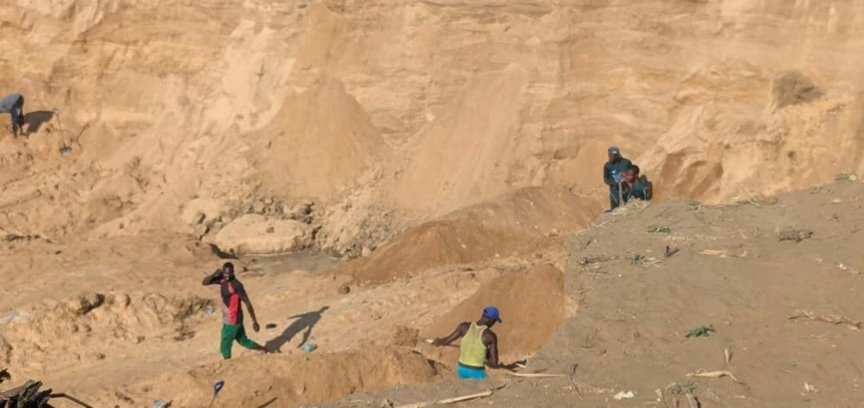
Then more came. With each passing day, grooves on the road grew deeper.
Each week, houses shook with more force, as tippers roared through the village.
In a few months, both the road approaching and the land abutting the school started to collapse.
Bala desperately tried to fight back. “I personally sponsored some journalists to investigate. I hired lawyers.
“But nothing was done, the cost of standing up to the miners, he explains, was too high.
“I’m just a private entrepreneur trying to survive.”
A School Buried Before It Could Grow
For a rural training institution, Bala invested massively: the land was purchased for N4 million, and another N6 million was used to carve out the primary hatchery pit, a heavy engineering job involving excavators, drainage channels, and reinforced walls.
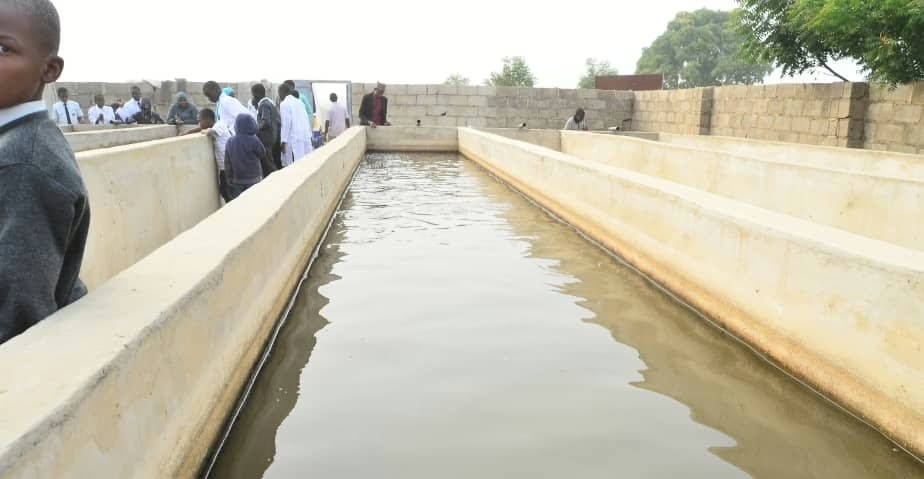
The pond collapsed after repeated vibrations from the excavators weakened the soil.
“That site alone had about N20 million sunk into it,” he explains quietly.
“If you calculate everything, the total cost today would be running into hundreds of millions.
“But how do you quantify the value of the fingerlings we lost? The broodstock? The equipment? The years we put in?”
He pauses, staring at the rubble from the collapsed fish pit, a 20-meter stretch of earth now swallowed by a gaping hole.
“This was supposed to train young people. It could have changed lives,” he adds.
Usman Haruna, a resident of Tassa who voluntarily served as a security guard, narrated that he watched the center “die slowly.” From his post at the gate, he saw the first sand trucks arrive at night, then multiply until the ground trembled with every trip.
“The day the main wall cracked, I heard it like a gunshot,” he recalls.
“I tried to raise the alarm, but what could one man do?” Usman still visits the site, though the gate he once guarded now hangs crooked. “I protected this place from thieves,” he says, “but I couldn’t protect it from the people destroying the land.”
Villagers Left to Count Their Losses
For the people of Tassa, the collapse of the fishery school is only one among many wounds.
Aisha Abdullahi, a mother of four whose children had been hoping to study at the center, speaks of the frustration the community feels.
“This school was our pride,” she says.
“My son wanted to learn fish farming so he wouldn’t have to run to Kano city looking for work.
“When the illegal miners destroyed the road, they destroyed our children’s future.
“Now nobody wants to come here to teach or invest.”
Another parent, Malam Shuaibu Nuhu, said authorities’ silence made him angry.
“Every day these trucks pass, the ground shakes. Our houses have cracks.
“The water sources are drying up because the miners have diverted the river. Nobody cares.
“The school that was supposed to help our youth is gone.”
Even students who once trained briefly at the center before it shut down have been left with nowhere to continue.
“We were learning fish breeding and how to run small ponds,” says 19-year-old Rabi’u Ibrahim.
“Now the place is empty. We just stay at home.”
For 15-year-old former student Salisu Ibrahim, the school was the first real dream he ever had.
He had hoped to learn hatchery management and start his own small fish farm.
“When I held a fingerling for the first time, I thought I was holding my future,” he says.
“But as the mining activities grew louder and the classrooms shook, learning became impossible.
“The day he arrived to find the school was wrecked, he knew the dream was gone. “I still keep my notes,” he says.
We Lost More Than a School, We Lost a Purpose – Instructor
Before the school collapsed, the hatchery manager, Musa Abdullahi, lived for the sound of splashing water inside the training ponds.
Every morning, he would arrive before sunrise, check the oxygen levels in the tanks, feed the broodstock, and prepare his materials for the day’s lessons.
Today, he stands in silence before the same place which is now a broken crater.
“I still go there sometimes,” he admits quietly.
“Maybe because part of me refuses to believe it’s gone.”
Musa was one of the first instructors hired to teach hatchery operations. He had left a job in Kano city because he believed so strongly in the rural development mission of the school.
“When the center opened, we saw excitement in the students’ eyes,” he recalls.
“Many had never seen a proper hatchery before.
“Some had only heard about aquaculture on radio programmes. To teach them was a privilege.”
But the day the main pond collapsed, Musa says he felt something collapse inside him too.
He shakes his head.
Musa now does odd consulting jobs in neighbouring communities, but he admits nothing matches the sense of purpose the school gave him.
“I didn’t just lose a job,” he says softly. “I lost a place where I felt I was making a difference.
“The future we were building together was destroyed before it even started.”
Experts Warn of a Looming Environmental Disaster
Environmental scientists say that the situation in Tassa is not unique: Illegal sand mining has turned into a national threat, destabilizing soil structures, damaging farmlands, contaminating waterways, and rendering infrastructure unusable.
Dr. Nafisa Shehu, a geographer at Bayero University, explained that sand extraction that lacks regulation weakens the natural cohesion in the soil.
“When heavy mining occurs near roads or buildings, truck vibrations spur erosion.
“As land starts to cave in, the channels for water shift. What happened in Tassa is a predictable result of unregulated sand removal,” she says.
She added that besides causing damage to the school, the activity is a long-term danger to the entire community.
“They could experience flooding. Their groundwater could be polluted.
“Houses could collapse. And if the miners continue, the village may become uninhabitable in the coming years.”
The loss of the center is also seen by fisheries experts as a setback for rural economic empowerment.
Dr. Yahaya Adamu, an aquaculture specialist in Kano, says the center could have helped hundreds of young people start sustainable fish businesses.
“A functional fishery school provides technical skills, reduces youth unemployment, and boosts protein supply in the state,” he says.
“Losing such an institution to illegal sand mining is a tragedy for both the community and the state’s agricultural development.”
A Struggle Between Power and Survival
Despite years of petitions, community protests, and media reports on the issue, residents claim the sand miners remain active and protected by what they describe as “big names in government.”
One of the village elders who has been actively pursuing to end this ming, Tsoho Abdulwahab, says, “We have tried all we can. Those controlling the sand business are powerful.
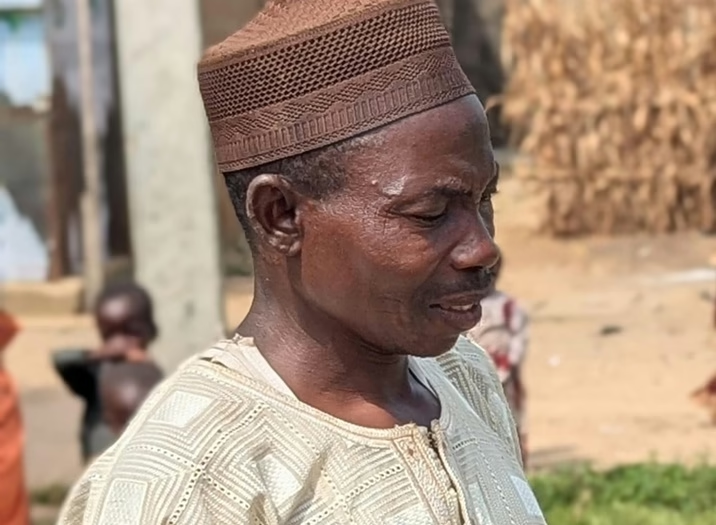
“When we complain, police come but nothing changes. They even threaten us.”
Tsoho recalled that violent clashes erupted between villagers and miners in June 2022 and again in November 2023, following what residents described as unauthorized excavation of their farmlands.
“The situation became so tense that we blocked the road leading to the riverbank,” he said. “After some hours, security operatives intervened, dispersed us, and allowed the miners to continue.”
Tsoho, who also heads the Tassa Farmers’ Association, alleged that influential figures including some traditional rulers within and outside the area were backing the mining activities and had links to the state government.
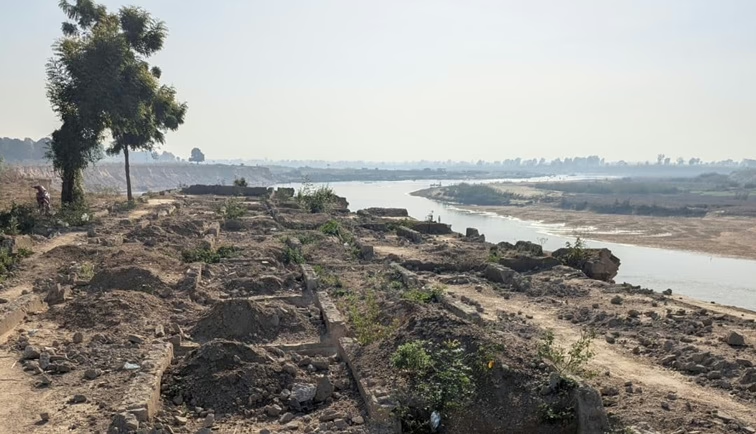
According to him, residents have been dealing with harassment and destruction of farmland for more than 15 years.
He listed those allegedly involved as: the Ward Head of Tamburawa, Auwalu; the Village Head of Tassa, Sani Umar; the Ward Head of Yanbarau, Abdullahi Dikko; and the Village Head of Fagi, Hassan Chiroma.
Others he mentioned included: Ado Garba, Musa Umar, Adamu Abdulmumuni, Nura Yunusa, Abubakar Umar Dantube, and Kabiru Danmaje.
He alleged that these individuals are among those suspected of benefiting from illegal mining activities with the backing of political interests.
To verify the claims, this reporter contacted several of the individuals named. However, they either declined comment, ended the calls, or questioned the reporter’s interest in the matter.
The fear is confirmed by Bala, its founder. “Their lives are at risk,” he says of the villagers.
“The activity sweeping their land can sweep their life.
“That is why whatever is done should focus on their own testimonies.
“I have my documents and evidence, but the priority should be the people.”
The Kano State Commissioner of Solid Minerals and Natural Resources, Hamza Safiyanu, expressed concern over illegal sand and mineral mining in the state, particularly the involvement in loss of properties.
“We are aware of the situation and taking steps to address it.
“We are working with stakeholders to identify and regulate these activities.”
A Community Waiting For Justice
Today, it is almost impossible to pass through the road leading to the Entrepreneurship Fishery Center.
The craters from where sand was illegally taken away are like open wounds on the landscape.
The dream of an aquaculture training hub had been buried under the weight of unchecked greed.
What remains is a community pleading for help, for the government to enforce environmental regulations, for security agencies to stop the intimidation, and for development partners to step in where private investment has been destroyed.
“We just want our land back,” Aisha says softly.
“We want our children to have opportunities. If the fishery school can be revived, it will save this village.”
The future of Tassa hangs in the balance for now, eroded like the land that once held so much promise.
On 26 December 2025, this reporter visited the Ministries of Agriculture and Education to seek clarification on the demolition of the fishery project in Tassa.
After waiting for about an hour at the reception, no official attended to him.
He was later directed to the Public Relations Units of both ministries, but no staff members were available.
A staff member eventually provided the phone contacts of the Commissioners for Agriculture and Education.
On 28 and 29 December, calls were placed to both ministries, but although the phones rang, there was no response or call-back.
Follow-up text messages were also sent, yet no reply was received.
This report was published with support from Civic Media Lab