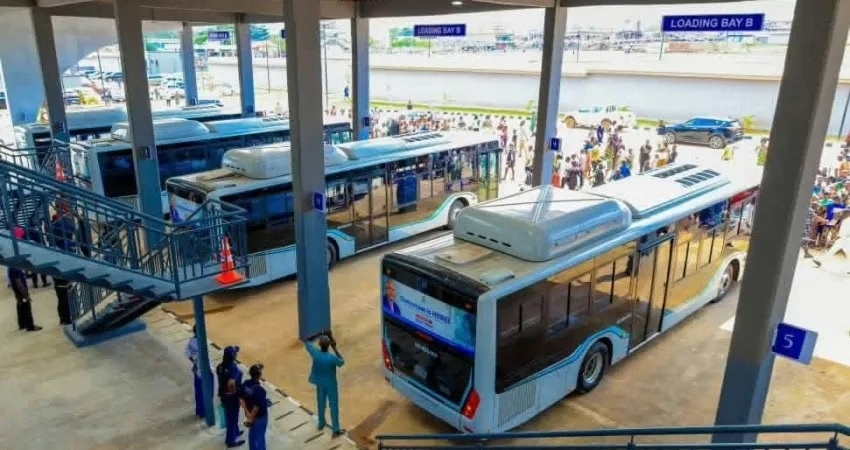
Enugu State Government has announced plans to restrict the movement of tricycles (Keke), yellow buses, and minibuses across five major corridors in the state capital as preparations advance for the rollout of the Bus Rapid Transit (BRT) system.
Commissioner for Transport, Dr. Obi Ozor, disclosed this on Monday during a consultative meeting with transport unions and stakeholders at the ministry’s headquarters in Enugu.
According to him, the corridors designated for BRT-only operations include:
- Okpara Avenue – Abakaliki Road – New Haven Junction – Naira Triangle – Emene Airport
- Ogui Road – Chime Avenue – Naira Triangle
- New Haven Junction – Bisala Road – Rangers Avenue – WAEC – Nkpokiti – Zik’s Avenue
- Ogui Road – Presidential Road – WAEC – Nkpokiti, and the entire Agbani Road axis
Dr. Ozor explained that these routes will become dedicated BRT lanes under Governor Peter Mbah’s agenda to transform Enugu into a modern, multimodal, and globally competitive urban hub.
He stressed that tricycles were never designed for high-speed corridors, adding that their presence on major highways poses safety risks and impedes traffic flow.
“This reform is not about displacing anyone,” he said. “It is about reorganizing the transport ecosystem so BRT buses operate on primary routes, yellow buses serve secondary roads, and tricycles provide last-mile connectivity. Everyone retains a place in the value chain.”
The commissioner revealed that the state has already taken delivery of 200 CNG-powered BRT buses and 4,000 electric taxis, set for assembly at ANAMMCO in Enugu. The first batch of 1,000 taxis is expected within three months.
He added that the government has built 84 modern bus shelters designed with safety, accessibility, and affordability in mind. With an estimated two million daily commuters, Enugu requires at least 8,000 buses to meet public transport demand, he said.
The new BRT buses will feature padded seating, functional air-conditioning, WiFi, and real-time safety monitoring systems.
“No passenger stands in these buses,” Dr. Ozor emphasized. “Every vehicle is monitored from our central command centre, and BRT fares now enjoy a 47% subsidy to ease transportation costs.”
The meeting also produced several resolutions, including that transport unions seeking participation in BRT or terminal operations must submit proposals and financial models for government evaluation.
The state’s electronic fare card, Ije Card, will be decentralized, with distribution expanded to reach five million residents within the next 90 days.
Allocation of loading bays at the newly constructed terminals will soon be completed following ongoing reviews.
Dr. Ozor urged operators to explore financing options to acquire buses or directly participate in BRT operations.
Transport stakeholders expressed strong support for the reforms.
Comrade Chidiebere Aniagu, Chairman of RTEAN in Enugu, endorsed the initiative but appealed for government attention to members’ concerns.
NURTW Chairman, Engr. Augustine Agu praised Governor Mbah’s achievements, saying, “Governor Mbah has achieved in two years what others couldn’t deliver in eight. His private-sector discipline is clear. We support him fully.”
Comrade Kingsley Edeh, representing the Amalgamated Tricycle Riders Association, noted the presence of over 18,000 tricycle riders in the state and appealed for affordable access to taxis for members transitioning into the new system.
Dr. Ozor has since inaugurated a joint review committee comprising ministry officials and transport union representatives to finalize operational guidelines ahead of the full launch of the BRT system. The rollout date will be announced soon.