Isiyaku Ahmed
Civil society organizations (CSOs) across Nigeria have been urged to embrace self-regulation as a pathway to stronger governance, transparency, and sustainability within the sector.
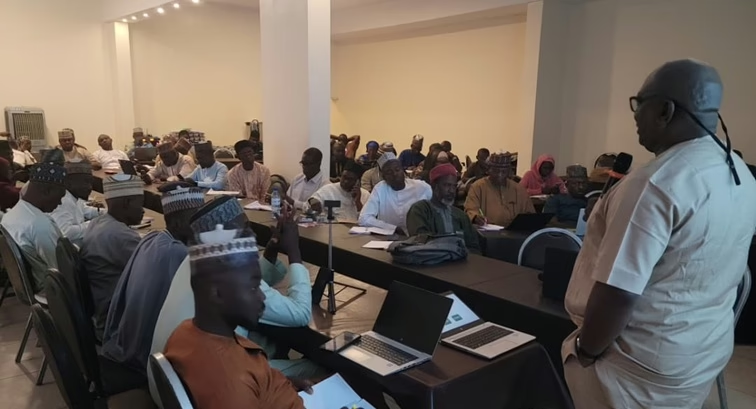
The call was made on Tuesday by Mr. Harry Udoh, Team Lead of the Ethics and Good Leadership Awareness Initiative (EGLAI), during his opening remarks at a two-day zonal capacity-building program titled “Scaling the Adoption of Self-Regulation in Nigeria” for CSO champions and sub-national network leads held at Tahir Guest House in Kano.
The program is facilitated by EGLAI with the support of the European Union Civil Society Organizations Strengthening Bridge Project (EU CSO-Bridge), implemented by International Institute for Democracy and Electoral Assistance (International IDEA).
Mr. Udoh said the training was designed to strengthen the legitimacy and credibility of civil society organizations by promoting humanitarian values, transparency, and accountability.
He explained that while CSOs have played a critical role in Nigeria’s development, the sector must put its own “house in order” to sustain public trust and continue to contribute meaningfully to national development.
According to him, experiences from engagements with successive National Assemblies showed that laws and regulations alone are not sufficient to guarantee a healthy civic space, stressing the need for a self-regulatory framework driven by CSOs themselves.
He recalled that the journey towards CSO self-regulation dates back to earlier EU-supported initiatives, which led to nationwide consultations and the eventual establishment of state-level CSO networks across all 36 states of the federation, with the last network completed late last year.
“These networks now provide the platform to drive the idea of self-regulation across the country,” Udo said.
He added that the current phase focuses on building the capacity of identified CSO champions who will return to their states to promote and multiply the adoption of self-regulation principles.
Watch Video Below
Mr Udoh noted that the agreed self-regulation modalities include a code of conduct, minimum standards of operation, and information disclosure requirements, all aimed at improving organizational governance, operational efficiency, and long-term sustainability.
He acknowledged that while many CSOs are doing commendable work, poor leadership and weak governance in some organizations have undermined the sector, insisting that self-regulation would help address these challenges.
The training targets representatives from seven North-West states, with at least six CSO participants from each of the states.
Participants are expected to serve as champions of self-regulation, monitor the civic space, report developments at the sub-national level, and work with stakeholders to improve the operating environment for civil society organizations.
He added that similar engagements had earlier been held in the South-East, as part of a nationwide effort to strengthen trust between CSOs, government, regulators, communities, and development partners.
In his goodwill message, the Kano State Commissioner for Information and Internal Affairs, Hon. Ibrahim Waiya, represented by Mr. Mustapha Muhammed Chiroma, Executive Director of the Community Rights Initiative of Nigeria (CORIN), commended EGLAI and its partners for leading efforts to promote accountability, democratic values, and good governance.
Comrade Waiya described the workshop as a strategic intervention aimed at strengthening democratic governance in Nigeria.
Speaking on behalf of the Kano State Government, Waiya said CSOs play a critical role in deepening democracy, promoting accountability, shaping public policy, and bridging the gap between government and citizens.
He stressed that the effectiveness and legitimacy of civil society depend largely on transparency, integrity, and commitment to self-regulation, describing the nationwide initiative to scale the adoption of hybrid CSO self-regulation modalities as timely and significant.
According to him, the program reflects a collective resolve to strengthen institutional credibility within the civil society sector and align its operations with global standards of accountability and ethical practice.
Conrade Waiya said the Kano State Government places a high priority on constructive engagement with civil society, noting that sustainable development, social stability, and inclusive governance cannot be achieved by government alone.
“A credible, accountable and self-regulating civil society is an indispensable partner in policy formulation, service delivery, conflict prevention and social mobilization,” he said.
He added that the initiative complements Kano State’s ongoing reforms in governance, public accountability, and citizen participation, while reinforcing the government’s commitment to an enabling civic space, rule of law, and participatory governance.
The Commissioner urged participants to approach the workshop as a call to leadership and responsibility, emphasizing that lessons learned must translate into concrete reforms within CSO structures and stronger partnerships with government and regulatory institutions.