Olu Allen
The recent headline, that the United States has carried out a major military operation in Venezuela and captured its president, is more than another geopolitical bombshell.
It is evidence of a shifting global order with immediate and concrete consequences for nations like Nigeria. The world has changed overnight.
In the early hours of January 3, U.S. forces struck multiple locations in Caracas.
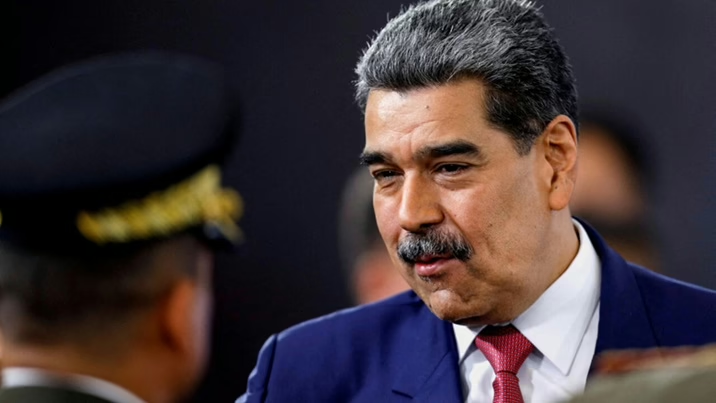
In a dramatic operation at the Fort Tiuna military base, Maduro’s residence, President Nicolás Maduro and his wife were captured and extracted.
President Trump declared the action would force a “safe and judicious transition,” with the U.S. planning to temporarily administer the country and tap its vast oil reserves.
The move is the most direct U.S. intervention in Latin America in decades. But while Vice President Delcy Rodríguez’s conflicting calls for Maduro’s release hint at the instability to come, the immediate shockwaves are hitting global oil markets.
For Nigeria, which just weeks ago anchored its 2026 budget on a $64 per barrel crude benchmark, this is where the story gets real.
The Oil Calculus: More than a price check
Initial market reaction has been paradoxically muted. Analysts see only a fleeting $2-$5 per barrel “risk premium” spike.
The real threat to Nigeria is not today’s price, but tomorrow’s supply. Venezuela sits on 303 billion barrels of proven reserves, the world’s largest, but produces less than a million barrels a day, a trickle resulting from two decades of mismanagement.
Its infrastructure is a ruin: pipelines are a half-century old, and experts estimate a $58 billion refurbishment cost.
This is the critical variable. If a U.S.-backed transition is smooth, capital and technology could flood in. The goal, as Trump stated, is to revitalize production to lower global prices and squeeze rivals like Russia. But “smooth” is a fantasy.
The more likely scenario is protracted chaos, a “post-Gaddafi Libya” situation, one energy strategist noted, where political fragmentation prevents any real production comeback for 3-5 years or more.
Nigeria’s fiscal planners are caught between these two poles. The Senate, sensing global uncertainty, has already adjusted the 2026 budget benchmark down to $60. But this may still be optimism.
The International Energy Agency forecasts a record global oil surplus for 2026. Whether Venezuelan oil floods the market or remains locked in the ground, the price direction is downward.
For an economy projecting 4.2% growth while wrestling with inflation and foreign reserve pressures, this is a dangerous squeeze.
The Nigerian Reality: Vulnerabilities laid bare
The Venezuelan drama holds up a mirror to Nigeria’s own economic frailties. The parallels are uncomfortable: an over-dependence on a single resource, strained state capacity, and vulnerability to global power plays.
Nigeria’s 2026 budget, even revised, remains a high-wire act. Debt servicing is projected at a staggering N15 trillion.
Our own oil production averaged just 1.66 million barrels per day in 2025, consistently below targets due to theft and underinvestment.
Now, imagine a world where U.S. firms and capital begin flowing into a stabilized Venezuela.
Nigeria risks losing crucial market share, particularly in the Western Hemisphere, not because our oil is worse, but because our “above-ground” risks, security, regulatory uncertainty, and infrastructure are higher.
From Imperative to Action: A four-point survival kit
This is not a drill. Nigeria’s response must be immediate and structural.
First, the budget framework must be stress-tested against a true worst-case scenario of $50-$55 oil. Hope is not a strategy.
Second, diversification must move from slogan to action. The reported $122 billion energy diversification plan to fix power and gas must be the absolute priority. We cannot thrive on oil alone.
Third, we must defend our oil competitiveness. This means fast-tracking the resolution of security and infrastructure bottlenecks that scare off investors.
It also means understanding our product: Venezuelan crude is heavy and sour, ideal for diesel. Nigeria’s lighter crude serves different markets.
We must strategically defend and expand those niches.
Fourth, we must fortify our buffers. The recent rise in foreign reserves to $45.24 billion is a start.
These reserves, alongside any stabilization funds, must be ring-fenced and enlarged. They are our only cushion against the coming volatility.
The Broader Lesson: Sovereignty in a Ruthless World
Beyond the barrels and budgets, Venezuela delivers a stark lesson in 21st-century realpolitik. Powerful states are increasingly willing to act unilaterally for energy and strategic advantage.
Africa cannot be a passive observer.
Nigeria, as Africa’s largest producer and a regional leader, must internalize this moment. What happens in Caracas today can destabilize Abuja tomorrow.
Our policy must be proactive: diversify our economy, secure our infrastructure, and assert our diplomatic weight. In a world where might is reasserting itself, resilience is the only form of sovereignty left.
Our leaders must recognize that all politics is now global, even when the dynamics originate thousands of miles away. The shockwave from Caracas is here.
We must decide whether to be flattened by it, or to ride it toward long-overdue reform.
Allen writes from Kano. He promotes good governance and writes on public affairs.