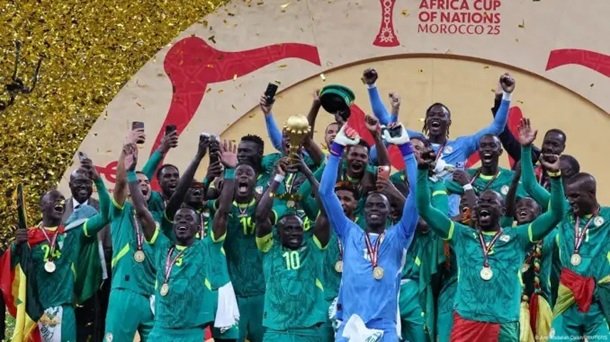
Senegal has been reinstated as Africa Cup of Nations (AFCON) champions after the Court of Arbitration for Sport (CAS) overturned a controversial decision that had stripped the country of the title and awarded it to Morocco.
The ruling, delivered on Tuesday, reversed a March decision by the Confederation of African Football (CAF) Appeals Board, which had declared Morocco 3-0 winners following a disputed final played in January.
Senegal had initially won the final 1-0 after extra time in Morocco, but the result was subsequently overturned after Senegalese players briefly walked off the pitch in protest against a late penalty awarded to the host nation.
The incident occurred in the closing minutes of regulation time when referee Jean-Jacques Ndala awarded Morocco a penalty with the score at 0-0.
Senegal’s players left the field in protest, causing a 15-minute interruption before the match resumed. Morocco’s Brahim Diaz failed to convert the penalty after his attempted Panenka chip was saved, while Senegal eventually secured victory in extra time.
However, CAF’s appeals panel later ruled that Senegal had forfeited the match under tournament regulations, awarding Morocco a 3-0 victory.
In overturning that decision, CAS ruled that the tournament regulations on teams refusing to play applied only when a team’s conduct caused the referee to abandon a match permanently.
The arbitration court also held that Ndala had the authority to decide whether play could resume and did not commit an error of law by allowing the match to continue.
“The Court of Arbitration for Sport has delivered justice to sport,” Senegalese Football Federation President Abdoulaye Fall said in a statement.
CAS said its three-member panel reached a unanimous decision, acknowledging the tense atmosphere surrounding the incident but rejecting claims that the referee’s decision was arbitrary.
The court maintained that the referee’s judgment did not appear to have been influenced by factors outside the game.
Morocco Plans Further Legal Challenge
Despite the ruling, Morocco has indicated plans to challenge the decision, raising concerns about the integrity of the CAS proceedings.
The Moroccan Football Federation alleged that German arbitrator Ulrich Haas had communicated with Fall 48 hours before the judgment was delivered, describing the alleged contact as an integrity concern.
CAS Director General Matthieu Reeb confirmed that the court received a challenge shortly before the verdict was announced.
However, he said the panel responsible for handling such challenges found insufficient grounds at that stage to postpone notification of the ruling.
CAS decisions can be challenged before Switzerland’s Supreme Court, although appeals are restricted to limited procedural grounds, including questions concerning the integrity of arbitrators.
Senegal’s lawyer, Patrick Kabou, dismissed the alleged communication between Fall and Haas as “unreal.”
Controversial Final Sparked Months of Dispute
The January final was marked by disorder both on the pitch and in the stands, with confrontations involving players, officials and ball boys.
The controversy continued for months after CAF overturned the original result, with Senegal refusing to accept the decision and continuing to assert its claim to the trophy.
In March, Senegalese players even paraded the AFCON trophy ahead of an international friendly against Peru, despite Morocco having been officially recognised as champions at the time.
The dispute also highlighted the tension between football’s Laws of the Game, which generally make referees’ on-field decisions final, and specific tournament regulations governing teams that refuse to continue playing.
CAS relied on the principle that refereeing decisions made during a match should generally not be overturned by sports tribunals.
It said Ndala’s decision to restart the match indicated that he considered the conditions for resumption to have been met, noting that both teams had returned to the pitch and expressed willingness to continue.
Senegalese Fans Welcome Ruling
The decision has been welcomed by football supporters in Senegal, where many viewed the initial CAF ruling as unjust.
A Dakar-based accountant, Mariama Sidibé, said the CAS judgment merely confirmed Senegal’s victory on the pitch.
She urged both countries to put the dispute behind them, describing Senegal and Morocco as brothers with longstanding religious, cultural and commercial ties.
A philosophy student, Sidi Sylla, also described the ruling as a victory not only for Senegal but for football generally.
The decision is considered unusual in international football, where overturning the outcome of a major tournament through legal proceedings is relatively rare.
The next men’s AFCON is scheduled to begin in June, with Kenya, Uganda and Tanzania serving as co-hosts.
Morocco, meanwhile, will continue its pursuit of a second continental title, having last won the competition 50 years ago.
(NPR)