Constance Meju
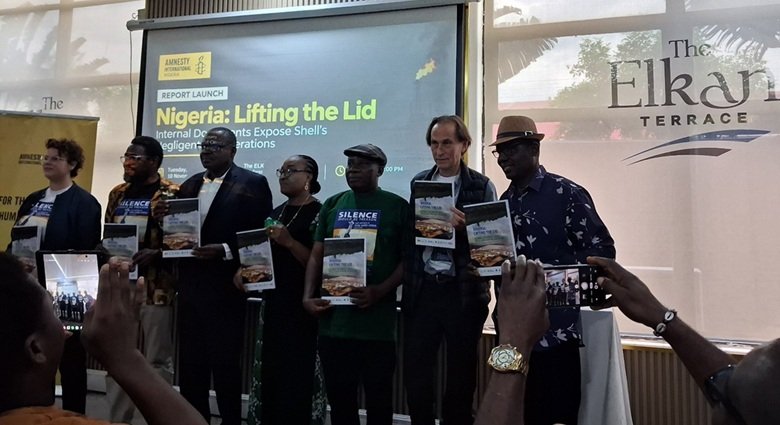
The long agitations of Niger Delta people for environmental justice have received a boost with the unveiling of an investigative report released in Port Harcourt by Amnesty International.
The report exposes unwholesome practices by oil giant Shell Petroleum Development Company, linked to acts of impunity that aided the abuse of both the environment and human rights in the oil-rich region.
At the unveiling of the careful and detailed study of Shell activities carried out by Amnesty International in conjunction with other international human and environmental defender groups, the oil giant’s complicity through inaction where and when it matters, and concealment of operational truth at some critical moments leading to acts of impunity against the oil host communities with high negative impact on the ecosystem, were exposed and condemned.
The report revealed records of oil wells closed without proper procedure, safety concerns raised over suppressed reports confirming that Shell senior staff actually allowed oil tapping to continue instead of repairing damaged pipelines, and serious questions about inappropriate properties and ineffective cost control management.
There was also a frightening revelation that Shell did not actually know where all its oil wells are.
Part of the report read: “Shell has always denied allegations that it operated its pipelines and other infrastructure negligently in the Niger Delta, maintaining in public that it followed ‘global Shell Group standards and the International Standards Organization (ISO) guidelines’ (despite exempting SPDC from those standards).
“But internal audits which have now been made public reveal numerous issues with SPDC’s management of its infrastructure.
“In 2011, one of them reported that attacks on the pipelines, including for oil theft, had resulted in a ‘significant backlog of pipeline maintenance and severely impacted the overall technical and operational integrity of the pipelines.”
“This confirms the concerns raised over decades by human rights and environmental justice groups that Shell’s discrepit pipeline system was dangerously unfit for operation.
In addition, experts noted that Shell lacked leak detection capabilities.
“Two important documents disclosed in the proceedings raised concerns by Shell’s technical experts over the effectiveness of its vital leak detection capabilities in Nigeria.
“Experts who visited the region in 2012 noted that ‘SPDC needs better leak detection on pipelines and flowlines.’
This was followed by a report from 2013, which found that ‘SPDC’s Pipeline Infrastructure has no real-time monitoring capabilities, other than station discharge pressures with Hi-Lo pressure trip settings. Only major third-party spills will not be observed on station discharge pressure profiles.”
Stressing that the identified gaps were significant since the ability of an operating company to respond quickly to a spill from its pipelines, to limit contamination which is key to reducing the likely impact of pollution, Amnesty International stated that Shell’s response has been slow and rarely thorough.
It also pointed out that Shell has been deceptive with its staff, mislabeling oil spills as sabotage or third-party interference when, in fact, the spills were caused by corrosion or other operational failures.
Shell executives knew rules were being broken but chose to be silent.
“One manager from Shell’s headquarters who visited Nigeria in 2012 emailed colleagues that his trip had ‘confirmed my suspicion that there is collusion, nepotism and corruption running through the veins of (SPDC)…that the fact is no one bats an eyelid here.
“Shell’s code of conduct is an inconvenience here: it is completely ignored.
“The report queried the divestment process that did not follow due process, and the financial deal between Shell and Renaissance, the company the former loaned money to buy off its Nigerian onshore assets.
“Nigeria’s industry standards require companies taking on an oil joint venture to have necessary financial resources to operate responsibly. But Renaissance was a new company with no track record that could be assessed.
“It had no financial history, and there was little information available in the public domain on the financials of any of the companies that made up the Renaissance Consortium.
“Renaissance even required assistance from Shell Plc to acquire SPDC.
Shell confirmed that it provided ‘secured term loans of up to US$1,2bn, to cover a variety of funding requirements.”
The report tied the divestment to Shell running away from the responsibility of decommissioning costs worth billions of dollars.
Pressing for action against the unearthed lies and deceit, Amnesty International called for action by the Nigerian government, pointing out that the report reveals very limited public knowledge of oil operations in the country and the complicity of both the federal government and Shell.
“The document also appears to confirm serious failings by both Shell and the Nigerian government over many years. They appear to show that Shell was operating its operations in breach of Nigerian law and regulations, which are benchmarked against international standards,” the report stated.
It noted that collective actions within and beyond Nigeria would need to be taken to correct the existing injustice in the Niger Delta, requiring a complete overhaul of Nigeria’s oversight of the oil industry, including audits by all oil operators in the country of the condition of all operational and decommissioned infrastructure and the publication of such findings; urgent studies to ascertain the impact of decades of pollution from extraction on the human rights of affected communities, specifically on health, water quality, fisheries and agriculture, as well as identify necessary remedial action.
The report further recommended the contribution of oil companies operating in Nigeria to a superfund with sufficient resourcing to fully clean up the Niger Delta to international best standards, and investigation of the alleged complicity of Shell staff in bunkering and bribery.
To the UK and Netherlands Shell offices. The report demanded an investigation to ascertain if Shell has infringed financial market rules by making misleading statements to shareholders concerning its environmental, social and good governance standards and their application; investigate the alleged staff complicity in bunkering and bribery and introduce legislation to require companies to conduct human rights and environmental due diligence across their global operations and supply chains, with a monitoring mechanism and enforcement procedure.
It also charged the international offices to hold Shell directors personally accountable for their involvement in the despoliation of the Niger Delta and the associated human rights abuses and work towards phasing out fossil fuel operations by 2030, while ensuring an adequate standard of living for lower-income people who rely on subsidized fuel as an urgent first step.
For Shell and Renaissance, the report demanded audits of all operational and decommissioned infrastructure with findings published so affected communities can assess the information, public access to all studies previously conducted concerning the impact of its operations on health, water quality, fisheries and agriculture as well as contribution to the Superfund for the clean-up of the region.
It challenged the Nigerian government to publicly disclose the full divestment agreement and the framework under which assets were sold, name all companies that acquired divested assets, identify all assets and liabilities transferred, and specify the communities where the assets are located.
Unveiling hard copies of the report, Director of Amnesty International in Nigeria, Isa Sanusi, said the report has shown that Shell puts profit ahead of human considerations in its operations, which has caused a lot of deaths in the Niger Delta.
He said the report generated deeper conversations on happenings in the Niger Delta, harping on that accountability is paramount.
“This report is key and very strategic. No one is above being held accountable. There must be accountability,” he stated.
Partners in the project and Niger Delta activists sent goodwill messages, commending Amnesty International and its partners for the detailed report, exposing previously hidden information, and continuing the drive for justice in the region.
Amnesty International’s report, Nigeria: Lifting the Lid: Internal Documents Expose Shell’s Negligent Oil Operations, presented virtually by Dominic Twommey, Amnesty International’s Campaign Network Coordinator, Business and Human Rights, draws upon a cache of internal documents, confidential audits, emails, and court filings disclosed during legal proceedings in the United Kingdom (including cases involving the Bille and Ogale communities).