Olu Allen
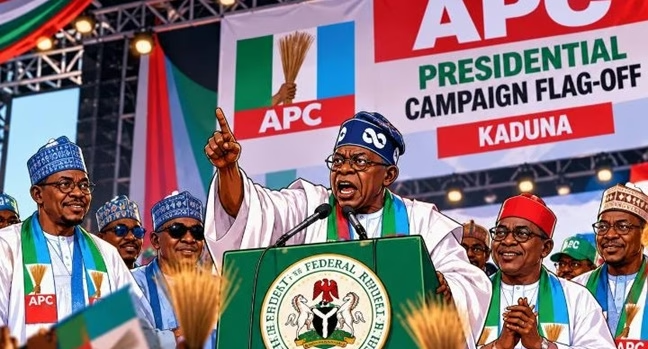
At the APC’s presidential campaign flag-off in Kaduna on Saturday, President Bola Ahmed Tinubu posed a question to his political opponents: Who created the hunger and poverty Nigerians are complaining about?
His answer was blunt: they did. His administration, he argued, was trying to eradicate them.
Former Vice-President Atiku Abubakar’s camp fired back, accusing the President of shifting responsibility for the country’s hardship onto the opposition.
And just like that, a question about the cost of living became another contest over political blame.
But beneath the exchanges lies a more consequential question: If the opposition created the hunger, who has been responsible for ending it?
The timeline does not lie
The APC has controlled Nigeria’s presidency since May 2015. Tinubu took office in May 2023.
The party has therefore occupied the centre of federal power for more than eleven years, while Tinubu has been responsible for presidential decisions for over three years.
Yet millions of Nigerians remain preoccupied with a basic question: how do we afford food, transport, rent and other necessities?
To be fair, hunger and poverty did not begin with Tinubu. Nigeria inherited deep structural problems, including weak productivity, insecurity, inadequate infrastructure, unemployment and longstanding failures in agricultural development.
No serious analysis can pretend otherwise.
But acknowledging history is not the same as granting an administration immunity from accountability.
Inherited problems explain where a government starts. They do not excuse everything that happens after it takes office.
A government must be judged not merely by the problems it inherits, but by the direction in which it moves the country and the results its policies deliver.
The numbers deserve more thancampaign rhetoric
The figures cited in the original debate point to a challenge that political exchanges cannot wish away.
The International Monetary Fund’s reported June 2026 assessment estimated that poverty had reached 63 per cent of Nigeria’s population under the national poverty line. It also estimated that 27 million Nigerians faced food insecurity in autumn 2025.
Meanwhile, the National Bureau of Statistics reported year-on-year food inflation of 17.52 per cent in June 2026.
These indicators measure different things. Poverty is not the same as food insecurity, and inflation measures changes in prices rather than whether a household can afford a meal.
Nevertheless, they raise a fundamental question about the relationship between economic stabilisation and the welfare of ordinary citizens.
A government may point to improving macroeconomic indicators. It may argue that painful reforms were unavoidable and that their benefits will take time to reach households.
Those arguments deserve serious examination.
But the family standing in a market, calculating what ₦10,000 can buy, is equally entitled to ask when economic recovery will become tangible.
Economic reform is a means to an end. The welfare of citizens is part of that end.
If the economy is stabilising, how quickly is that stability translating into more affordable food, improved purchasing power, productive employment and greater household security?
That is not an unreasonable question. It is the very question a government seeking public confidence must be prepared to answer.
Who removed the subsidy?
Atiku’s response also raised the question of who removed the petrol subsidy and presided over the subsequent exchange-rate adjustment.
Those were policy decisions taken under Tinubu’s administration.
The government has defended its reforms as necessary to reduce fiscal pressures, address economic distortions and improve stability. These are legitimate policy arguments, and their merits should be assessed against evidence of their costs and benefits.
But the consequences for transport fares, food distribution and household purchasing power cannot simply be transferred to opposition politicians because they criticise the outcomes.
Equally, it would be intellectually dishonest to attribute every increase in food prices or every instance of poverty to one policy. Insecurity, production costs, exchange rates, weather conditions, logistics and other structural factors also matter.
The question, therefore, is not whether every hardship can be traced to Tinubu personally. It cannot.
The question is whether his administration’s policies, considered together, are delivering the improvements Nigerians were promised—and whether those bearing the costs are receiving adequate protection.
That distinction matters. Accountability is not the same as scapegoating, just as explaining a policy is not the same as proving its success.
A campaign rally cannot settle this
Tinubu has every right to defend his record and explain why he believes his policies will produce better outcomes.
Atiku and other opposition figures have every right to challenge that record and offer alternatives.
But neither a campaign speech nor a sharp rebuttal is a substitute for evidence.
The President should explain what his administration has achieved in reducing the cost of living, improving food affordability and protecting vulnerable households. Where progress has been made, the evidence should be presented. Where targets have been missed, the reasons should be acknowledged.
The opposition, in turn, must do more than criticise. It should explain what it would do differently, how its proposals would be funded and how Nigerians could measure their results.
The public deserves a contest of policies, not merely a competition in assigning blame.
That is what democratic accountability requires.
The question
The APC has governed Nigeria since 2015. Tinubu has been President since 2023. Hunger and poverty predate both his administration and the current campaign, but the responsibility to address present conditions rests substantially with those exercising power today.
The opposition must answer for its own record and defend its own proposals. No political party should be permitted to rewrite history for electoral convenience.
But neither should the party in power be allowed to substitute accusations against its opponents for an account of its own performance.
When a President asks who created the hunger, Nigerians are entitled to ask a more immediate question:
What has your government done to reduce it, what has worked. and when will ordinary families feel a meaningful difference?
These are not questions that can be settled by applause at a campaign rally. Nor can they be dismissed as opposition propaganda.
They demand evidence, measurable outcomes and an honest assessment of the choices that have brought the country to this point.
A campaign rally can produce applause. A political argument can generate headlines. But only credible evidence and demonstrable results can establish whether the lives of ordinary Nigerians are improving.
And when the subject is hunger, that distinction is not merely political. It is a matter of public accountability.
Allen writes on public affairs and advocates for good governance