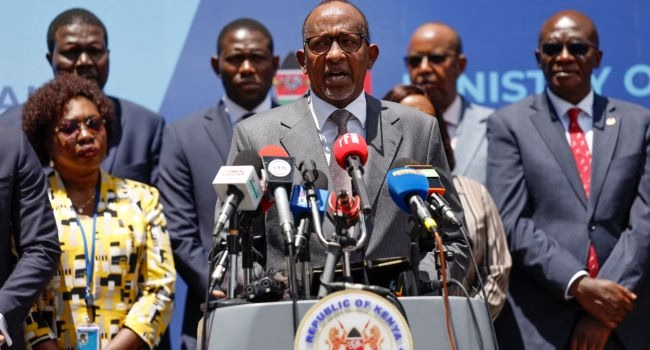
Kenya has recorded its first-ever case of the deadly Ebola virus following the death of a citizen who recently returned from the Democratic Republic of Congo (DRC), Health Cabinet Secretary Aden Duale announced on Tuesday.
The unnamed patient passed away at approximately 11:30 p.m. on Monday while undergoing emergency treatment in isolation at a Nairobi hospital.
The landmark case has prompted health authorities to deploy extensive containment and contact-tracing protocols across the capital.
According to the Ministry of Health, the patient had been living in the DRC for seven years before falling ill roughly a month ago. After receiving initial treatment in the DRC, he traveled overland to the Ugandan capital of Kampala.
On 3 October 2026, he boarded a commercial flight to Nairobi’s Jomo Kenyatta International Airport (JKIA). Upon arrival, he was transported by relatives to a private facility, where clinical teams immediately isolated him after he exhibited classic symptoms of viral hemorrhagic fever, including severe bleeding under the skin.
Subsequent laboratory tests confirmed the presence of the virus.
In a swift response to prevent local transmission, public health officials have mapped out 28 primary contacts. This group includes family members, the drivers who transported him, and the healthcare workers who provided initial care.
Furthermore, the government is working with aviation authorities to track 23 passengers and four crew members who were aboard the flight from Kampala.
All identified individuals will undergo a mandatory 21-day quarantine and monitoring cycle.
“I wish to assure the public not to panic, as all systems are in place to mitigate the spread of the disease,” Duale told reporters, emphasizing that emergency response teams have been fully activated.
Medical experts confirmed that a safe, specialized burial protocol will be enforced to eliminate any further risk of fluid-based transmission.
Medical officials confirmed the patient contracted the rare Bundibugyo strain of Ebola, which is currently driving the DRC’s 17th official outbreak.
The strain presents a unique challenge to regional containment strategies because, unlike the more common Zaire strain, there is currently no approved vaccine or specific antiviral treatment available for the Bundibugyo variant.
The World Health Organization (WHO) reports that the ongoing outbreak in Central Africa has been devastating, accounting for 4,082 deaths out of 8,463 recorded cases.
While neighboring Uganda successfully contained a brief spillover and was declared Ebola-free in August, Kenya had never previously recorded a single case within its borders.
Local health officials have placed all points of entry, including border crossings and international airports, on high alert.
Vigilance has been heightened to ensure rigorous screening of arrivals from high-risk regions.