Musa Na Allah, Sokoto
The Sultan of Sokoto and President General of the Nigerian Supreme Council for Islamic Affairs (NSCIA), Dr Muhammad Sa’ad Abubakar III, has issued a compelling global call for peace, declaring that no society can achieve meaningful development, religious freedom or human progress in the absence of peace.
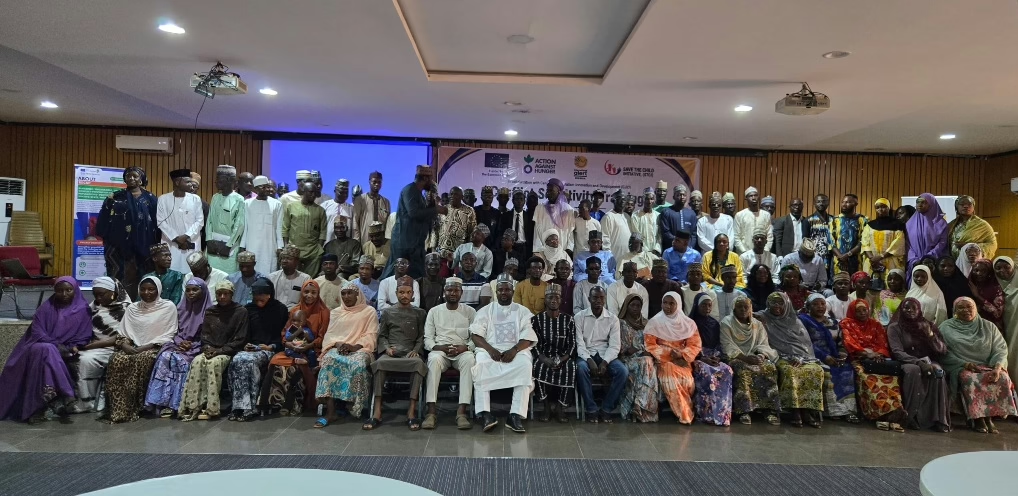
The Sultan made the declaration in Sokoto while represented by the Waziri of Sokoto, Professor Sambo Wali Junaidu, at the opening of a two day conflict sensitivity training workshop for media practitioners and influencers.
The programme was organized by the European Union, Action Against Hunger, International Alert and Save the Children Initiative (STCI), in partnership with the Nigerian Union of Journalists (NUJ), Sokoto State Council.
The Sultan stressed that peace should not be treated as an abstract ideal, but as a fundamental condition for human existence, development and the practice of religion.
He stated emphatically: “Without peace, nothing will move forward; without peace, you cannot conduct your religion.”
He therefore urged stakeholders, particularly journalists and other influential voices, to make the promotion of peace a central responsibility, warning against narratives capable of deepening religious, ethnic, political and communal divisions.
According to him, the media has enormous power to shape public opinion, influence human behaviour and either reduce or intensify tensions, making responsible and conflict sensitive journalism essential to peace building.
The Sultan called on media practitioners to exercise professionalism, restraint, accuracy and fairness, particularly when reporting conflicts and other sensitive issues capable of provoking public tension.
He said peace must be promoted not only in Nigeria but across the world, stressing that societies cannot achieve sustainable development where violence, hatred, intolerance and division dominate public life.
Earlier, the Chairman of the NUJ, Sokoto State Council, Comrade Usman Muhammad Binji, commended the supporting organisations for facilitating what he described as a long awaited capacity building programme for working journalists in the state.
Binji urged participants to take the training seriously and apply the knowledge and skills acquired to strengthen peace and stability in communities across Sokoto State and Nigeria.
He noted that journalists have a profound responsibility to ensure that their reports do not inadvertently fuel conflicts, spread misinformation or aggravate already fragile relationships among communities.
Also speaking, the Chairman of the Sokoto State Council of Ulamas, Sheikh Sidi A. Sidi, challenged journalists to uphold accuracy, balance and professional integrity in their reporting.
Sheikh Sidi warned against allowing religious, ethnic or political considerations to influence news gathering and dissemination, urging journalists to remain committed to facts irrespective of the identity or affiliation of individuals involved.
He stressed that inaccurate or deliberately distorted reports on religious and communal matters could have devastating consequences, particularly in an environment already vulnerable to misunderstanding and conflict.
The workshop also seeks to establish a Community of Practice through which journalists, media influencers and other stakeholders can sustain collaboration, exchange knowledge and promote conflict sensitive approaches to journalism beyond the training.
The initiative is expected to strengthen the capacity of participants to identify conflict triggers, avoid inflammatory narratives and use the media as a platform for dialogue, reconciliation, tolerance and peaceful coexistence.
The gathering underscored the growing recognition that the battle for peace cannot be won through security measures alone, as credible information, responsible journalism, constructive public discourse and community engagement remain critical weapons against conflict.
With Nigeria and several other countries facing security challenges, communal tensions and deepening social divisions, participants were urged to deploy the enormous influence of the media towards building bridges rather than widening existing fault lines.
The central message from the workshop was clear: peace is the foundation upon which development, freedom of worship, social stability and human prosperity are built and its protection must remain a shared responsibility beyond political, religious, ethnic and national boundaries.