Table of Contents
Yawale Adamu
A Deputy Chairman of Darazo Local Government paid N20,000 for 50 hectares of protected forest land, N400 per hectare for land that smallholder farmers would later buy from him and others like him at N35,000 per hectare. Sixteen people are now dead.
Payment receipts and official allocation letters obtained by WikkiTimes show that parts of the Aliya and Yautare forest reserves, gazetted public land under Bauchi State authority, were distributed in 2022 to politically connected individuals and traditional rulers at prices no ordinary farmer could access.
Those first-tier beneficiaries resold their parcels into a secondary market at markups of up to 8,650 percent, leaving smallholder farmers holding government-issued documents for land that herders, displaced from their traditional grazing routes by the same scheme, would later reclaim by force.
The officially recorded death toll stands at 16: ten people killed in Misau, one in Zaki LGA, one in Bogoro LGA, and five police officers in Darazo. Several additional casualties among farmers and herders remain unconfirmed. Not one official has faced prosecution.
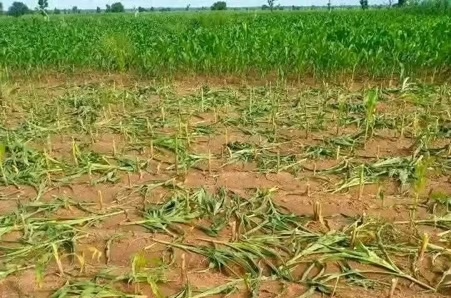
At dawn in an open space deep inside the Aliya Forest, Auwalu Sade, a farmer, while inspecting what remained of his farmland, found that the crops had been flattened, the surrounding huts had been burnt, and the ground was littered with ash.
Just a few months earlier, he had paid hundreds of thousands of naira to clear the ten hectares of land he had purchased from Darazo local government officials.
He said he spent a lot on harrowing, tilling, seeds, and other planting operations, hoping for a bumper harvest.
“The thought of losing all my investments to the inhuman activities of herders still remains hurtful. I have spent hundreds of thousands, but they are all in vain”, Sade told WikkiTimes.
Like Sade, many farmers continue to live in anguish, haunted by the painful memories of their investments in farming, allegedly wasted by the herders as they matchetted some while feeding others to their animals.
The farmlands, he said, were allocated legally to them by government officials, noting that after farming for a few years, herders later claimed that the farmlands were their grazing reserves.
“I bought ten hectares of land at the rate of N35,000 per hectare, so if you calculate, I have paid N350,000 cash. I was later allocated the land by government officials after they checked and verified my payments.
“So, how can just one day some herders will come and claim ownership of the lands, not only do they claim the lands but destroy all that we planted?”, he queried.
Other farmers told WikkiTimes that their farmlands were allocated by authorities after they purchased from local officials, traditional rulers, or influential figures within the state.
In 2022, in a bid to promote agriculture and food security, the State Government allocated 2,500 hectares for farming in Aliya and Yautare Forests.
However, most of the land allocations were allegedly later resold to smallholder farmers by powerful individuals who had received them.

The process, according to findings gathered during field visits and interviews with local farmers, has triggered farmer–herder conflicts, fueled environmental destruction, and exposed serious gaps in government oversight.
An allocation document of two hectares for a traditional ruler
According to multiple accounts, some beneficiaries who received large parcels of land reportedly sold the plots to smaller farmers, creating a secondary land market inside what should have remained a protected forest.
“The people who got the land are not farmers. They took the land because they have connections”, a traditional ruler told WikkiTimes on condition of anonymity.
A payment receipt reviewed by WikkiTimes shows that a deputy chairman, Bello Haruna, was allocated 50 hectares of land in Aliya forest for N20,000, while another paid M15,000 for the same size of farmland, corroborating claims by farmers who bought the land as second-tier buyers at exorbitant prices.


Farmers Caught in a Dangerous Dispute
The situation took a violent turn when disputes erupted between farmers cultivating the newly acquired lands and pastoralists who traditionally moved their cattle through the area.
Locals near Aliya and Yautare reserves said herders later attacked several farms, accusing farmers of blocking grazing routes and destroying pasture.

Recounting his experience, Jibrin Taura said he narrowly escaped death while working on his farm, as the herders came, destroying plants and inflicting machete cuts to anyone who dared to challenge them.
“Everything we planted was destroyed. I was working on one of my farms when I heard my neighbour calling for help. First, I thought he had a snake bite, but as I stood up, half of my farm was filled with cows grazing on near-harvest millet”, Taura said with tearful eyes.
“We lost millions of naira. All my hopes were on what I thought I would get during harvest season, but I took it as an act of God”, he added.
The attacks reportedly resulted in significant destruction of farmland and property, leaving many farmers in financial distress, while several lives, including those of police officers, were lost in the incidents.
A farmer, Ali Gabchiyari, said that he was lucky to have harvested part of his crops after a peace agreement was brokered between the two parties.
He noted that only a few of them enjoyed the opportunity, as herders returned and launched further attacks on their farms.
According to him, he acquired the farmlands after disposing of his most valued farmland, the one he inherited from his ancestors.
“I have sold my inherited farms in my village to buy the newly approved lands in Yautare. I followed all the procedures, and it was allocated to me after showing all the evidence.
In fact, they checked on the map before allocating the hectares to me”, Ali said.
Fulani Leaders Distance Themselves from the Attacks, Blame External Forces
The leaders of the two main Fulani groups in Darazo, the Miyatti Allah Kautal Hore and Kautal Fulaku, have distanced themselves from the alleged atrocities, saying it was external forces, not indigenous Fulani, who perpetrated the acts.
Jingi Shadarki, the leader of the Miyatti Allah Kautal Hore, while addressing members of the two groups after the incidents, acknowledged that the area has suffered incalculable losses due to the violence, which, he said, has left a deep scar on the relationship between farmers and herders.
In a video seen by WikkiTimes, Shadarki said that, as peace-loving and law-abiding groups, they would not in any way engage in acts that would jeopardize the state’s peaceful atmosphere, noting that a non-member group was responsible for the mayhem in the forests.
“Darazo LGA has suffered huge economic losses; we have all witnessed it, but we will not allow this to happen again. Previously, we were not united, which led to unpleasant events. This happened as a result of lapses in our leadership, but it has to be stopped”, Shadarki said.
He vowed that they would not fold their hands to allow unscrupulous elements to tarnish the good image of the peace-loving Fulanis in the LGA, while calling for understanding from farmers.
For his part, Bello Jingi Gabarin, Chairman of the Kautal Fulako, corroborates, “What happened has taught us a bitter lesson; it is high time we unite ourselves. These acts were perpetrated by Fulanis who are independent; they are not members of either Miyatti Allah or Kautal Fulako”, he emphasized.
However, the Chairman of the Sade Farmers Association, Aminu Abubakar, alleged that it was a combined team of invited Fulanis from outside the area that destroyed their farmlands.
Alh. Abubakar, who is also the treasurer of the Amalgamated Farmers Association (Hadaka) in Darazo LGA, noted that for the past two years, farmers and herders in the area have lived in harmony, except this year.
“It was a gang up on us. They were invited from outside our areas; they are not the indigenous Fulanis with whom we have lived for a long time. These ones are real terrorists since they can kill or injure anyone who dares to stop them”, he said.
On the state government’s revocation of farmland allocations and the establishment of a fact-finding committee, he said they welcomed the idea and called for fairness to both sides in the interest of justice and peace.
He, however, alleged that the ongoing demarcation of the grazing land is likely to favour certain interests, pleading with the committee, especially the local government team, to be transparent and accountable in the exercise.
“They said there were irregularities during the allocation exercise, but who allocates the lands? Was it not the government officials? We, the farmers, were given the lands by the government, and if there are faults, it was the officials who did it, and as such they are the ones to be held responsible”, he said.
The chairman said that if the government wants to be transparent in the exercise, the original owners of the lands whose farms are not affected should be returned to them in the interest of justice.
“What we are appealing to the government is that any farmer whose farmland is not affected should be returned to him. This will prevent future occurrences of clashes because it will not augur well if injustice prevails in the exercise”, he advised.
Lack of Accountability
Several residents alleged that the allocations were carried out with little transparency, allowing officials responsible for land management to operate without effective oversight.
The absence of clear records and public documentation also makes it difficult to determine the exact number of hectares allocated or the identities of all beneficiaries.
“These lands were allocated to influential individuals and highly connected politicians; the local government officials know how many hectares were allocated because, as a layman, an ordinary farmer can not just claim ownership of the farm without being allocated to him by the government,” said a traditional ruler whose name was withheld for fear of persecution.
However, several efforts to speak to the Chairman of Darazo L.G.A, Sama’ila Ya’u, were not successful. Several calls put through to him went unanswered, and WhatsApp and SMS sent to him had not been responded to as of press time.


Screenshot of WhatsApp message sent to the Darazo LGA Chairman
When contacted, Muhammed Sani Abdu, the Information Officer at the Bauchi State Ministry of Land and Survey, confirmed that local officials had overallocated the approved hectares and noted that the issue is being handled by a committee set up by the state government.
Although he declined to share details of the committee’s findings, Abdu said what remains is the office work, as the government has finished its investigations into the incidents surrounding land allocation in Darazo LGA.
“They (Darazo local government officials) are responsible for what happened. As a result, the then local government chairman was removed from office. All details of the circumstances are with the committee”, Abdu told WikkiTimes before he hung up the call.
Further attempts to reach him proved abortive, as calls to his number were blocked.
Legal Experts React, Say Victims are Entitled to Compensations
Umar Shehu Damagun, a legal expert, said the government has the right to revoke any land allocation, but only with adequate compensation.
According to him, before revoking any land, it must be based on overriding public interest, including peace, and, in situations where the government realigns the land, the original owners of the disputed land must be given preference over any other individual.
“The law is clear about this: all land belongs to the government, and it has the right to revoke land, but it must be for a public interest. But it can’t revoke your land and be reallocated to anyone unless the government wants to do something in the land for public use”, he said.
Another legal luminary, Idris Safiyanu Gambo Esq, said the victims are entitled to compensation under the Land Use Act and Section 44 of the Constitution, which addresses the compulsory acquisition of property.
“The victims are entitled to compensation or reimbursement as contained in Section 44 on Compulsory acquisition of property”, he said.
A report by SBM Intelligence warned that violent land disputes are driving food insecurity, economic pressure, and market disruption across Nigeria.
In a report titled “The Price of a Parcel: An Analysis of Land Disputes and Their Impact on Food Security in Nigeria,” the SBM attributed recurring conflicts undermining agricultural production to longstanding weaknesses in land governance, including unresolved tensions over communal, family, and formal ownership.
The report, which analyzed 54 violent land-dispute incidents between October 2019 and January 2026 and a survey conducted across the six geopolitical zones, found 112 fatalities were confirmed. It added that land-related violence is no longer a localized issue but a national economic and food-security concern.
“The findings also show that the impact of land disputes varies across the country but remains significant nationwide. In some locations, traders reported severe supply chain disruption linked to insecurity on farming routes and in producing communities.
In others, weak land administration, delayed justice, and poor dispute resolution mechanisms were identified as major obstacles to stability and investment”, it said.
Repeated Committees with little Actions
Prior to the Darazo incidents, deadly clashes between farmers and herders have occurred in the state. In July 2020, after a deadly clash in Misau LGA, the government set up the Air Commodore Tijjani Baba Gamawa(rtd) committee to investigate the causes of the conflict.
However, many argue that the reports and others prior have not been implemented, and in an open letter addressed to Governor Bala Mohammed, Musa Azare, a former aide to the governor, argued that the real problem lies in the failure to act on the recommendations of past committees constituted by the same administration.
Azare cited other committees, such as the Late Surveyor Yahaya Baba Committee of Inquiry, and the Auwal Jatau Committee, saying implementing their reports would reduce clashes and promote peace.
He argued that the committees produced reports and White Papers identifying illegal allocations, encroachment on grazing reserves, and abuse of land-use regulations, all of which should be addressed.
Azare further argued that the continuous creation of “committee after committee without implementing the findings of previous reports leads to confusion and a loss of direction regarding the appropriate course of action.”
He added that the widespread and arbitrary allocation of forest reserves, grazing lands, and cattle routes originally gazetted in the 1940s, 1950s, and 1960s is at the heart of the conflicts.
He alleged that many hectares of land designated for agricultural use and grazing have been reassigned to politicians and other individuals who are neither farmers nor pastoralists.
This report was produced with support from Civic Media Lab