Sufyan Lawal Kabo
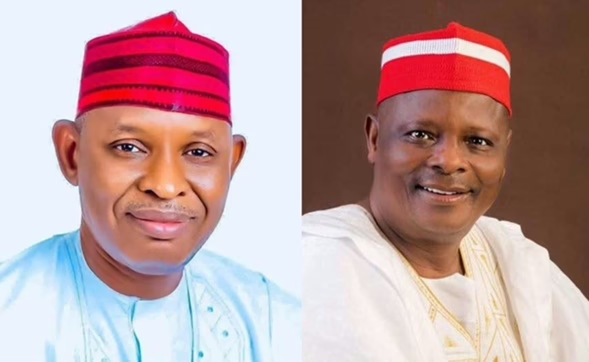
In recent times, a growing chorus has attempted to frame the evolving political relationship between Rabiu Musa Kwankwaso and Abba Kabir Yusuf as one of betrayal. It is a narrative driven more by emotion than by facts, more by loyalty to personalities than by commitment to the people of Kano State.
Yet when one carefully examines the situation with calm reasoning and historical perspective, a different picture emerges, one that compels us to ask a more honest question. Who truly stands with the people, and who is driven by personal political preservation.
To begin with, it must be clearly stated that Governor Abba Kabir Yusuf has never publicly demonstrated hostility toward his political mentor.
There has been no confrontation, no public denigration, and no reckless statements that suggest a breakdown of personal respect. The pleasantries remain. The restraint remains. The discipline remains.
What we are witnessing is largely a battle among supporters, political aides, and overzealous loyalists on both sides, many of whom have turned what should be a strategic political discussion into a theatre of personal attacks.
Even in mature democracies, leaders cannot completely control the tone and conduct of their followers, especially in a politically vibrant environment like Kano, where political consciousness runs deep and emotions often run high.
Notably, on several occasions, Governor Abba has cautioned against such excesses, signaling his preference for civility over chaos.
Furthermore, the issue of political realignment must be understood within the broader context of Nigeria’s evolving party system. Politics is not static. It is dynamic and often requires difficult decisions. If indeed a shift becomes necessary, it cannot automatically be labeled as betrayal.
The reality on the ground is that parties rise and fall in strength and relevance. A leader at the helm of a state cannot afford to operate in isolation from national political currents.
Strategic alignment is often essential for securing federal collaboration, attracting investments, and ensuring that the interests of the state are protected. Across Nigeria’s political history, leaders have moved across parties in pursuit of what they consider the best platform to serve their people.
Such decisions, while controversial, are often rooted in pragmatism rather than treachery.
We must also confront a fundamental truth about politics and human nature. No leader is infallible. Not even Rabiu Musa Kwankwaso himself. Political history in Kano reminds us that even the most respected figures have made strategic miscalculations.
The contest between Kwankwaso and Ibrahim Shekarau remains a case in point, where political dynamics did not favor him at a critical moment. If such moments have occurred before, it is neither unreasonable nor disrespectful to suggest that similar risks could arise again.
Governance is too important to be tied to blind loyalty when caution and foresight are required.
More importantly, the concept of betrayal itself must be properly defined. Betrayal in governance is not about disagreement between two individuals. It is about the failure of a leader to serve his people.
If Governor Abba Kabir Yusuf were to abandon his campaign promises, neglect development, or compromise the welfare of Kano citizens, then and only then could the word betrayal find legitimacy. But the reality on the ground suggests otherwise.
Across sectors such as education, healthcare, infrastructure, youth empowerment, agriculture, water supply, and security, the administration has demonstrated visible commitment. Projects are ongoing. Policies are being implemented. Communities are witnessing tangible impact.
Public sentiment, as reflected in various engagements and feedback channels, indicates growing satisfaction with the direction of governance. By this standard, it is difficult to argue that the governor has betrayed the people.
At this point, it is also necessary to reflect on political history involving Kwankwaso himself. His own journey has included moments of divergence from political associates and mentors, including figures like Abubakar Rimi and others within Kano’s political landscape.
These shifts were never universally condemned as betrayal by the people. Rather, they were understood as part of the natural evolution of political leadership.
Why then should a similar development today be interpreted differently.
Why should one standard apply to the past and another to the present.
Equally worthy of reflection is the pattern observed among some of Kwankwaso’s closest political associates over the years. Figures such as Abdullahi Umar Ganduje, Yunusa Dangwani, and Aminu Dabo have at various times distanced themselves politically.
While no leader can retain every ally indefinitely, a recurring pattern of high profile departures naturally invites introspection. It raises the question of whether the issue lies solely with those who leave or whether there are deeper structural and leadership dynamics at play. This is not an accusation but a call for honest reflection.
There is also a broader philosophical issue at stake. Leadership must ultimately serve the people, not personal networks or political hierarchies.
When decisions are made, the guiding principle should be public interest. If Governor Abba Kabir Yusuf’s actions are driven by a desire to strengthen Kano’s position, enhance development, and secure a better future for its citizens, then such actions must be evaluated on their merit, not on their alignment with individual expectations.
Interestingly, global political history provides useful parallels. In many countries, protégés have at times taken independent paths from their mentors, leading to stronger governance outcomes.
One notable example is the relationship between Nelson Mandela and subsequent leaders who, while respecting his legacy, made independent decisions suited to their time.
Leadership evolves. Context changes. What matters most is the outcome for the people.
As we draw to a close, I, Sufyan Lawal Kabo, offer this sincere counsel to Rabiu Musa Kwankwaso. The title of Jagora is not diminished by stepping back. In fact, history honors those who lead from behind with wisdom and restraint.
The great Ahmadu Bello had the opportunity to pursue the highest office in Nigeria, yet he chose to remain Premier of Northern Nigeria, prioritizing regional stability and development over personal ambition. Similarly, Aminu Kano built a legacy not on control but on ideological leadership and grassroots empowerment.
True greatness lies not in holding on, but in knowing when to guide quietly and allow others to lead boldly.
Kano stands at a critical juncture. Its progress must not be hindered by personal disagreements or mischaracterizations.
If there is any betrayal to be feared, it is the betrayal of the people’s trust. And on that count, the evidence so far suggests that Governor Abba Kabir Yusuf remains firmly aligned with the aspirations of Kano’s citizens.
History will judge, not by loyalty to individuals, but by service to the people.