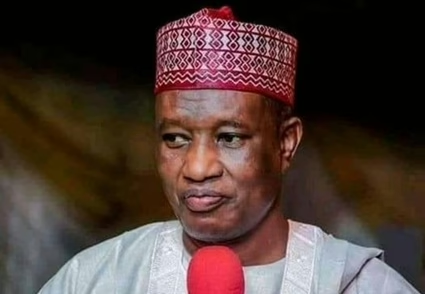
Comrade Najeeb Nasir Ibrahim
The resignation of the Deputy Governor of Kano State represents a significant turning point in the state’s recent political developments.
For weeks, the political atmosphere in Kano had been dominated by tensions between the deputy governor and the Kano State House of Assembly, creating uncertainty that threatened to distract the government from its primary responsibilities.
In any democratic system, political disagreements are inevitable. However, when such disputes begin to interfere with the smooth functioning of government institutions, they risk undermining public confidence in leadership and governance.
The prolonged controversy surrounding the deputy governor had reached a point where many observers believed a decisive step was necessary to restore stability.
Within this broader context, the decision to resign can be interpreted as a move that helps ease the political tension that had been building in the state.
While the former deputy governor continues to maintain his innocence regarding the allegations raised against him, stepping aside has created room for the government to redirect its attention toward governance and public service.
Political stability within the executive arm of government is essential for effective leadership. Kano State, as one of Nigeria’s most influential political and economic centers, requires a leadership structure that operates with unity, coordination, and focus.
When internal conflicts dominate the political landscape, attention is inevitably diverted from critical issues such as economic development, education, healthcare, security, and youth empowerment.
The situation also highlights the important role of democratic institutions in addressing political disagreements. The Kano State House of Assembly exercised its constitutional authority in initiating proceedings concerning the deputy governor’s conduct.
While such processes may generate controversy, they remain a vital mechanism for ensuring accountability within a democratic system.
At the same time, the resignation reflects a political decision that prevents further escalation of tensions between key institutions of government.
By stepping aside, the former deputy governor has allowed the administration to move forward without the constant pressure of an unresolved institutional confrontation.
Looking ahead, the challenge before the Kano State Government is to transform this moment of political transition into an opportunity for renewed focus on governance and development.
Citizens expect tangible progress in areas such as infrastructure, job creation, youth empowerment, and improved social services.
Beyond Kano State, this development also offers broader lessons for Nigeria’s democratic environment. It demonstrates that political crises can sometimes be resolved through decisions that prioritize institutional stability and the continuity of governance over prolonged political confrontation.
For Kano, the hope is that this moment will mark the end of a period of political distraction and the beginning of renewed commitment to governance and development.
With the tension surrounding the deputy governor now eased, the administration has a clear opportunity to demonstrate that delivering the dividends of democracy remains its highest priority.