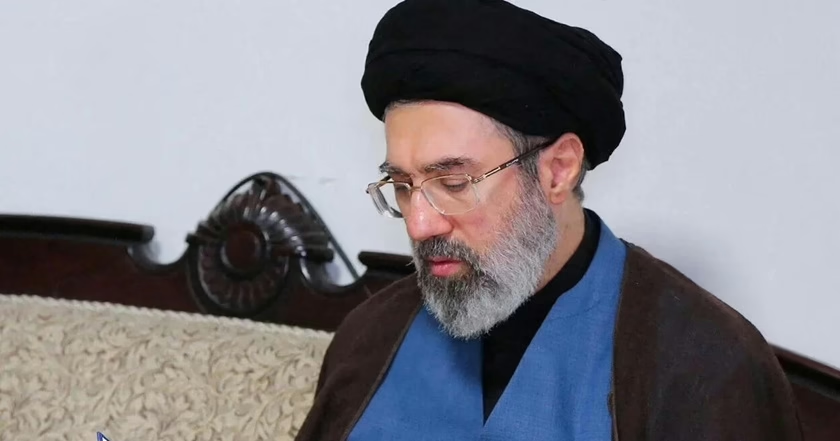
For the second time, Iran’s theocratic rulers have chosen Khamenei as Supreme Leader of the Islamic Republic, naming Mojtaba Hosseini Khamenei to succeed his father, who was killed in Israeli airstrikes on 28 February 2025.
Khamenei, 56, is the second son of Ali Khamenei, who led the Islamic Republic for 36 of its 47 years after succeeding its first leader, Ruhollah Khomeini. Mojtaba’s wife and, reportedly, one of his children, were also killed on the first day of the joint U.S.-Israeli war.
He has not previously held any official position, but had a reputation both as a powerful figure behind the scenes, and for manoeuvring for years to succeed his father in a position that wields power almost unbound by any checks or balances.
“From more than 20 years ago when rumors began that Mojtaba has ambitions to replace his father one day, I have watched with horror as the requisite pieces for what can only be described as a hereditary succession fell in place year after year,” said one political activist, who declined to be named out of fear of retribution.
Read more: Ali Khamenei, Iran’s Supreme Leader Who Built a De Facto Military Dictatorship, Killed in U.S.-Israeli Strikes
The move doubled as an act of defiance against Iran’s attackers, who are evidently intent on regime change. On March 3, Israel bombed the building where the 88 clerics known as the Assembly of Experts would meet to choose a successor.
And President Donald Trump, after calling the elder Khamenei “one of the most evil people in history,” had already called the younger Khamenei “unacceptable.”
“He’s going to have to get approval from us,” Trump told ABC News on Sunday, hours after news of the selection emerged.
“If he doesn’t get approval from us, he’s not going to last long. We want to make sure that we don’t have to go back every 10 years, when you don’t have a president like me that’s not going to do it.”
The selection was announced by SMS to Iranians, among whom Mojtaba Khamenei has long had a reputation for skullduggery and power plays.
When Mahmoud Ahmedinejad, then the relatively unknown mayor of Tehran, was propelled to the presidency in 2005, Mojtaba Khamenei was thought to have orchestrated the Islamic Revolutionary Guard Corps (IRGC) and Basij paramilitary’s support for his candidacy.
As the years passed, behind the serene facade of studying and teaching at the seminary in the religious city of Qom, more claims and rumors narrated the ever-increasing influence and power wielded by Mojtaba.
The common thread was that younger Khamenei enjoyed the same close support that his father had maintained with the Revolutionary Guards, whose sources of both economic, political and military power have all been put in danger by the massive U.S. and Israeli airstrikes of the past week.
On Sunday, the IRGC issued a statement pledging “deep respect, total loyalty and absolute obedience.”
“The Guards aren’t just fighting for proxy groups or missiles, they are fighting for their very existence,” said another analyst based in Tehran, who spoke on condition of anonymity.
“The cartel they had created, an octopus that had tentacles in almost every vestige of the Iranian society, from economy, to media, to religion, has constrained all the other many actors and factions with the Islamic Republic.”
“Many of these factions are almost openly calling for the limiting and even disbanding of the Guards. Should anybody from any of these factions become the new leader, the days of the Guards will be numbered,” he added.
The attacks on Iran may have paved the way for Mojtaba’s rise, but they leave little room for him to change the country’s course.
The war has instead solidified the country’s “revolutionary” ideology, which casts Iran as the global challenger to Western hegemony, and given the new leader a personal reason for hostility to the U.S.
“If before there was even the slightest of chances that Mojtaba Khamenei might take the country down a path of major reforms, such as those initiated by the Saudi crown prince Mohammad Bin Salman, which would include détente with America, it’s now impossible,” the analyst said.
“Mojtaba didn’t lose just a father on that day, he lost a mother, a wife and a child. He is filled with an undying desire for revenge, and the Guards know this.”
Trump’s opposition to Khamenei’s son may even have helped his ascendancy.
“While it was always highly probable that Khamenei’s son would replace him, there had been mounting efforts by other factions to sway the vote of the 88 members of the Experts Assembly in recent months,” the activist said.
“But when Trump, as enemy number one of the regime, said he would not accept Mojtaba Khamenei, it became almost a certainty that he would be elected. Anyone who opposed him could be easily accused of being in America’s camp.”
Concern that the new leader may be targeted may also explain the stuttered timing of the announcement, five days after it was first tipped.
The delay allowed the announcement to coincide with a day of particular religious importance in the Shiite calendar, but also to make sure he is safeguarded from attacks the United States and Israel are bound to conduct against him.
“Ensuring the security of the new leader is even more important than how he was selected,” said Ali Gholhaki, a hardline columnist known for his close ties to the security establishment, in a post on social media.
“We [must] prevent the continuation of recent bitter events,” he said, referring to the killing of the elder Khamenei.
(TIME)