Rekpene Bassey
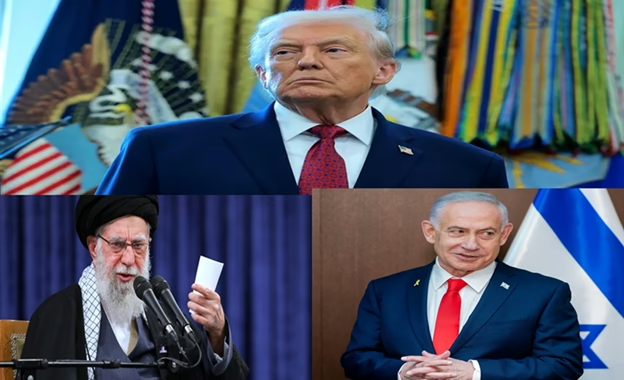
The declaration by U.S. President Donald Trump that American forces have commenced “major combat operations” inside Iran under the codename Operation Epic Fury marks one of the most consequential military escalations in Middle Eastern geopolitics in recent decades.
Whether framed as a calibrated show of force or the opening salvo of a broader campaign, the declaration fundamentally alters the strategic equation between Washington, Tehran, and their respective allies.
Coming on the heels of Israeli airstrikes on Tehran and Iran’s retaliatory missile launches targeting U.S. facilities and allied interests in the Gulf, the region now stands at the threshold between deterrence and full scale war. The stakes extend far beyond bilateral hostility; they implicate global energy markets, great power rivalry, nuclear non-proliferation, and the fragile security architecture of the Middle East.
The strategic backdrop of the current conflict has emerged from decades in the making.
The crisis cannot be understood without reference to the rupture created by the Iranian Revolution, which reoriented Iran from a U.S.-aligned monarchy to an ideologically driven Islamic Republic openly hostile to Western influence. Since 1979, the U.S.–Iran relationship has oscillated between cold hostility and proxy confrontation, never normalizing and periodically erupting into an overt crisis.
The nuclear dimension intensified after Washington withdrew in 2018 from the Joint Comprehensive Plan of Action (JCPOA), commonly known as the Iran nuclear deal.
Tehran’s gradual breaches of enrichment limits, coupled with its development of advanced centrifuges and expanding missile arsenal, deepened fears in Washington and Jerusalem of an emerging nuclear threshold state.
For Israel, whose leadership views Iranian nuclear capability as existential, preemptive action has long been part of its strategic doctrine. For the United States, containing Iran intersects with broader goals: safeguarding Gulf allies, maintaining maritime security in the Strait of Hormuz, and projecting credibility amid rising global competition.
At this point the question emerges: Is Operation Epic Fury a demonstration of resolve or strategic gamble?
The operational profile of the current U.S. strikes: multi-branch coordination, precision targeting, and explicit messaging suggests a dual objective, to wit: degrading Iran’s nuclear and missile infrastructure while reasserting deterrence credibility.
The language employed, warning Tehran that it must not “challenge the strength and might” of American forces, signals more than tactical intent; it is strategic theater.
The United States is communicating not only to Iran, but to regional actors and global rivals that it has capabilities for escalation dominance.
Nevertheless demonstrations of strength can produce asymmetric responses. Iran’s military doctrine emphasizes hybrid warfare: ballistic missile saturation, drone swarms, cyber operations, and the activation of proxy militias from Lebanon to Iraq and Yemen.
Direct conventional parity is not Tehran’s objective; strategic persistence and calibrated retaliation are.
Iran’s missile launches against U.S. installations and allied interests in the UAE, Saudi Arabia, Bahrain and Qatar, among others, reflect this doctrine; limited but symbolically potent strikes designed to signal capability without necessarily crossing the threshold into total war. But this narrative may be altered by the inflammation of passion resulting from the killing of Ayatolah Ali Khamenei, Iran’s supreme leader.
A key issue in the conflict is the Israeli Factor.
This factor is premised on preemption and existential calculus. Israel’s earlier airstrikes against Tehran have injected a combustible variable into an already tense landscape.
For Israeli planners, preventing Iran’s nuclear advancement is not a matter of prestige but survival.
The declaration of a state of emergency and civilian shelter advisories underscore the seriousness with which Jerusalem anticipates retaliation.Israeli military doctrine rests on rapid, decisive operations to degrade adversaries before they consolidate strategic advantage.
However, a synchronized U.S.–Israeli offensive risks reinforcement for Tehran’s narrative of encirclement, potentially consolidating domestic support for retaliation.
The conflict seems to point to possible escalation pathways. One of such pathways is a tendency for miscalculation in this multipolar theater.
The greatest immediate risk lies not in deliberate escalation but in miscalculation. Several flashpoints loom in such miscalculation, among which are proxy activation.
Hezbollah in Lebanon or militia networks in Iraq could initiate secondary fronts, complicating Israeli and American defensive posture.
The other front is in maritime disruption. Closure or harassment of shipping through the Strait of Hormuz would shock global oil markets.
Then there is of course cyber retaliation. Iran has, has on its own, demonstrated capacity for disruptive cyber operations targeting energy and infrastructure sectors.
Great power involvement, is yet another angle of possible escalation.
Russia and China, both expressing concern, may increase diplomatic or material backing to Tehran, expanding the geopolitical footprint of the crisis.
Each vector multiplies uncertainty. For example energy security and global economics have potential for reverberations.
Roughly one-fifth of the world’s oil transits through the Strait of Hormuz. Even the perception of sustained conflict triggers price volatility.
A protracted confrontation would strain already fragile global supply chains and intensify inflationary pressures worldwide.
For Europe, heavily dependent on energy imports, escalation threatens economic stability.
For Asia, particularly China and India, the Gulf remains indispensable to energy security. Thus, the conflict reverberates far beyond the immediate battlefield.
The diplomatic equation borders on whether de-escalation can prevail. The European Union, Russia, and China have urged restraint, positioning themselves as potential mediators.
However , diplomacy faces formidable barriers. Such barriers include mutual distrust hardened by decades of hostility.
Domestic political pressures in Washington, Tehran, and Jerusalem could also be a telling factor in the conflict. This hinges on the reputational cost of appearing weak after overt military engagement.
Still, crisis history suggests that even the most heated confrontations often culminate in tacit understandings. The key question is whether back-channel diplomacy can outpace battlefield momentum.
From strategic assessment a question for the end game resonates. Where does the conflict lead to? Outright but brief war, deterrence, or prolonged standoff? Three plausible trajectories emerge in reflection.
First, controlled escalation followed by deterrence reset. Limited strikes and counter-strikes conclude with implicit red lines reestablished. This outcome preserves faces for all parties while avoiding full-scale war.
Second , regional conflagration through proxy fronts ignite, maritime routes are disrupted, and sustained air and missile exchanges ensue. This scenario would profoundly destabilize the Middle East.
Third, extended hybrid conflict ensues. Rather than open war, the region slides into prolonged cyber, proxy, and covert engagements; an intensified version of the shadow war already underway.
Finally we arrive at a crucial inflection point.
The present confrontation is not merely a bilateral dispute; it is a test of deterrence, alliance credibility, and the resilience of the global order.
Iran’s next moves will be critical and urgent, but so too will Washington’s calibration of force and Israel’s threshold for further preemption.
History demonstrates that wars in the Middle East rarely unfold according to initial design. Strategic signaling can harden into strategic entrapment.
The coming days will determine whether Operation Epic Fury becomes a footnote in coercive diplomacy, or the opening chapter of a wider regional conflict.
For now, the world watches as the balance between power projection and prudence hangs in precarious equilibrium in the current U.S – Iran and Middle East crisis.
Bassey is the President of the African Council on Narcotics, Drug Prevention and Security Specialist.