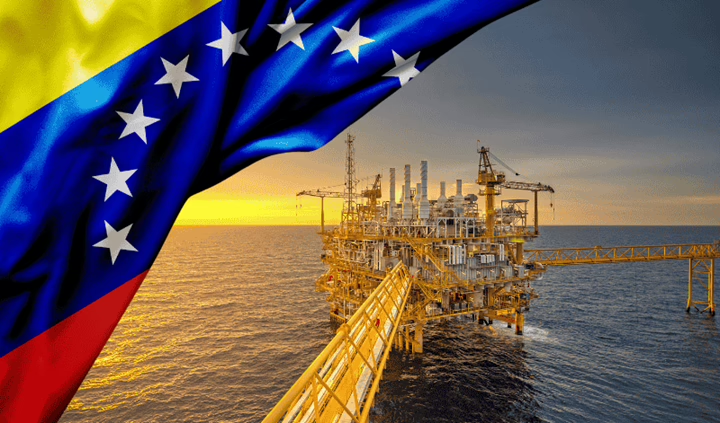
Just days ago, Shell announced that newly issued U.S. general licenses for oil and gas exploration in Venezuela would allow it to advance its long-stalled Dragon gas project, tapping into an estimated 4.5 trillion cubic feet of natural gas reserves off Venezuelan shores and potentially bringing first production online within three years.
The development reflects broader shifts in investor sentiment and regulatory frameworks in one of the world’s most resource-rich but politically complex energy landscapes, and holds timely lessons for African energy producers seeking foreign capital and technical partners.
Since the Trump administration’s sanctions regime in 2019, Venezuela’s hydrocarbons sector has been largely isolated from global markets.
Chevron, bp, Repsol and Shell now stand among the companies authorized to engage in energy projects and transactions, following an expansion of licenses issued by the U.S. Treasury’s Office of Foreign Assets Control (OFAC).
Under these general licenses – including GL 46A and GL 48 – U.S. companies can participate in certain exploration, production and service activities previously prohibited, provided they comply with strict oversight, reporting and contractual conditions.
Shell’s Dragon project, which had been stalled for years due to shifting U.S. policy and sanction uncertainties, illustrates how regulatory clarity can reshape risk perceptions.
More than a decade in planning, the Dragon field’s revival depends on OFAC’s clear, predictable licenses that provide foreign investors with a defined legal pathway for engagement.
This recalibration of U.S. sanctions policy coincides with legal reforms inside Venezuela.
A recent draft amendment to the Hydrocarbons Law promises to expand private participation, granting greater operational autonomy and offering more attractive terms for investors – a significant departure from decades of strict PDVSA-dominated control.
Together, these changes are reshaping investor sentiment in Caracas and beyond. Energy companies and project developers who once dismissed Venezuela as unbankable are now cautiously evaluating opportunities, recognizing that legal certainty, enforceable contracts and predictable policy signals – not just resource potential – unlock capital flows.
Similar dynamics are playing out in Africa. Despite abundant reserves, with Nigeria, Angola, and Mozambique among the continent’s most resource-rich nations, investment often stalls at the project development and financing stage rather than at resource discovery.
Clear regulatory frameworks, credible market participants and enforceable contracts remain prerequisites for attracting significant capital.
“The conditions that are unlocking foreign capital in Venezuela are precisely what Africa must prioritize to attract and sustain global energy investment,” says NJ Ayuk, Executive Chairman of the African Energy Chamber.
“Strong host-government agreements, enforceable fiscal terms and reliable dispute-resolution mechanisms will distinguish projects that receive funding from those that remain on paper.”
These themes are front and center as industry leaders prepare for African Energy Week 2026, scheduled for 12–16 October in Cape Town.
With capital markets tightening and competition for investor attention intensifying, African producers must demonstrate that their regulatory frameworks are as certain and transparent as the resource potential beneath their ground.
In Venezuela’s case, a market long sidelined by sanctions is beginning to re-enter global investment channels, not because the resources changed, but because policy frameworks and sanctions relief provided a credible pathway for engagement.
For Africa, the lesson is clear: credibility and legal clarity are strategic imperatives for unlocking the investment it requires.