Olu Allen
We often pretend Nigeria exists in isolation. It does not. It is part of a global pattern, only that our own version wears a more dramatic mask.
A writer, Angelo Giuliano, recently drew a striking comparison of power and wealth across nations. His reflections are worth borrowing before we bring the mirror home.
In the United States, oligarchs do not hide from power; they finance it. They sit in front rows, fund campaigns, write policy through lobbying firms, and then return to their corporations to profit from the laws they helped shape. It is not called corruption. It is called the system.
In Russia, the story took a different turn. When oligarchs became too powerful in the 1990s, the state moved to cage them. They were allowed to keep wealth but not power.
The message was simple: make money, but do not own the state.
In China, the wall between wealth and political authority was built even earlier.
Billionaires may exist, but none imagine themselves larger than the state. Money may breathe near power, but it does not sleep beside it.
Now, Nigeria.
For decades in Nigeria, wealth behaved differently.
The truly rich stayed quiet.
They avoided open political alignment.
They funded discreetly, whispered cautiously, and rarely showed their faces in public political battles.
Why?
Because power in Nigeria has always been unpredictable.
Today’s ally could become tomorrow’s investigation.
Today’s billionaire could become tomorrow’s example.
Silence was protection. Distance was insurance.
Their quiet was not just about future safety, but about ancestral memory. Many of today’s quiet fortunes were built in the embers of the last military regimes.
To speak too loudly was to risk stirring the ghosts of where the money came from. Discretion was the interest paid on unspoken national debts.
Politicians, on the other hand, amassed enormous wealth in office, often with little consequence. Justice rarely came. Accountability was mostly theoretical.
The only real fear of reckoning in Nigerian political history used to come during military coups, when the sudden change of power sometimes swept through the elite like a storm.
But something has shifted.
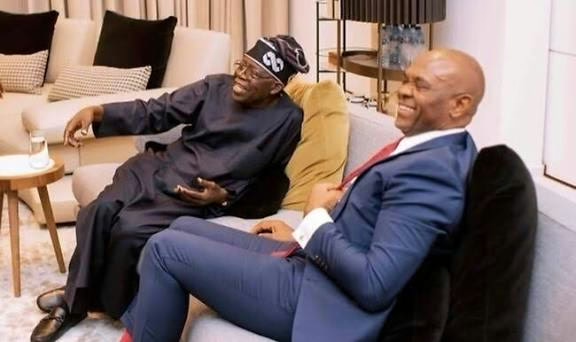
Under Bola Ahmed Tinubu, Nigeria is witnessing an unusual spectacle:
billionaires speaking loudly, openly aligning, publicly praising, and visibly celebrating political power.
They no longer whisper.
They no longer hide in the shadows of boardrooms.
They step forward, issuing statements, offering endorsements, attending state functions with visible pride.
This is new.
In Nigeria’s past, proximity to power was often concealed.
Now, it is performed.
The question is not whether rich men support governments, they always have.
The question is why they now do so without caution.
Is it confidence in stability?
Is it protection guaranteed?
Is it alignment of interests between state power and private wealth?
Perhaps the caution dissolved because the current administration sent a clear signal: this is not a tenant in power, but a landlord. The abrupt, painful economic reforms were a message to the elite.
We are burning the house down to rebuild it. You can either stand with us in the fire, or be consumed by it.’ The billionaires chose to stand in the fire, publicly, to ensure they were there for the rebuilding.
In America, oligarchs fund power and shape policy.
In Russia, oligarchs exist but under a tight leash.
In China, wealth never attempts to dominate the state.
Nigeria is writing its own version, one where the wealthy once hid from politics but are now stepping into the open arena without fear. This isn’t merely the return of crony capitalism.
This is the arrival of a political-industrial complex, where the line between a boardroom and a cabinet office is not just blurred, but deliberately erased.
And when the rich stop pretending to be neutral, it tells you something profound about where power truly sits.
A nation must always ask itself one uncomfortable question:
Are politicians controlling wealth…
or is wealth now standing confidently beside power because it knows it is safe there?
History shows that when money and power become too comfortable in the same room, the people are often the ones left outside the door.
The more urgent question for Nigeria is: who will be asked to leave the room first when the comfort runs out?
Allen writes from Kano, he writes on public affairs and promote good governance.