Olu Allen
There is something deeply revealing. and profoundly troubling. about a governor who inaugurates his tenure not by strengthening institutions, but by ritually dismantling the symbols of his predecessor.
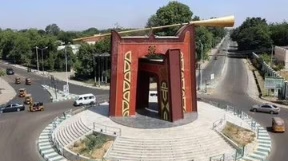
In Kano today, the removal of APC memorabilia and the demolition of structures such as those at Mallam Kato go far beyond partisan rivalry.
They announce a dangerous doctrine: that public space is partisan territory, and governance is a seasonal renovation project tied to party colours.
Governor Abba Kabir Yusuf has offered no compelling public-interest justification for these actions. Why should public structures, funded by taxpayers, be treated as partisan property to be erased?
This is not reform. It is symbolic cleansing: a familiar Nigerian ritual where political victory is mistaken for a licence to rewrite physical history.
From Rivers to Lagos, we have seen this theatre before. Each time, it is marketed as a “new beginning.”
Each time, it is merely the old politics of zero-sum competition, now executed with bulldozers.
Let us be clear: this is not a defence of the APC.
It is a defence of a foundational democratic principle. Public infrastructure belongs to the people, not to political parties.
A new administration inherits a duty of continuity, not a demolition permit for its opponent’s legacy.
This politics of erasure is compounded by an even more corrosive habit: mercenary defection.
Reports of Governor Yusuf’s impending switch from the NNPP to the APC were met not with outrage, but with weary resignation. In Nigeria, party defections no longer signal ideological realignment or moral reckoning.
They signal calculation. Politicians move like traders, following the market of power. currently defined by access to the federal centre, fiscal pipelines, and political immunity.
The hypocrisy is breathtaking. The same politician who yesterday branded the APC a “disaster” may tomorrow celebrate it as the “only platform for unity.”
There is no embarrassment because the system imposes no penalty for betrayal.
We should stop pretending otherwise: most Nigerian politicians do not belong to parties; parties are temporary vehicles they board and abandon. Ideology is decorative.
Manifestos are ceremonial. What matters is survival. When remaining loyal becomes inconvenient or risky, the voter’s mandate becomes disposable.
This is where the real damage occurs.
When an elected official defects after winning office:
The voter’s choice is adulterated. Citizens voted for a party-backed vision, not an individual shopping for better offers mid-term.
Governance becomes short-term and performative. Leaders who anticipate defection invest in symbols, not institutions.
Politics becomes transactional. Betrayal is rewarded with appointments and applause—not recalls, by-elections, or accountability.
The demolitions in Kano are the physical expression of this mindset.
They signal that governance is not continuity, that each administration may waste scarce resources to erase the past. Today it is APC symbols.
Tomorrow it will be NNPP’s. The result is a cycle of waste, bitterness, and instability, financed by citizens who need roads, schools, and jobs, not political theatre.
From Outrage to Guardrails
If Nigeria is serious about reform, indignation is not enough. We need enforceable institutional restraints:
A watertight anti-defection law
The constitution must be amended to eliminate the abused “division in party” loophole. Defection after election should mean automatic forfeiture of office.
The ballot as a binding contract
Electoral law should recognise the party platform as integral to voter choice. Defection must trigger recall mechanisms or by-elections.
A public asset charter
Any demolition or alteration of public infrastructure should require transparent legislative or judicial approval grounded strictly in public interest, not partisan impulse.
Final Word:
Calculators vs. Conviction
This is not about Abba Yusuf alone. He is a product of a political system that rewards shapeshifting and punishes consistency. But leadership is tested precisely at moments like this.
You may change parties, but you cannot transfer public trust.
You may demolish structures, but when you demolish continuity and stewardship, you govern nothing but resentment.
Nigeria is trapped in a cycle where calculators outrank conviction, survival trumps service, and demolishers replace developers.
Until institutions impose real costs on betrayal and erasure, our democracy will remain a fragile skeleton—constantly torn down before it can bear the weight of our aspirations.
Power is borrowed. Integrity is not. And once demolished, it is the hardest structure of all to rebuild.
Olu Allen writes from Kano. He writes on public affairs and promote good governance. He can be reached via oluallen1904@gmail.com.