Stephen Enoch
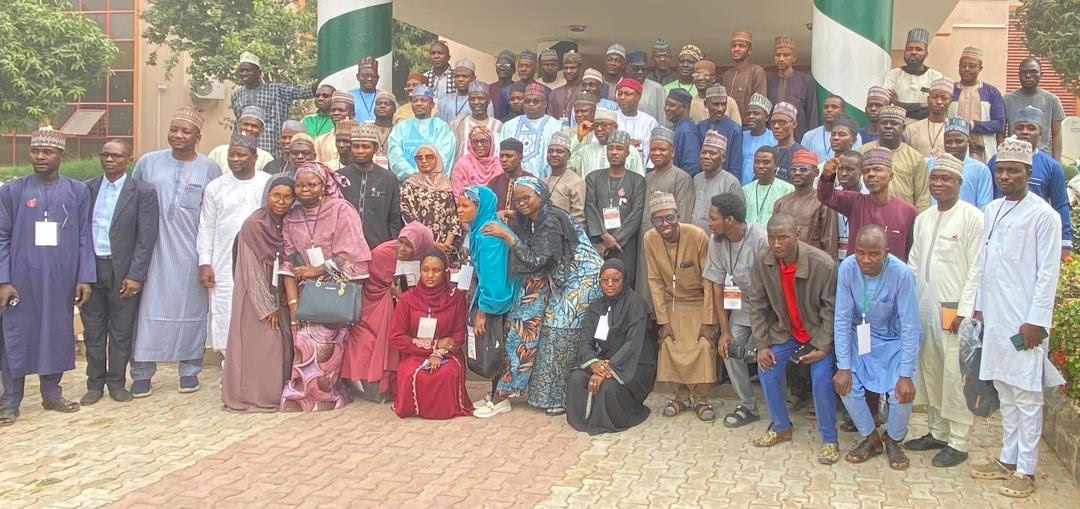
The Kano State Government, through the Ministry of Information and Internal Affairs, in collaboration with Kano Online Media Chapel (KOMC), hosted a two-day retreat for online newspapers in Dutse, Jigawa State.
The retreat, which is taking place from January 14 to 15, is supported by the Kano State Government through the Ministry of Information and Internal Affairs.
The activity, which is aimed at strengthening professionalism and ethical standards in digital journalism, is being held at the Human Development Centre, Dutse, Jigawa State.
The program is themed “Strengthening Digital Journalism through Ethical Practice and Responsive Online Engagement.”
It brought together members of the KOMC, Directors from the Ministry of Information, academics, and other seasoned professionals in journalism.
In his welcome remarks, the Chairman of the KOMC, Abubakar Dangambo, described the retreat as timely and essential.
He noted that the retreat is designed to enhance the skills of online journalists, deepen their understanding of ethics, and improve responsible engagement with audiences in the fast-evolving digital media space.
“Ethical standards must be continuously inculcated in journalists, especially those operating in the digital space.
“Digital journalism is dynamic and constantly evolving, making regular training and retraining unavoidable for practitioners who want to remain relevant and credible.
“The retreat is expected to significantly improve the capacity of members, enabling them to engage audiences responsibly while upholding accuracy, balance, and fairness in reporting,” he said.
The retreat was formally declared open by the Kano State Commissioner for Information and Internal Affairs, Comrade Ibrahim Abdullahi Waiya.
In his address, Comrade Waiya reaffirmed the Kano State Government’s commitment to journalism, describing the media as a critical partner in governance and development.
He said the government supported the retreat because of its belief in the power of ethical journalism to promote accountability, peace, and informed citizen participation.
Comrade Waiya noted that digital journalism represents the future of the media industry, but warned that without strong ethical foundations, it could easily be abused.
“There is a need for professionalism, drawing a clear line between online journalism and citizen journalism.
“While everyone can share information online, not everyone is a journalist.
“Professionalism must guide online journalism to avoid misinformation, sensationalism, and abuse,” he cautioned.
The Commissioner also affirmed that the Kano Government respects press freedom and is working towards developing a State Freedom of Information framework similar to the national Freedom of Information Act (FoIA).
In his remarks, the Chairman of the Kano State Council of the Nigeria Union of Journalists (NUJ), Suleiman Abdullahi Dederi, commended the Ministry of Information for facilitating the retreat.
He said trainings of this nature are crucial to safeguarding the future of journalism, particularly in Kano.
Dederi urged participants to apply the knowledge gained to their daily practice.
The Kano State NUJ Chairman stressed that doing so would help distinguish professional journalism from casual social media content and promote credible, ethical reporting.
Similarly, the Chairman of the Jigawa State Council of the NUJ, Ismaila Ibrahim, acknowledged the importance of the retreat.
He stated that integrity in journalism depends on adherence to ethical principles and responsibility.
“I urge participants to engage responsibly online to foster public trust and social cohesion,” he said.
He also revealed that Jigawa State has recently established its own Online Media Chapel, expressing hope for stronger collaboration and shared learning among online journalists across states.