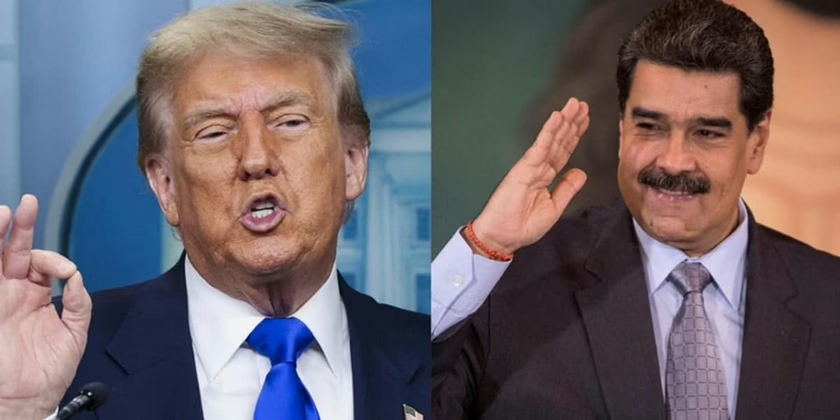
US President Donald Trump announced that Venezuela’s Nicolas Maduro has been captured and flown out of the country after the United States carried out a large-scale strike that has been sharply condemned by Iran and Russia.
The Venezuelan government has not confirmed Maduro’s capture, but Vice President Delcy Rodriguez said his whereabouts and those of First Lady Cilia Flores are unknown. In televised comments, Rodriguez demanded proof of life from Washington and said the January 3 attack killed officials, military personnel, and civilians across the country.
Details are still emerging about the strikes and events unfolding inside Venezuela, but US Attorney General Pam Bondi said Maduro and Flores have been indicted in the Southern District of New York, where they will “soon face the full wrath of American justice on American soil in American courts.”
“Maduro has been charged with Narco-Terrorism Conspiracy, Cocaine Importation Conspiracy, Possession of Machineguns and Destructive Devices, and Conspiracy to Possess Machineguns and Destructive Devices against the United States,” Bondi said in a statement.
What happens next in Venezuela is far from clear, but the US strikes and the capture of Maduro have already been strongly condemned by some of Caracas’s strongest partners.
Moscow, which maintains close ties with Venezuela, said it was extremely concerned by reports that Maduro and his wife had been forcibly removed from the country during “aggressive actions” from Washington.
“We call for immediate clarification of this situation,” the Russian Foreign Ministry said in a statement.
“Such actions, if they did indeed take place, constitute an unacceptable violation of the sovereignty of an independent state, respect for which is a key principle of international law,” the ministry said in a statement.
Trump said in a Truth Social post that further details will be announced at a news conference later on January Saturday
The US military action on the Venezuelan capital of Caracas comes after months of rising economic and military pressure from Washington on the South American country, including intercepting Venezuelan oil tankers and killing dozens in strikes on boats near its waters that allegedly were carrying drugs.
Washington has also contested Maduro’s legitimacy as president since he succeeded Hugo Chavez in 2013, pointing to successive elections that the opposition and others said were rigged in his favor.
Venezuela is Moscow’s most important partner in Latin America and has provided diplomatic backing and military support for Maduro’s regime over the years as he has faced international and domestic pressure over contested elections and an ongoing economic crisis.
The Russian Foreign Ministry called the January 3 strikes an “act of armed aggression against Venezuela” by the United States, saying any “excuses” given to justify such actions were “untenable.”
“We reaffirm our solidarity with the Venezuelan people and our support for the Bolivarian leadership’s course of action aimed at protecting the country’s national interests and sovereignty,” said a statement from the ministry.
The ministry added that Latin America must “remain a zone of peace.
Iran, another key ally of Venezuela, condemned the US military attack, according to Iranian state outlet Press TV.
The Iranian Foreign Ministry said the alleged attack violates Venezuela’s sovereignty and territorial integrity as well as the UN charter.
“The US military aggression against an independent state that is a member of the United Nations is a gross violation of regional and international peace and security, the consequences of which will affect the entire international system,” the ministry said.
Cuba, one of Maduro’s staunchest allies, denounced what it described as a “criminal” US attack on Venezuela and is urgently calling for a reaction from the international community.
Mexico’s Foreign Ministry also condemned the strikes, saying that the move “seriously jeopardizes regional stability.”
Many governments across Europe, including those in Poland, Britain, Belgium, and Italy, said they are closely following the situation and working to ensure the safety of their citizens in the region.
Others, such as Ukraine and Kosovo, have said that they stand firmly with Washington following the strikes.
In a statement, European Union foreign policy chief Kaja Kallas said Maduro “lacks legitimacy” and called for a “peaceful transition” following his capture.
“Under all circumstances, the principles of international law and the UN Charter must be respected. We call for restraint,” Kallas said.
China, which maintains strong economic and strategic ties with Venezuela, has not yet offered an official comment on the strikes or Maduro’s removal. The Chinese Foreign Ministry has only issued an advisory for its citizens to not travel to Venezuela.
US forces descend on The Skipper off the coast of Venezuela on December 10.
But Beijing, along with Moscow, expressed support for Venezuela this month as it confronted a US blockade on sanctioned oil tankers. China remains a top buyer for the majority of the oil shipped out of the South American country.
The day before the strikes, Maduro welcomed Qiu Xiaoqi, China’s special representative on Latin American affairs, for a visit to Caracas, where they discussed China-Venezuela ties and Chinese investment projects in the country.
(RFE/RL)