Olu Allen
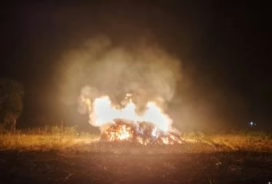
Reports of explosions in Jabo village, Sokoto State, following an announcement by United States president Donald Trump that U.S. forces had carried out airstrikes against ISIS targets in Nigeria, mark an unsettling moment in the country’s security history.
The Federal Government has since confirmed intelligence cooperation with the United States in relation to counter-terrorism operations.
If accurate, this would represent the first publicly acknowledged instance of a foreign power conducting a direct kinetic strike on Nigerian soil.
That fact alone warrants sober national reflection.
Nigeria’s security challenges are severe and long-standing.
Armed groups have overrun communities, displaced millions, and eroded state authority in parts of the country.
Few would dispute that Nigeria benefits from international cooperation in intelligence, surveillance, logistics, and training. In that sense, foreign assistance is neither new nor inherently objectionable.
However, the manner in which assistance is rendered matters. Coordination is not equivalent to command, and cooperation should not blur the lines of sovereignty.
The use of foreign military force within Nigeria’s territory, even in pursuit of legitimate security objectives, raises important questions about authority, oversight, and accountability.
It is also important to resist simplistic narratives.
Nigeria’s insecurity is not a religious conflict, nor is it best understood through the lens of external ideological battles.
It is fundamentally a crisis of governance. For years, reports by security agencies, civil society organisations, and the media have pointed to financing networks, arms flows, and cross-border movements linked to instability in the Sahel.
Yet prosecutions have been limited, and accountability remains weak.
Foreign governments do not intervene as neutral arbiters of morality.
Their actions are shaped by strategic interests, domestic political considerations, and regional calculations.
Framing external involvement as altruistic protection of Nigerian lives obscures these realities and diminishes the responsibility of the Nigerian state to lead its own security response.
A particularly troubling aspect of the reported strike is the implication that Nigeria lacks the capacity to carry out such operations independently.
The Nigerian Air Force has demonstrated operational reach within the sub-region, including rapid deployments in response to political instability in neighbouring countries.
It is therefore reasonable to ask why similar capabilities appear constrained when confronting armed groups within Nigeria’s borders.
Some analysts attribute this to a deficit of political will rather than technical capacity. Counter-terrorism competes with electoral calculations, fiscal pressures, and entrenched interests.
Where decisive action is delayed, violent groups exploit the resulting gaps.
None of this is an argument against partnership. Contemporary counter-terrorism is necessarily collaborative.
Yet in credible security arrangements, the host nation retains clear command authority, democratic oversight, and responsibility for outcomes.
Assistance should strengthen domestic institutions, not substitute for them.
Finally, transparency is essential.
If foreign-led strikes have taken place on Nigerian territory, citizens deserve a clear explanation from their government.
Silence or ambiguity only deepens public unease and weakens trust in state authority.
Nigeria can accept help without surrendering agency.
The challenge is to ensure that cooperation enhances sovereignty rather than quietly eroding it.
Allen writes on public affairs and promote good governance. He can be reached via oluallen1904@gmail.com.
I