Ahmed Yahaya Joe
According to Julius Caesar in Act II, Scene II (1599) by William Shakespeare;
“Of all the wonders that I have yet heard, it seems to me most strange that men should fear; Seeing that death, a necessary end, will come when it will come.”
Yet, enigmas never die. This is probably because they live with such aplomb. There is, however, no paean without the pain of separation as the mortal remains of the deceased are committed to earth.
Not in a burial, but the planting of a seed in a profound celebration of life. A time for Thanksgiving reminiscent of when an eclipse meets the dawn of a new era.
This life is from a warm, enclosing womb to a cold reality of an inevitable grave, as Orson Welles (1915-1985) agrees with Caesar, albeit with the brutal reality of solitude in between that; “We’re born alone, we live alone, we die alone. Only through our love and friendship can we create the illusion for a moment that we’re not alone.”
Welles significantly reminds us that, “We are truly alone in this universe, from the moment we are born, to the moment we die.”
If so, is there any moral for Nigeria at large in the timing of the nonagenarian’s passing?
The question is pertinent not only because our nation is currently at inter-communal crossroads but also to facing turbulent times under low-hanging ominous clouds of collective mistrust.
Against that background, Professor Adamu Baikie CON was an unusual icon who set aside primordial sentiments and other differences when it was not convenient for him.
For others. His family. His friends.
His nation at large owes him a huge debt that may never be repaid. It therefore behoves rare duty and singular honour to keep him alive by being exemplary of such a man for all seasons.
Perhaps why Adagbo Onoja had a premonition when he posted on 21 April 2021, “Adamu Baikie as a flashback to history,” as he goes on;
“It is doubtful if nearly anyone in Nigeria today can afford to be indifferent to the cascade of news of violence, of threats of violence, of anger, frustration, of unchecked use and misuse of power, and of humiliation of the Other person or groups…..
But there was a time when society was working, whatever the imperfections. It must have its own healing touch to refresh memories about such times through its most arguable signifier, Professor Adamu Baikie.”
https://intervention.ng/23847/
But let us hear directly from the deceased in his own words about a halcyon period in our nation;
“We didn’t know any other person than Sardauna Ahmadu Bello, the then Premier of the Northern Region. There was absolutely no issue of religion, tribe or any other sentiment.” – Daily Trust newspaper edition of Sunday, 19th February 2017
Here, the late Professor Baikie was referring to Nigeria College in 1957, the forerunner of Ahmadu Bello University which by 1965 graduated its first set of 426 with only 147 from the entire North now 19 states including the FCT.
He goes on about 1949 when he commenced teacher training college prior in Zaria;
“Out of the 22, we were four from the North, myself from Kano, Shehu Kakale from Sokoto, Jonathan Bamaiyi from Minna, and Bata Mtshelia from Garkida; the rest were a mixture of Yoruba and Igbo.” – Daily Trust newspaper edition of Sunday, 26th September 2021
“Hali zanen dutse, ba mai shafewa,” therefore no surprise that Marcus Aurelius adds in retrospect such colossus as Prof. Baikie is comparable “To be like the rock,” which encapsulates the foregoing Hausa adage loosely translated as “character is an emphatic mark drawn on a rock,” as the Roman continues in his Meditations published in 180 AD, “…. that the waves keep crashing over. It stands unmoved, and the raging of the sea falls still around it.”
Looking back, the recently deceased teacher’s teacher continues, “After my Grade III training in 1950, I was posted to Gusau (Zamfara State). I taught there between 1951 and 1952.”
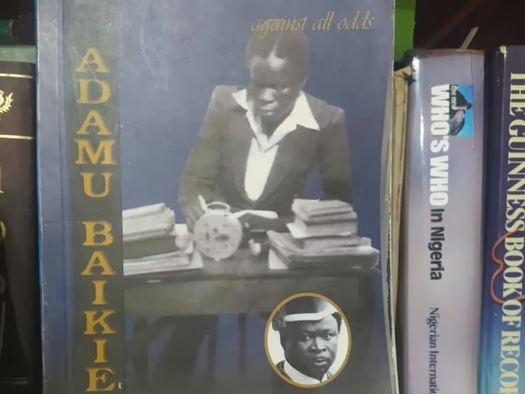
No doubt a defining period for the future professor of Education as seen in the attached vintage picture barely in his 20s on the cover of Baba Adamu’s definitive 2012 must-read memoirs that comes with a curious caveat he adopted;
“A man must be inordinately conceited…who will sit down and write his own biography fully expecting that it will be published during his lifetime.”
Indeed, the late Dan Masani Babba of Wusasa and Tafidan Gedege outlived his biography by 13 years!
See details of Baba Baikie’s vicissitudes from “a peripatetic existence for generations,” in the 733-page Against All Odds: An Autobiography (2012).
“Invictus” is a Latin word translated in English as “unvanquished” used in ancient Rome for undefeated warriors.
“But more significantly for us as a metaphor for the late Professor Baikie is the title of William Henly’s 1875 poem of four stanzas, sixteen lines each containing eight syllables that start and concludes;
“Out of the night that covers me
Black as the pit from pole to pole,
I thank whatever gods may be
For my unconquerable soul…..
It matters not how strait the gate,
How charged with punishments the scroll,
I am the master of my fate
I am the captain of my soul.”
Meanwhile, “The Man in the Arena” is a passage in a speech by the 26th President of the United States, Theodore Roosevelt entitled “Citizenship in the Republic” on April 23, 1910 in Paris, France.
It is about someone, anyone who is heavily involved in civic responsibility that often requires courage, skill, or tenacity, as opposed to those who are sideliners and watching.
If so, which side of the divide would Professor Baikie have been in a time babel of voices on Christian genocide in Nigeria?
Let us once again hear from sage wisdom.
“I always ask myself which side I am supposed to be. This is because about 50 per cent of my family members are Muslims. My wife came from a Muslim family.
Her parents and all other members of her family were Muslims, but she became a Christian through her aunt. We always talk about this as a family.
Every ceremony I have here, they come.
When they have theirs, we go.
I think people are behaving out of ignorance. People are becoming too worldly and selfish. Some make up these differences because at the end of the day, there would be fighting, and their target was usually to get worldly materials from this fighting and nothing more.
When the Igbo left Sabon Gari in Kano during the civil war, my sister was in charge of one Igbo man’s property. When he came back, she gave him all the rent paid when he was not around, and that was how he recovered.
For me, what is happening now is a result of religious misinterpretation. We don’t have Dattawa (people of integrity) now.”
Let us, therefore, salute the tenacity this towering quintessential gentleman of letters with intellectual sagacity.
A brilliant scholar, dedicated, dutiful, and loyal public servant and lifelong teacher, lecturer, and administrator who served his nation meritoriously in various capacities too numerous to recount here.
A huge reservoir and cascading fountain of knowledge with an inherent ability to read people like a book.
A masterly mentor with a long trail of mentees.
He was also a syllabus of contrasts:
Well learned but plain.
Downright serious but gregariously humorous.
Top flight achiever but down to earth.
An epitome of exemplary determinism and stark contingency.
Habitual workaholic and a rare man of unequivocal charity.
A thoroughly detribalized Nigerian and well principled person that abhors any form of religious exhibitionism and ethnic grandstanding.
A pacesetting achiever with an impeccable pedigree from many classrooms, various lecture halls, and not a few executive suites.
Professor David Adamu Baikie CON, who passed at the ripe age of 94, is survived by his children: Abdallah, Ado, Tanimu, Jummai, Ladidi and many grandchildren including numerous wards and extended family members.
A wake keep will be God willing held in his memory on Monday, 22nd December 2025 at 4.00 pm at the St. Bartholomew’s Cathedral, Wusasa, Zaria.
While his funeral service would take place on Tuesday, 23rd December 2025, at the same venue by 10.00 am, Internment follows at the Wusasa cemetery.
May his soul rest in peace with his creator, amen.
“It is not the critic who counts; not the man who points out how the strong man stumbles, or where the doer of deeds could have done them better.
“The credit belongs to the man who is actually in the arena, whose face is marred by dust and sweat and blood; who strives valiantly; who errs, who comes short again and again, because there is no effort without error and shortcoming; but who does actually strive to do the deeds; who knows great enthusiasms, the great devotions; who spends himself in a worthy cause; who at the best knows in the end the triumph of high achievement, and who at the worst.
If he fails, at least fails while daring greatly so that his place shall never be with those cold and timid souls who neither know victory nor defeat.” – Theodore Roosevelt (1858-1919)