Ahmed Yahaya Joe
“Diplomacy is the art of telling people to go to hell in such a way that they ask for directions.” – Winston Churchill, British Prime Minister 1940-1945 & 1951-1955
What subtlety in statesmanship can President Bola Tinubu grasp from the recent detente between Donald Trump and Zohran Mamdani?
The American president’s “exceedingly warm reception” of the Mayor-elect of New York at the Oval Office was quite surprising even for close watchers as the duo have hitherto had a very vexatious relationship that even descended to constant name-calling and frequent taking swipes at each other.
Despite the lack of parity between Tinubu and Trump as commanders in chief as Mao reminds us “Politics is warfare without bloodshed,” against the background of Clausewitz’s “war is the continuation of politics by other means.” If so, “The target of your strategy should be less the army you face than the mind of the man or woman who runs it.” – p.165 33 Strategies of War (2006) by Robert Greene
Little wonder, Ms. Onubogu entitled her November 21 presentation to the US House of Representatives Subcommittee on Africa, “A Serious, Well-founded Wake-up Call” – a rapprochement that should collectively jolt us to recover the pan-Nigerian story.
More so, President Tinubu, as she had prior highlighted Nigeria’s unnecessarily longstanding ambassadorial vacuum in Washington DC, a huge challenge in bilateral relations albeit the recent better late than never foreign service nominations.
Interestingly, the Wikipedia page of our “master strategist” states that he got admitted into Chicago State University in 1975.
This was when Henry Kissinger (1923-2023) was still in office as the 56th Secretary of State during which he famously enunciated “Diplomacy is the art of restraining power,” adding that “when statesmen want to gain time, they offer to talk.”
How could Asiwaju’s handlers whilst formulating the “Renewed Hope agenda” have missed that Kissinger in his 1994 912-page book simply entitled Diplomacy, states that “Military men are just dumb, stupid animals to be used as pawns in foreign policy”?
Again, if so, why are Nigerians getting so worked up over President Trump’s sabre rattling when, as we have already encountered in Part I, how Nigeria deftly outflanked an entrenched Italian position during the late 1960s?
The “12 disciples of Nigeria” were the pacesetting career diplomats who formed the nucleus of Nigeria’s foreign service ahead of national independence.
These pioneers were recruited and trained by the British purely based on merit after rigorous vetting, a series of qualifying examinations, and extensive interviews that took place in Lagos and London in 1957.
They were as follows in alphabetical order of surnames: Phillip Asiodu, Chike Chukwura, John Garba, Adedokun Haastrup, Leslie Harriman, Chukwuemeka Ifeagwu, Dickson Igwe, Omotayo Ogunsulire, Olumide Omololu, Aminu Sanusi, John Ukegbu and Soji Williams.
Hear the Igbobi oldboy in his own words on that select group; “We came from all parts of the federation with vastly varying degrees of years in the public service, and also a variety of academic backgrounds.
“All of us were put through the same furnace of training and were expected to emerge at the end of the conveyor belt as accomplished diplomats (and without any attempt at self-adulation), I could assert that by the time of our independence three years later, we were more or less reduced to a common level of awareness.
“We had brought to our new vocation, different ideas of what it meant to us, and what were our obligations, towards it. – pp.371-372
After the demise of Ambassador Omotayo Ogunsulire (1930-2023) leaves Chief Phillip Asiodu b.1934 as the last surviving of those magnificent men.
Then there was Ambassador Aminu Sanusi (father of Khalifa Muhammadu Sanusi II), the only other Northerner apart from Old Grammarian Garba in that distinguished seemingly pan-Nigerian line-up regardless.
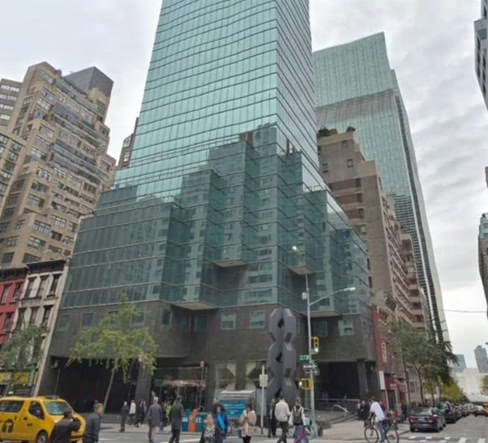
Arguably, no proudly Nigerian icon abroad is as symbolic as the Nigeria House along Second Avenue in Midtown Manhattan, New York. Built and commissioned in 1992 at a reported cost $32 million the 22-storey skyscraper wrapped in green reflective class was designed under the watch of President Shehu Shagari in 1982 by the now rested Kano architectural firm, Ella Waziri & Associates but delivered by the Lagos multinational outfit, AIM Consultants.
It remains mindboggling that such a massive investment in the financial capital of the US with over 90,000 square feet of letable space would not have since 2023 the compliment of hosting any Permanent Representative from Nigeria at the United Nations headquarters just next block on First Avenue. Unfortunately;
“The Office of the Auditor-General of the Federation has advised that since the New York edifice is strategically located, deteriorating and underutilized, it should as a matter of urgency, be comprehensively rehabilitated before it constitutes an embarrassment to Nigeria.” – Nation newspaper edition of September 5, 2022
Apparently, Ambassador Garba and Ms. Onubogu are not the only Nigerians at a precarious junction of inter-communal existence. Hear the 81-year-old ace columnist, Debo Sobowale, who puts it that;
“Irrespective of who is making the one-sided narrative regarding religious conflict in Nigeria, people like me feel cold.
“In the storm of national controversies ignited by President Trump’s threat to invade Nigeria, I am one of a very tiny minority of Nigerians caught in all the crossfire – whether religious, political, ethnic or just mischievous.”
On my father’s side in Lagos, Christians constitute about 85 per cent of the people I serve as Head of Family. By a twist of fate, it is the same side of the family which, has linked me/us to the North. My paternal grandmother – Aisha — was a Fulani born and raised in Shinkafi, Zamfara State.
My grandfather was a Muslim and an Imam. His vault is still in our family house at Agbowa-Ikosi. My father, his only surviving son, was forced to convert to Christianity when he was dragged off to war in Europe.
That was how generations of Sobowales became Christians. Muslims are in the overwhelming majority in my mother’s side of Lagos Island. My grandmother, also a rebel, married a Christian and had only one daughter, who also married a Christian. I was brought up as a Christian. But, my wife was the daughter of a chief imam in Lagos Island.”
– Vanguard newspaper edition of November 16, 2025
Now a final word on Ambassador Garba’s parental background in his own words but not before some more on his extraction. This writer believes such to be salient as we are all members of an increasingly cosmopolitan village in Nigeria.
While how Nigerians would wrestle the behemoth of “politicization of religion” to the ground and exorcize the demon of the “religionization of politics,” is mainly left to us it is not entirely to the 47th President of the United States or the 119th Congress on Capitol Hill.
As Nigerians, we must endeavour to remain vigorously tolerant, positively optimistic, and overly inclusive in our national project lest we take that a tortuous road to Sudan.
Unfortunately, Ambassador Garba’s book reprinted in 1998 is again out of print again. Sadly, many Nigerians have not benefitted from his vicissitudes;
“My people were originally Kanuri who lived in some unspecified part of the present-day Borno State.
Owing to untoward circumstances, there was a large exodus a long time ago, which included members of my family. They moved westward until they reached Katsina. When my people reached Katsina, they were not allowed to settle within the city walls, being foreigners, but had to camp some distance outside it.
They eked out an existence through pursuits peculiar to rural dwellers, namely hunting and farming. My ancestors became great hunters, and it is a well-known fact in the Hausa social arrangement of earlier days, the hunting class formed the backbone of the army whenever there was war; and there were quite a few of these.
My people, being as renowned great hunters were invited from time to time by Sarkin Katsina to help him in his various wars against his numerous enemies, which ranged along all the four cardinal points of the compass.
Having proven their prowess on the battlefield in the various campaigns over the years, Sarkin Katsina, on an occasion, in recognition of his appreciation and as a mark of gratitude, invited the elders among my people to nominate a leader who would be titled.
According to family legend, the title of Kauran Katsina (Chief Warrior of Katsina) was bestowed on our chosen leader, and this title was held by us until shortly after the Jihad of Shehu Usumanu dan Fodio.
Later on, Sokoto had appointed a Pullo (Fulani) Sarkin Katsina whose appointment had been rejected by a section of the Katsina community, including our own faction. Instead, we had appointed a rival Kado (Hausa).
We rose in revolt but were worsted by the Fulani in the encounter by the Fulani and their supporters.
Our people had to flee westwards, once again and took refuge in places (in today’s Niger Republic) such as Damagaram, Tasawa, and Maradi.
“It is significant that the Chief (Emir) of Maradi, even today, which is a little short of two hundred years after the departure from Katsina, continues to style himself Sarkin Katsina, while the erstwhile French colonial rulers refer to Maradi as Katsina.” -pp. 1-2
In conclusion;
“My father (born in Gazawa near Maradi) spoke Hausa, Kanuri, Fulfulde, Shuwa-Arabic, and Sara-Kabam fluently. But this resourceful man had also taught himself English sufficiently as to bear the title of ‘Tafinta’ (Interpreter) at the Provincial Office, Nassarawa, Kano, between the years 1929-1930, and with the UAC at Gusau, from 1930 to 1934.
He had no formal education but never missed the opportunity to learn, to which I had contributed in no small measure. In the early years in Maiduguri, his Kanuri companions called him Garba Jibdama (Garba of the Jibda, or civet cat).
Later in life, when he had risen to be foreman and lining-sinker in the well sinking section of the Geological Department, they called him Garba Baramma (Garba of the Wells).
He addressed himself as Mallam Garba Katsina throughout his life. Only after he had gone to the Hajj in 1960 did he change his name to Alhaji Garba Muhammadu, assuming his father’s name.
From 1939 to 1943, he worked for the Kano Local Authority, sinking wells mainly in the Hadejia, Gumel, and Kazaure emirates.
He retired in 1944 but continued to live in Kano City. During the years that he had been in and out of Kano, he had lived at Yakasai, Dan-Agundi, Gwangwazo, Tudun-Wazirci, and finally back to Kofar Dan-Agundi ward where he lived his last days on earth.
Here, he died on 13th March 1972, at the age of about eighty-seven years. My mother had left my father when I was about six years old.
There was never a formal divorce. Before I was born, my father had married Fatu, a Fulani from the same Geidam where he had married my mother.” – pp 13-14
Concluded.