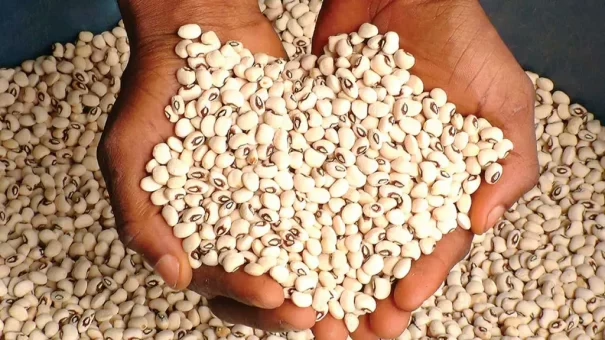
Nigeria’s agricultural sector is losing an estimated $362.5 million to $363 million annually in foreign exchange due to the protracted international ban on its dried beans exports, primarily by the European Union (EU).
The significant financial toll underscores the profound consequences of neglecting food safety standards and proper agricultural practices on the nation’s drive for economic diversification.
The figure was one of the highlights of the communiqué issued yesterday at the National Summit on Agroecology and Public-Private Partnerships on Agroecology in Lagos.
The initial EU ban, instituted in 2015 and repeatedly extended, was triggered by the discovery of alarmingly high levels of the pesticide Dichlorvos (DDVP) in exported beans, far exceeding the acceptable Maximum Residue Limit (MRL).
The chemical, often used by local farmers and merchants to preserve beans against weevils and other pests, has been banned in the EU since 2006 due to its known toxic effects on human health.
Addressing reporters at the end of the programme, stakeholders, including the General Manager, the Kaduna Agricultural Development Agency (KADA), Muhammad Rili warned that the continuous use of highly hazardous pesticides, many of which are banned in developed nations, exposes Nigerian farmers and consumers to acute and chronic health issues.
The summit noted the disproportionate impact of pesticide use on developing countries.
“Although countries such as Nigeria use only 25 per cent of the chemical pesticides produced worldwide, their farmers experience 99 per cent of pesticide deaths due to poisoning.
“Research cited by the summit shows that the World Health Organization (WHO) estimated 385 million farmers fell victim to acute poisoning in 2019, with most of these cases occurring in Asia and Africa.
Furthermore, 75 per cent of smallholder women farmers surveyed in 2022 on the impact of highly hazardous pesticides reported experiencing health challenges attributed to pesticide use, with common symptoms including difficulty in breathing, dizziness, headaches, nausea, vomiting, eye problems, skin rashes, catarrh, diarrhoea, and respiratory problems.”
Other observations made by the summit in its communiqué included a critique of the 2025 budgetary allocations for agroecology, biodiversity, and climate resilience.
The summit noted that major allocations were domiciled in the Presidency (State House – HQTRS) and the Office of the Secretary to the Government of the Federation. Stakeholders argued that these allocations should instead be under the Federal Ministry of Agriculture and Food Security and the Federal Ministry of Environment for proper coordination and effective implementation.
While the total budget for States and key MDAs in agroecology has increased over the 2020 to 2024 period, the summit cautioned that the activities detailed in these budgets have not been commensurate with the financial commitment.
To help the industry and reverse these trends, stakeholders urged the federal and state executives, and their respective Houses of Assembly, to scale up the yearly budget for agroecology and extension services.
They stressed the importance of ensuring the timely consideration, passage, and total release of these budgets as a strategic approach to increase food production, reduce hunger and poverty, and achieve food and nutrition security.
The summit further called on the Federal and State Governments to urgently start the preservation and promotion of Nigeria’s Indigenous Seeds, Seedlings, and Livestock for Agro Biodiversity. They recommended establishing and strengthening Community Seed Banks across all states. The summit urged the banks to ensure the preservation, safekeeping, regeneration, and accessibility of Nigeria’s indigenous seeds/animal breeds, while also serving as hubs for participatory and innovative breeding programmes that improve quality, enhance resilience to climate stress, and support the long-term conservation of agro-biodiversity.
The summit urged Federal and State governments to allocate more public investments in agriculture to address strategic areas that would increase the agricultural GDP to at least six per cent The crucial investment areas,the summit include: Extension Services, Access to Credit, Women in Agriculture, Youth in Agriculture, Appropriate Labour-Saving Technologies, Inputs, Post-Harvest Losses Reduction Supports (processing facilities, storage facilities, trainings, market access, etc.), Climate Resilient Sustainable Agriculture (CRSA)/Agroecology, Irrigation, Research and Development, Monitoring and Evaluation, and Coordination.
(Thenationonline)