Olu Allen
Nigeria is a classroom. The lesson changes weekly. But this week’s topic?
When the law bends without breaking, and why that should terrify you.
Mallam Nasir El-Rufai is arraigned. A court reserves ruling on his bail application.
Under any textbook reading of the Administration of Criminal Justice Act 2015 (Sections 162–166) and the Nigerian Correctional Service Act (Section 17), the pathway is rigid: await judicial determination, or file a formal variation. Compassionate release exists, a but it requires documented application, medical or exceptional grounds, and judicial endorsement.
Nothing in between. The law is not supposed to blink.
Yet here we are.
El-Rufai is released. Not after a ruling. Not after a public, legally audited variation.
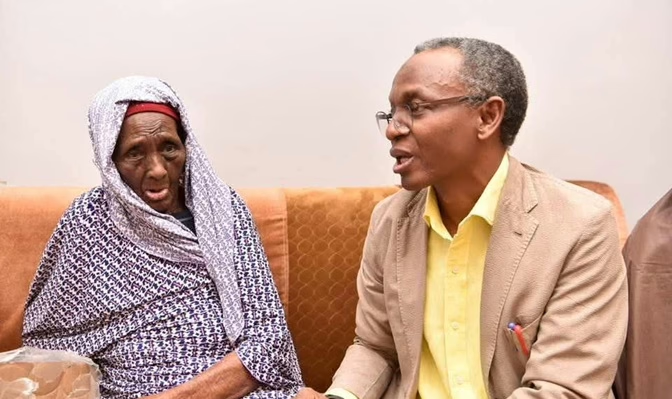
The moment? His mother’s burial.
Now pause. Strip away emotion. Think like a prosecutor, then like a spin doctor.
Is it possible that a legal pathway was quietly activated? Yes, temporary release for funerals is not unknown.
Is it possible that discretion was exercised by correctional authorities without an explicit judicial order? Also, yes, Nigeria’s system has a shadow track of “administrative convenience.”
But that’s not the real question.
The real question: Why does the system discover flexibility only when the optics are most flattering?
Because timing is never neutral in Nigerian politics.
A detention projects strength.
A compassionate release projects humanity.
Sequence them right, charge, hold briefly, release for burial, and you don’t just enforce power. You produce a narrative.
This is political recalibration: not abandonment of the law, but its careful, cinematic adjustment.
What a perfect narrative this is:
· Critics soften: “Let the man bury his mother.”
· Supporters cheer: “Government is humane.”
· The state loses nothing—yet gains moral cover, ethnic quiet, and a distraction from the substance of the charges.
No protests. No outrage. Just silence, and a former governor back in his living room.
But here is the deeper issue, the one that should keep every thinking Nigerian awake.
El-Rufai is not an ordinary citizen. He is a former FCT minister, ex-Kaduna governor, founding father of the APC, and a man with deep intelligence community ties. When the state bends for him, it is not bending for a person. It is bending for insider status.
So ask yourself, and ask it coldly:
Would an ordinary citizen, a trader, a teacher, a journalist, receive this same flexibility at their parent’s burial?
If your answer is no, then this conversation is no longer about El-Rufai.
It becomes about a system where:
· The law is constant in theory,
· …but elastic in practice,
· …and the elasticity is reserved for those who matter.
And one more question, the cynical one:
Was the arraignment itself timed before the burial? Did the EFCC know? Did anyone calculate that a quick detention followed by a “humanitarian” release would generate more goodwill than a simple bail grant?
We may never know. But in Nigeria, where power writes the first draft of every story, not knowing is also a verdict.
Let me be clear:
Nigeria does not always break the law.
Sometimes, it simply bends it at the most convenient angle.
That is not always illegal.
But it is always revealing.
And here is what it reveals:
A two-tier justice system where procedure is for the powerless, and narrative management is for the powerful.
The judiciary’s silence is also an act.
The court reserved ruling. It did not order release. Yet release happened.
Did the prosecution withdraw opposition quietly? Did correctional authorities act on a phone call? Did the judge issue a practice direction that no one will publish?
Silence from the bench, when a high-profile defendant walks out mid-proceedings, is not neutrality. It is acquiescence.
So what do we do with this?
Don’t just rage. Observe. Document. Compare.
Next time an ordinary citizen is denied bail for a petty offense, remember this week.
Next time the government lectures on rule of law, ask: Does it apply to everyone, or only to those without a powerful name and a funeral card?
Nigeria is not a failed state.
It is a flexible state.
And flexibility without accountability is just privilege wearing a robe.
Share this if you believe the law should not have a favorite child.
Allen writes from Kano,he writes on public affairs and promote good governance.